Understanding the trick-taking renaissance
Looking at the rise of trick-taking games from a data-driven perspective


There has been a lot of discussion around the term ‘trick-taking renaissance,’ which describes a phenomenon in which more great trick-taking games are released now than at any point in the (relatively recent, especially when we’re talking trick-taking games) history of hobby board games. It’s sort of taken as a fact, and it’s easy to see why when you look at games like The Crew: The Quest for Planet Nine (Sing, 2019) and Lord of the Rings: The Fellowship of The Ring — The Trick-Taking Game (Bornmueller, 2025), among many, many others.
I am going to contend today that the trick-taking renaissance is descriptive but not entirely accurate. I will attempt to argue that the trick-taking renaissance is actually a return to form for the genre, and I think we can show this with data.
First, let’s establish our data sources. I will be looking at Board Game Geek data from multiple perspectives. First, we will look at the category ‘Card Game’, then we’ll look at the mechanic ‘Trick-Taking’, and we’ll look at how those interplay over the last 35 years. Before we get to the charts, let’s talk about the baseline thinking. I have limited the dates of consideration from 1991 to 2025. I think 1991 is as close as we can come to establishing a true start to the board game hobby boom, though we’ll quickly find as we look at the data that it’s not quite that straightforward.
We’re going to start our exploration by looking at how many card games are in the BGG database for a given year. While there are times I will caveat that BGG data is innately flawed, this is not one of them. It’s an extremely thorough database of games, and they make their data widely available. Rather than raw counts of games, I’d like to look at a percentage of games with the ‘card game’ category released in any given year with a minimum of 100 ratings on the site.
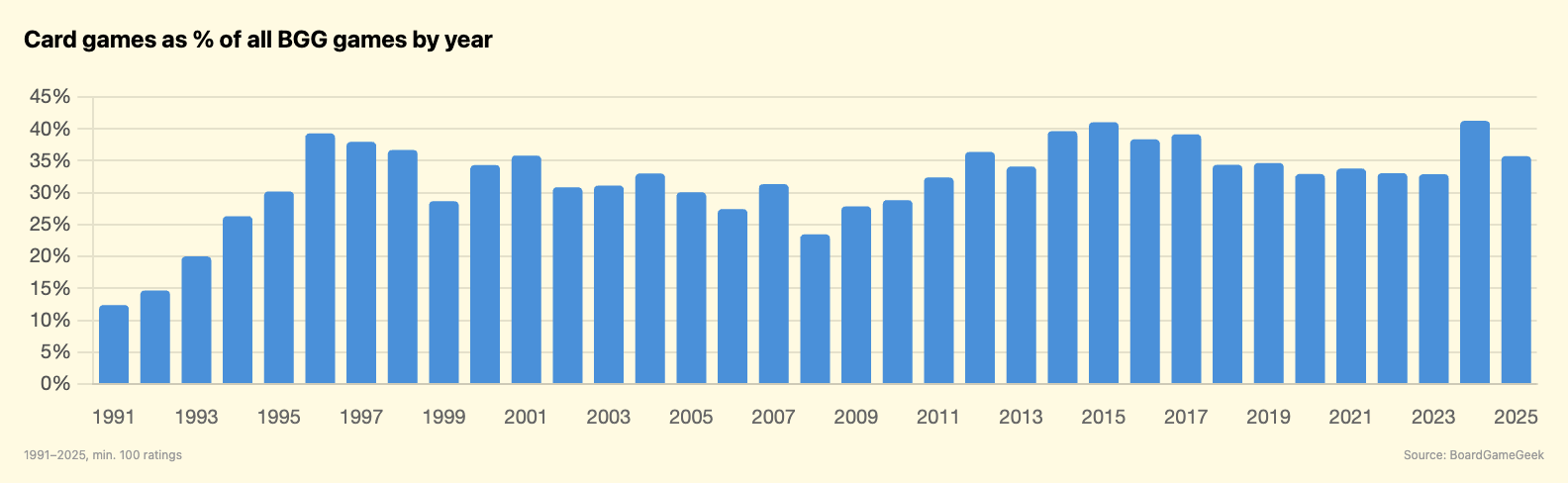
The ratio above will be important in further analysis, but for context, let’s look at the total card games released by year. We’ll also take a look at all games released by year, again with that minimum rating count.
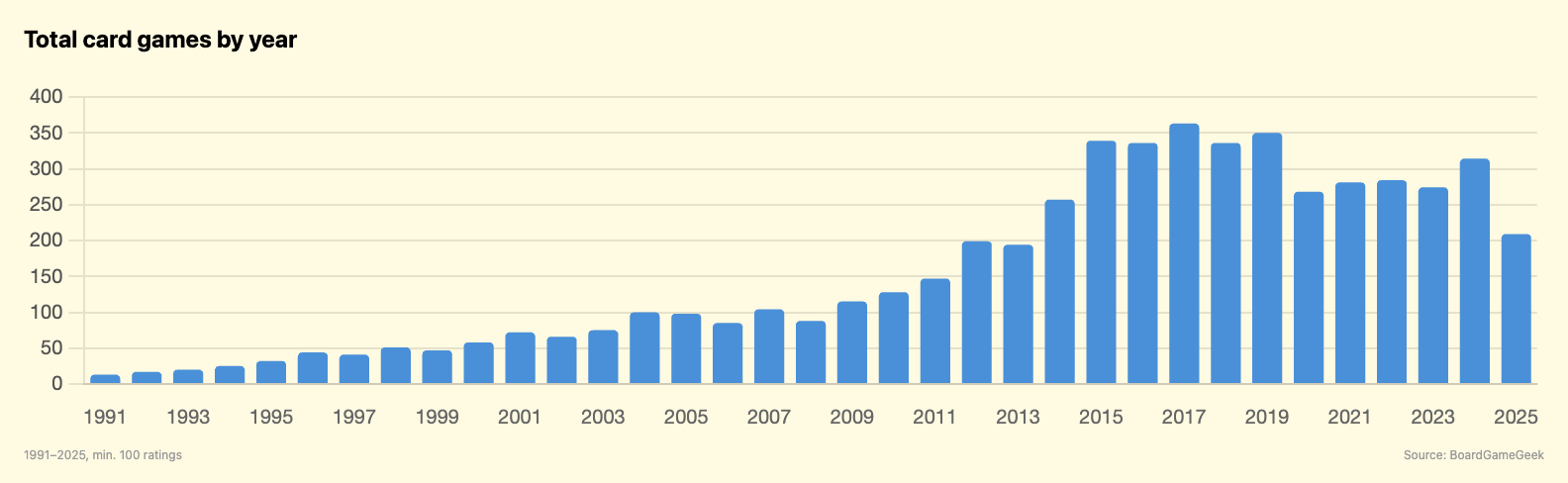
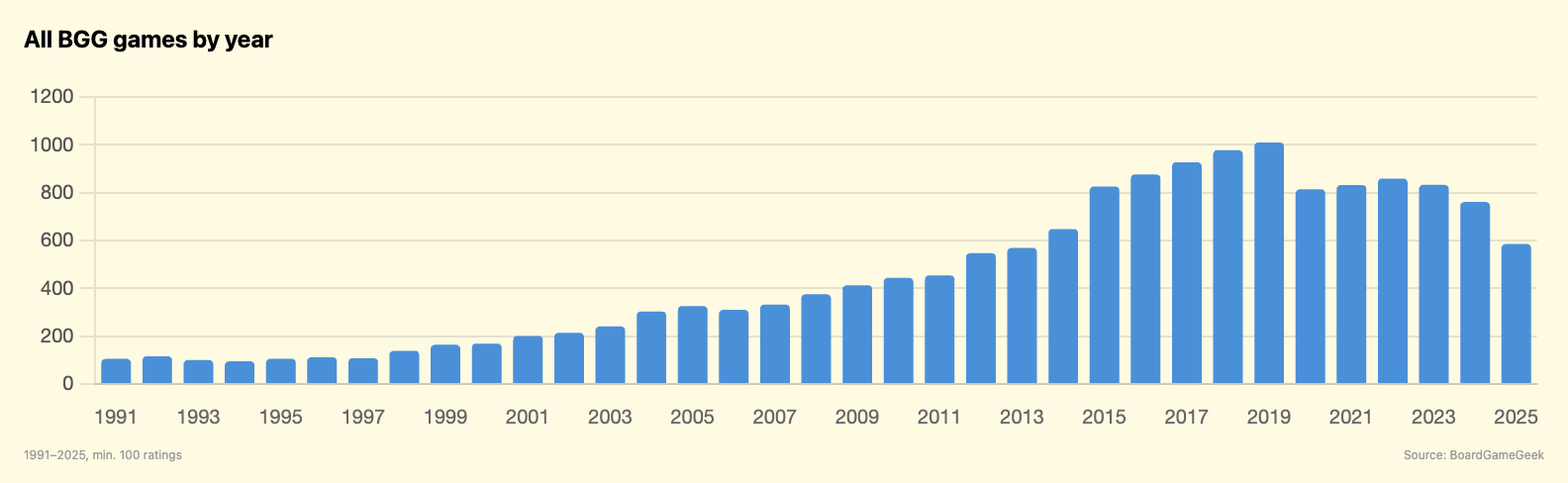
There’s something interesting that happened in 2020 — and we shouldn’t be particularly surprised about it. Let’s now turn to all games on BGG by year without a minimum rating filter before looking at how many games meet our minimum-rating threshold. There are some interesting things happening here more broadly in the industry that I think we should discuss. Further, we should also note that there is an anti-recency bias in these numbers, so I’m trying not to over-index on 2025 or even really 2024.
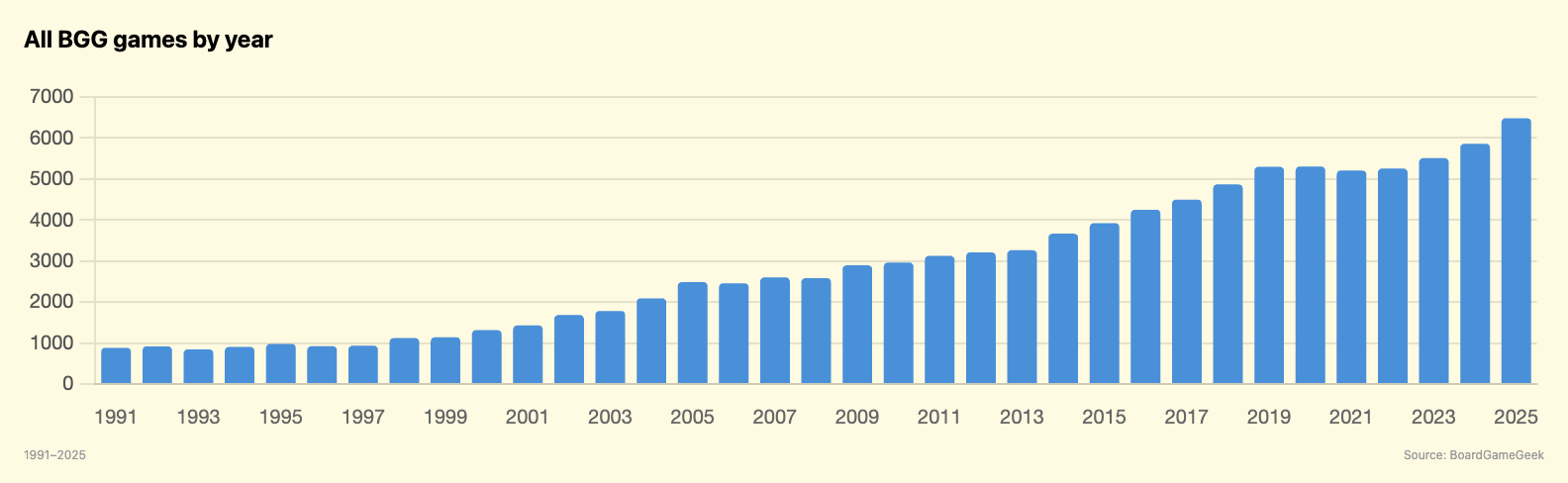
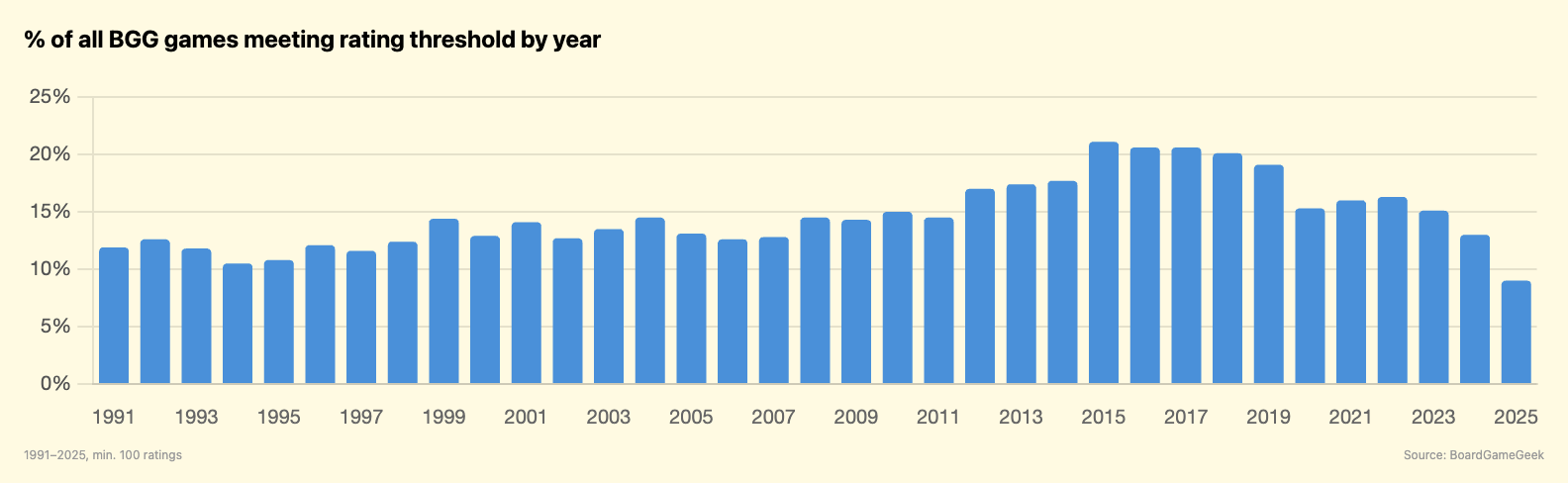
First, we see very clearly the impact of the COVID-19 pandemic in 2020. While there was a slight depression in games released in 2021, there was a significant drop in games meeting our threshold. Because being present on BGG is not an indicator of a game actually having been released, there are plenty of questions we should ask about this data. How many of these games actually saw release? The dip in the last two years is perhaps expected — that’s something we might need to look at again in 6 to 12 months, because it’s hard to capture this sort of data historically.
If we decrease our threshold, the data is even a little more revealing. This is at a minimum of 5 ratings. That 2020 drop is fascinating to me.
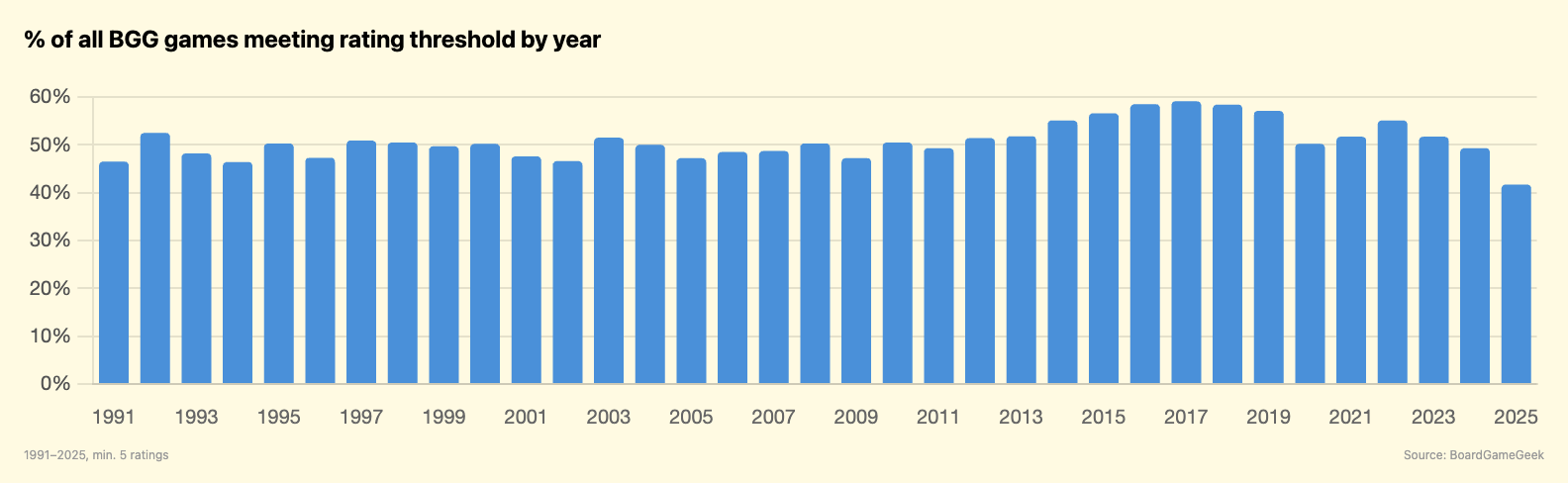
While the rate of games meeting the threshold increases those years, it still represents a significant drop. Five ratings is a very low bar, even if we account for shifts and changes in user behavior on BoardGameGeek over the last decade. In essence, we see that fewer games received even any attention. And while it’s a dip, it’s still above several years before 2012. We will further investigate the gap between 5 ratings and 100 ratings in our next section, but we’re not quite there yet.
Before we move forward, there are probably some questions you’re having about the data. Let’s talk through my thoughts.
Does this represent enough games released every year to really reflect the release of trick-taking games? I think so. BGG tends to have enough extremely thorough users to account for extremely unpopular games.
Is it unrealistic to expect at least 100 users to rate a game? What about 5? I don’t think it’s unrealistic. I have been very tuned in to the trick-taking scene over the last five or six years, and when I look at 2025 releases without at least five ratings, I see extremely little I’ve heard about. In fact, I’ll actually call out a few others I recognize below, because I think that’s interesting.
- Rook Requiem (Vega) is an exception, as it’s a game I’ve been anticipating for some time now, but it hasn’t actually been released — 2025 is an artifact of a longer release process.
- Stepping Stones (Campbell and Newman) is a compendium trick-taking game from Ryan Campbell, who you may know from the Trick Talkers podcast, and Daniel Newman, who you may know from many of his games, including Reapers (2021), Enemy Anemone (2023) and Gachapon Trick (2024), among others. It has not been released physically.
- Trick of the Killer Tomatoes (Yamaoka) I know largely for the name, but I’ve heard a tiny bit about it. Sirou Yamaoka is a well-respected trick-taking designer — see also Pompiers (2019) and Flip Over (2017), though, so if this ever sees wider release, it’ll absolutely lift out of that five-rating limitation.
- Monster Taking (Nakata) is a two-player trick-taker released at the last TGM, and I got a copy through Travel Games in the UK.
- Angelian (Hugame) is a trick-taker from the designer of The Icarus Club (2021), among others.
- Butt Radio (Mr Ben, Owen and Petchey) is an oddball design from three designers, two of whom I’ve played games from. Mr. Ben owns Travel Games, and I’ve played his Shochikubai (2025) and would love to play others. Mike Petchey has designed Sakana Stack (2025), which I’ve been meaning to play, and the excellent Tricky Landing (2025) and Roller Disco (2026). I don’t know David Owen.
There are a few more on the list, but all of these (save Rook Requiem) are games either printed in extremely small runs or not printed at all, some of which will likely never be published traditionally — and those are just the ones I know. I recognize plenty of designer names from various Discord groups, including a number of interesting domino trick-takers. Oh, and there’s a Trombone Champ (Anarchy) trick-taker, but that one’s also not out yet. Great video game, though.
Tangents aside, though, I think this demonstrates a clarity in the data that’s important to recognize here. We’re not dealing with (extremely, at least) small sample sizes here, and the data is reliable. Now, we do know that not every user of the site rates and not every gamer is a user of the site; we certainly also know that not every person who owns a game is marking themselves as so on BGG. This is going to be especially amplified by some of these more obscure games, where a few people rating or marking as owned might represent a still-small group. We’ll try to correct for this by dealing with percentages rather than raw numbers, though we’ll use the filtering mechanism of ratings to get at more interesting data.
Here’s what I’m positing: There is a trick-taking renaissance that we can see in the data, insofar as we define a renaissance like the French one — an attempt to revive and surpass ideas of the past. However, I’d also posit that discourse sometimes misses the revival aspect of this, and I think that’s as important an aspect as any here.
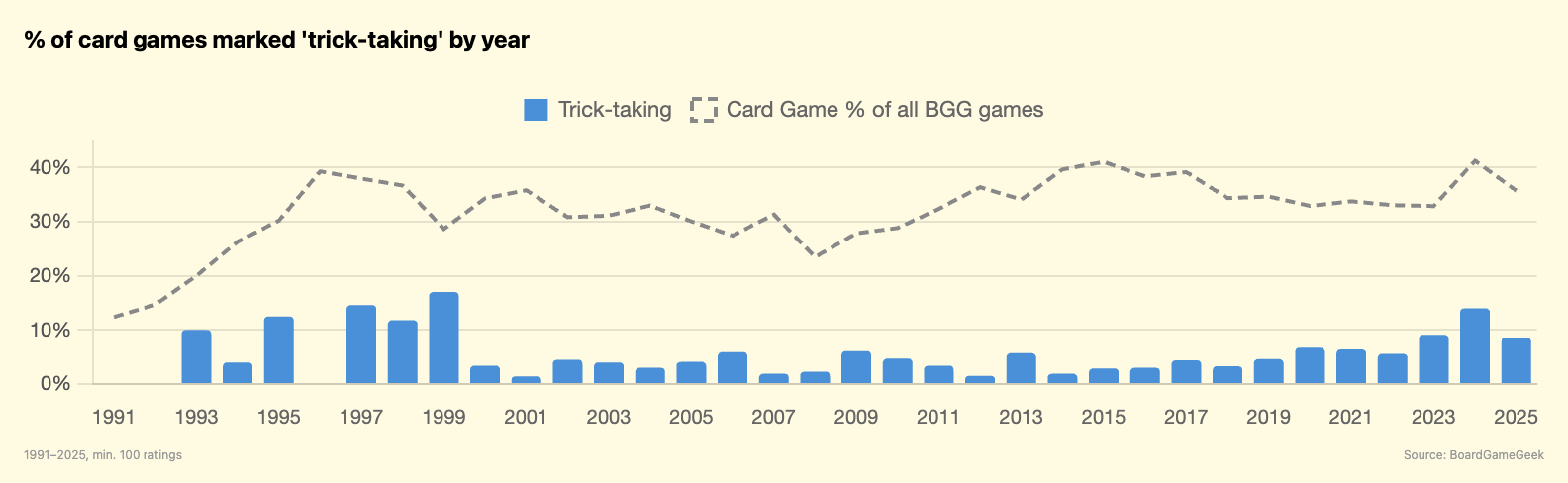
Two things come to mind here. First, it has not (in the modern hobby) been the case that more than 17% of threshold-meeting card games have also been trick-taking games. Further, it has never been the case that more than roughly 40% of games on BGG have been card games in the first place. We see a very clear decrease in 2000 around trick-taking games, and that doesn’t entirely correspond with a marked decrease among card games more generally.
If we expand our criteria to all games regardless of rating count, we see a similar pattern with the same uptick at the end, with of course a higher rate than we’ve experienced in the past.
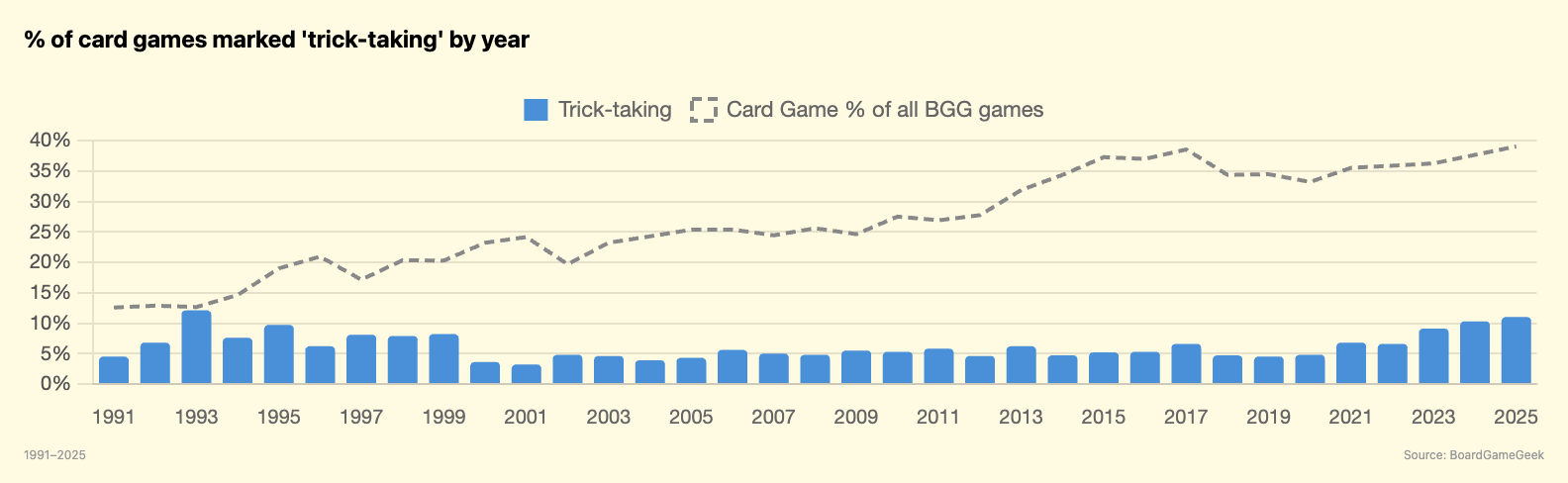
That’s the trick-taking renaissance. Just over 10% of all card games on BGG in the last two years have been trick-taking games. That’s it. Sometimes it’s easy to get a bit myopic about all this and see the shift as a monumental one that’s taking over the gaming hobby. And to a certain extent, we’ve seen something like that, with thoughtful board game critics like Efka and Elaine at No Pun Included and Tom at Shut Up And Sit Down having shown a stronger preference for trick-taking games than they might have previously.
If there’s a trick-taking renaissance, then we should also wonder about the lull in the genre from 2000 to roughly 2020. Why did that percentage drop down to often below 5%? Were these the trick-taking dark ages? I don’t think we have to be quite that dramatic about it, but it feels closer to a restoring of a former spot than anything. Trick-taking is concept we can accurately trace back nearly a millennium, and perhaps it’s understandable that its spot among hobby games faded as more people entered the scene. These are wonderings and not even former hypotheses, though.
Now, we can wonder more deeply about the relationship between more-rated games and less-rated games, keeping in mind the thresholds we’re using here aren’t scientific. We can (and should) also consider that there are communities of trick-taking fans that live in the gaps between the 5 and 100 thresholds we’re using. Are these low-print-run, obscure games part of the trick-taking renaissance, or are they something different altogether?
A renaissance isn’t a thing necessarily because knowledge was lost or forgotten. Those pushing forward in a renaissance don’t gain knowledge ex nihilo. It’s the trick-taking hobbyists that drove the renaissance and kept things moving, and now there are simply more hobbyists.
At any rate, I’d like to answer that question in a future newsletter. I do suspect this one has gone on long enough for today. If I had to draw any conclusion out of this data, it’s that there was a clear lull in trick-taking in hobby board games, and that lull is over — at least it is right now. As a trick-taking fan, this is decidedly a good thing, because it introduces more people to these timeless concepts. Trick-taking games can be traced back nearly 1,000 years, and variants can trace back a long time, too. Partnership trick-taking games? They’ve been around for at least 400 years.
One thing we haven’t talked about are the drivers of the trick-taking renaissance, the games that helped reinvigorate public interest. I think some of those are well-established, like The Crew: The Quest for Planet Nine (Sing, 2019), but there are others. A couple weeks ago we dove into how Scout influenced things, and I think it would be interesting to inspect the games commonly considered to be the drivers of this renaissance.
One last chart for you all.
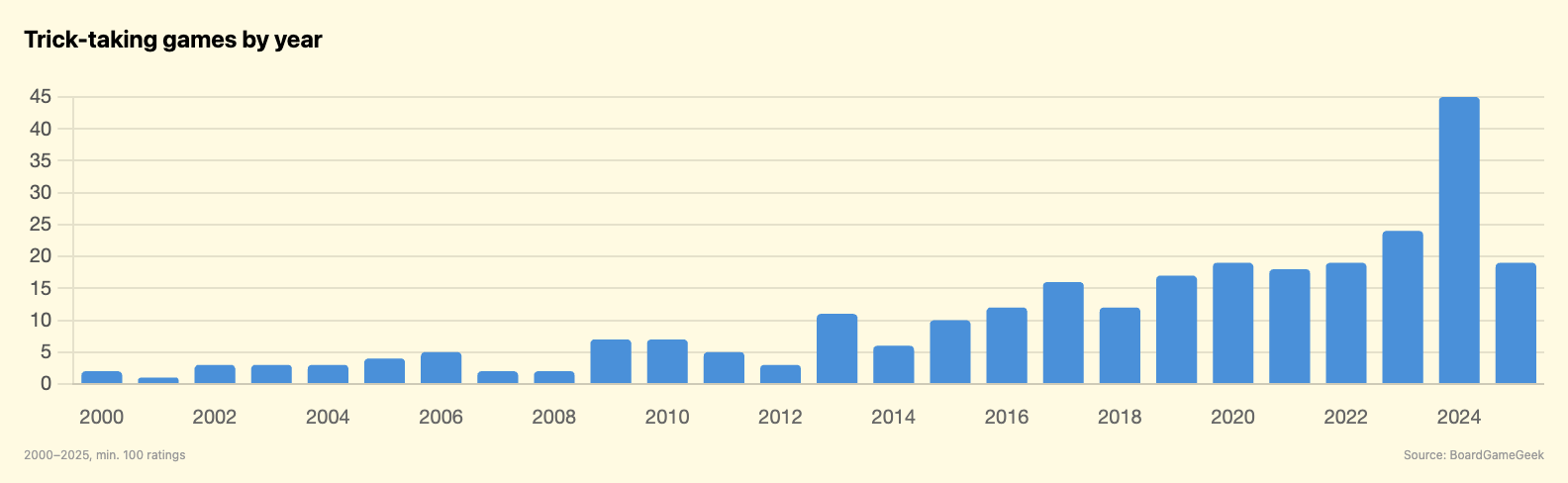
These are trick-taking games with at least 100 ratings released since 2000. I’ve deliberately held back this specific chart because I don’t think it’s telling the whole story. It shows a huge year for trick-taking (in relative terms — 100 ratings is not a lot, really, is it?), but it isn’t evidence on its own of a trick-taking renaissance — it’s evidence of an aberration; one year does not make a renaissance.
We should assume that ratings are a lagging indicator when we look by year. We should also acknowledge that a year as a discrete unit isn’t actually how we experience the world, by and large. The question remains: If 2024 was such a big year for trick-taking games among hobby gamers, what will 2025 look like? It already looks a lot like 2022, and we know that this data will change over time. It’s probably already changed in the week since I originally gathered this data.