Three great games I played recently
And then three more, briefly

Typeset (Jasper Beatrix, 2024) is a word game where you’re constructing words turn-by-turn, and each turn, you’ll write just a single consonant (and however many available vowels you’d like), either at the start of an empty word slot or at the leftmost space of any other word. Your aim is to write six beautiful high-scoring words, but it gets a little weird: Each round takes five turns, and at the end of the round, you have the option to bow out and score your points.
Why would you want to stop before anyo ther player, you wonder? If you continue, you might be able to write some nice, long words. Longer words score you more points. If you don’t want to place a letter, you can take a penalty, but you only get but a meager helping of those penalties. At some point, you just have to write a letter. And if you’ve been waiting three rounds for an S to finish a 7-letter word, but you’re out of penalties and you have to place a letter, you might just end up plopping a Q down at the end, instead. Do you want to guess how many points a word that’s not a word is worth? Yeah. It’s zero.
Typeset is explicitly a push-your-luck word game, but sometimes, things will just shake out perfectly — for your dad, that is. I played with him at the end of a long road trip, and he scored full marks for every word. Every last word. No penalties. Wild stuff.
Typeset was designed and illustrated by the game design collective known as Jasper Beatrix. It was published by DVC Games.
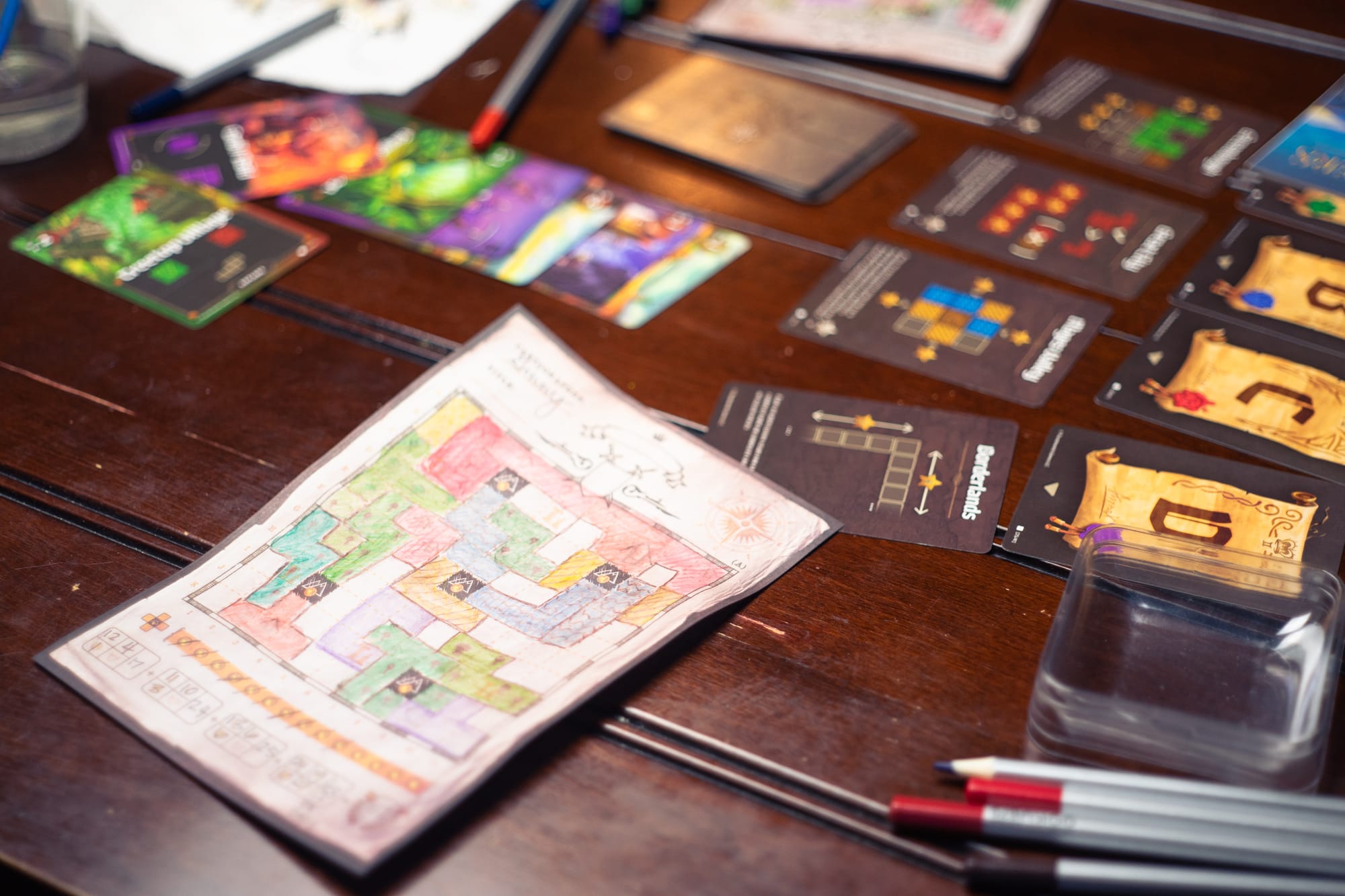
Cartographers (Adan, 2019) remains one of my all-time favorite in the ‘write something on a sheet of paper’ games, and I had a great time playing it again with some coworkers at my last game night with the company. (I’ve since moved on to another job.) It’s an excellent large-group game, in part because there’s no player order; everything happens simultaneously, and you’ll spend your time just drawing away.
Each turn, somebody draws a card, and you’ll have to draw the corresponding polygonal tile on a player sheet. You’ll be drawing in one of several terrains, and you’ll want to do so in concordance with scoring objectives that rotate throughout the four rounds of the game. Each round has two scoring objectives, with each objective appearing in two consecutive rounds — it’s a seasonal thing.
The large group play Cartographers unlocks is boosted by a painful-but-also-important (I think?) addition of some direct player conflict. When a monster is drawn, you’ll have to hand your paper to your neighbor, who then gets to draw a monster tile on your sheet. Squares on your sheet with adjacent monster tiles score negative points. That player interaction tilts this away from simply being a cozy game, and honestly, I think the game’s also quite good without it. Both methods of play work, and that’s because the scoring system is great.
Cartographers was designed by Jordy Adan, illustrated by Luis Francisco and Lucas Ribeiro, and published by Thunderworks Games.
Trickarus (Cannon, 2024) takes the story of Icarus (you know, the guy who flew too close to the sun) and turns it into a trick-taking game. Every time you win a trick, you move up a track, and the higher you get on that track, the closer to the sun you’ll be. If you ever fly too high, you’ll fly into the sun. You’ve won too many tricks, and now you must suffer for your hubris. You don’t lose automatically, but you’ll drop below the lowest player, and it will be hard to come back from that position. Importantly, when you you move up the track, you skip over other players, adding a real sense of peril to the whole game.
And if it ended there, it would just be a great game, and I wouldn’t be talking about it again. See, in Trickarus, I’ve discovered that I often want to fly close to the sun, and sometimes I actually want to fly directly into it. The end-game condition isn’t that you just fly into the sun and the game ends; instead, when you’ve flown into the sun (or somebody else has, but if you’re reading this newsletter, I bet it’ll be you), the round doesn’t end immediately — it plays out until the end of the current round. That leads to all sorts of weird play, including (but not limited to) forcing other players to fly into the sun after you, at which point they plummet below you; flying into the sun only to climb above everyone again; and hanging out near the sun and trying to force other players into the sun instead of you. It’s that leap-frog effect.
The emergence of a strategy where one flies into the sun intentionally is fascinating, and in some ways, I wonder if that’s an even better take on the myth: Flying into the sun might not be deadly. You can come back from it. You’ve seen it happen once. It could happen again. It could be you!
I love it. As an aside: I wonder if there’s a game to made about Achilles’ heel. As a kid, I often got Icarus and Achilles confused. That’s a funny thing.
Designed by Bajir Cannon, illustrated by Tomoaki Mizuno and Wakana Mizuno, and published by Learn Bridge Online.
A few interesting trick-taking plays, though in decidedly less depth:
- The 32nd Day of the 13th Month (6jizoGames, 2025) is a suitless climbing game where the starting card is the lowest rank, and you can loop back around just once. It’s a bit weird but it played pretty differently with different groups. Fascinating stuff.
- Karaoke Trick (argent, 2025) is one of my favorite recent trick-takers. When you win a trick, you lead from a visible reserve in front of you, and if you’re out of cards in your reserve, the next player around the table leads. It’s great.
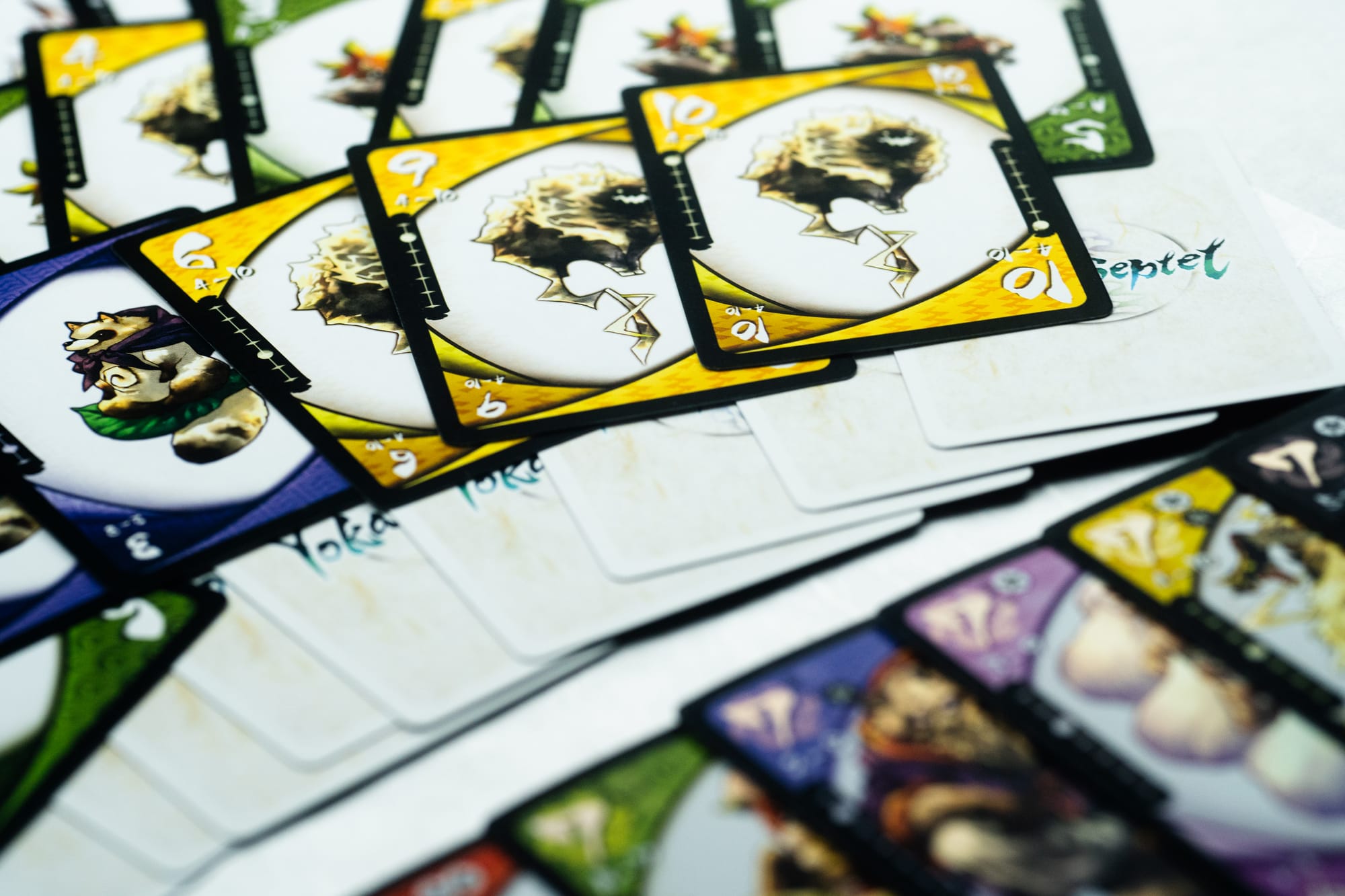
- Yokai Septet (Yokouchi, 2018) is a partnership trick-taking game where each team is trying to capture four boss yokai (7s) without capturing seven tricks. That provides a ton of tension, and when it ramps up, it really ramps up. My (game) partner and I won a trick in dramatic fashion the last time I played.