How Sail succeeds as a two-player cooperative game
This trick-taking game is constantly making players reprioritize.

There are times when it’s a bit hard to know what to write about in this purportedly weekly newsletter. (I do generally hit the mark there, though sometimes — like today — a bit by the skin of my teeth.) There are times I’ll turn to something timely and topical, or I’ll focus on something interesting I’ve been playing, or just tell you about a few games I like.
Not every newsletter can be a data-driven deep dive, after all. And that’s just fine, because while I enjoy writing about those kinds of things, it turns out that it takes me quite a bit more time to do, largely because I get sidetracked looking at the data near-constantly. I haven’t done that today. Simply put, I haven’t played a lot of games in person the last week or so. Having returned home from a long trip last week, we’ve still been playing a little bit of catch-up. (I know you’re here for the board games, but I suspect — at least a little bit, or at least for a few of you — these diversions are alright.) I’ve also been reveling in the success of my favorite soccer team, which it turns out has been a bit distracting, too. So, a bit of a free form thing is what you’re going to get.
First: I’ve finished playing through all of Sail (Koryo and Yusei, 2023) with my friend Michael on Board Game Arena. It’s as good a cooperative two-player game as any out there, and I wonder sometimes how it’s perceived outside of trick-taking fans. I’m clearly one of those, and Michael and I have played plenty of trick-taking games together, so I can’t truly say. But I do think it’s one of those great games that moves beyond genre, and not simply because it has a board, although that’s absolutely part of it.
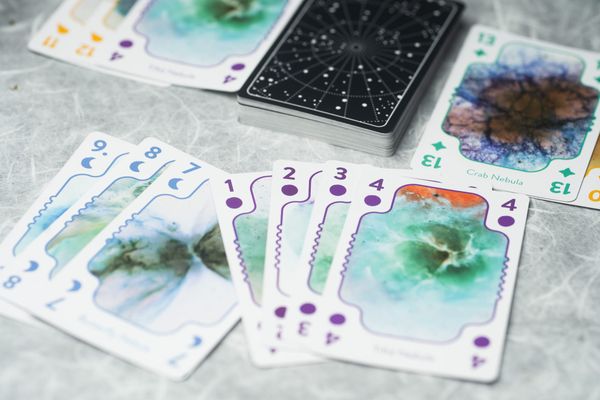
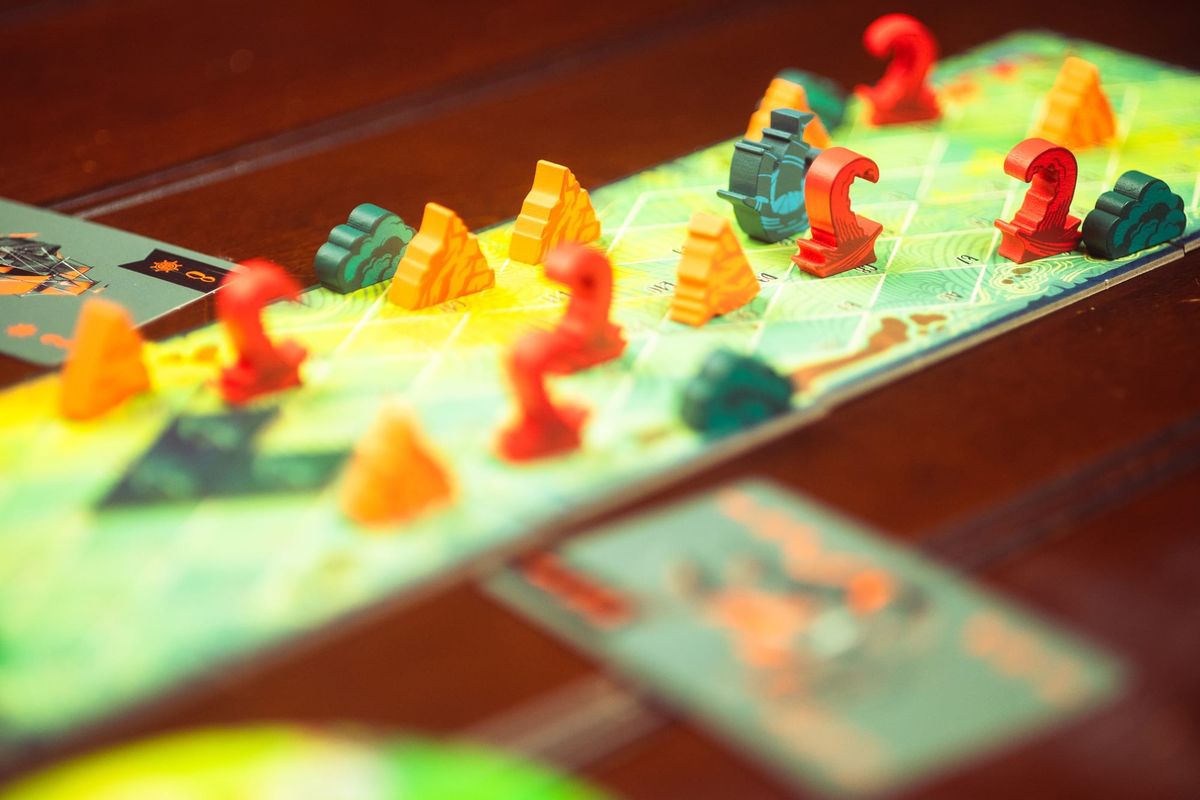
In Sail, you’ll be sailing a ship through treacherous waters. You’ll try to avoid krakens (and sometimes fail), running into large rocks (and sometimes fail), and generally try to steer the ship on the right course. (And, yes, sometimes fail.) You’ll do this through trick-taking. Cards fall into four categories: krakens (1–3), cannons (4–5), wheels (6–8) and whales (9). Playing certain combinations affects your positioning differently: krakens with krakens moves you, but it makes you more likely to lose later. Krakens with cannons essentially reverses that. Cannons with cannons reveals undealt cards and lets you perform a card action. Wheels with wheels move you along the map without additional harm. Your goal is, as you’d imagine, to make it to the end of the map.
Sail is, at its very core, a deeply tactical game. Trick-taking games almost universally are, right? You’re always responding to some previously unknown information when you follow a trick, and when you lead a trick, you’re reacting to potentialities. There are, of course, some trick-takers that prioritize strategy over tactics, though you’re largely looking at games that strip away hidden information. Reapers* (Newman, 2021) does this with a draft. Some find an interesting mix, like Luz (Shinzawa, 2014), Vamp on the Batwalk (Simantov, 2021) or Xylotar (Wray, 2024), each of which approaches hidden information in a different way.
In Sail, both players start each round with 9 cards. There are 27 cards total, and unless you play absolutely optimally with the kraken deck, you’ll have at least a few cards unaccounted for. Those unknowns are what make Sail a great two-player game. (See, there’s that tricky problem of symmetry, right?) But there’s a funny thing about that, because success in Sail often looks like eliminating as much hidden information as possible. The whole of the game is premised upon pairing cards together, and the more you know about what your partner can possibly do, the easier that process becomes.
There's an entropic force at play in the game, though: Once one player wins four tricks, the round ends, and the game is capped at five rounds. If you're not prioritizing progress, you might find yourself stuck prioritizing short-term gains. It's both the game's timer and a way the game forces you into suboptimal positions.
There’s a lot to love about Sail, but that transition from tactical to strategic, when you’re able to find it, makes the game sing. I’m always a little surprised to see the level of success Sail has achieved, even if it’s hard to pin down what exactly that means. A two-player trick-taking game with a map and all sorts of hazards — it’s a really approachable game, even if it sounds a bit arcane. It’s well-deserved, though.
Well, a short one today, but I hope you’ve had a great week and have plans to play board games this weekend. I think I’ll have to make some plans myself — maybe some great two-player games with my wife? (We’ll see if the toddler has other plans.)