Three games you can teach in five minutes or less
Two card games and a game with a string on a bead


As the holiday season nears, we’re all starting to think about the games we can take to family members’ homes. Or I am, at least. And maybe you are, too. Gathering around the table for games, either before or after eating, which was inevitably involved at one point or another, is a time-honered tradition for many families, and we’re not alone there. Often that meant Scrabble with my mom’s side of the family, and while I often wasn’t playing, I was often staring over people’s shoulders.
In retrospect, that might have been a little annoying, this kid staring over your shoulder as you pick a word, with turkey still quietly (or at least that’s the hope) digesting. These three games can get those kids (especially past me!) at the table alongside the rest of the family.
Take 5 (Kramer, 1994)
It’s perhaps a little odd to have two games with ‘five’ in the title featuring in this newsletter (of five games, no less). I don’t mind, of course, but I think it’s fascinating. Of course, this game was once better known even to English-speaking audiences as 6 Nimmt. (It’s also a little odd to decrease the number, but I guess you are literally ‘taking five’ and not six?)
OK, but let’s talk about this game. It’s on the older side, as far as modern board games go. It was first released in Germany in 1994, and it was designed by the inimitable Wolfgang Kramer, who stands as one of the great designers of the late 20th and early 21st centuries. While many of his more notable games now hover in that comfortable-but-strategic range, this early effort fits all comers.
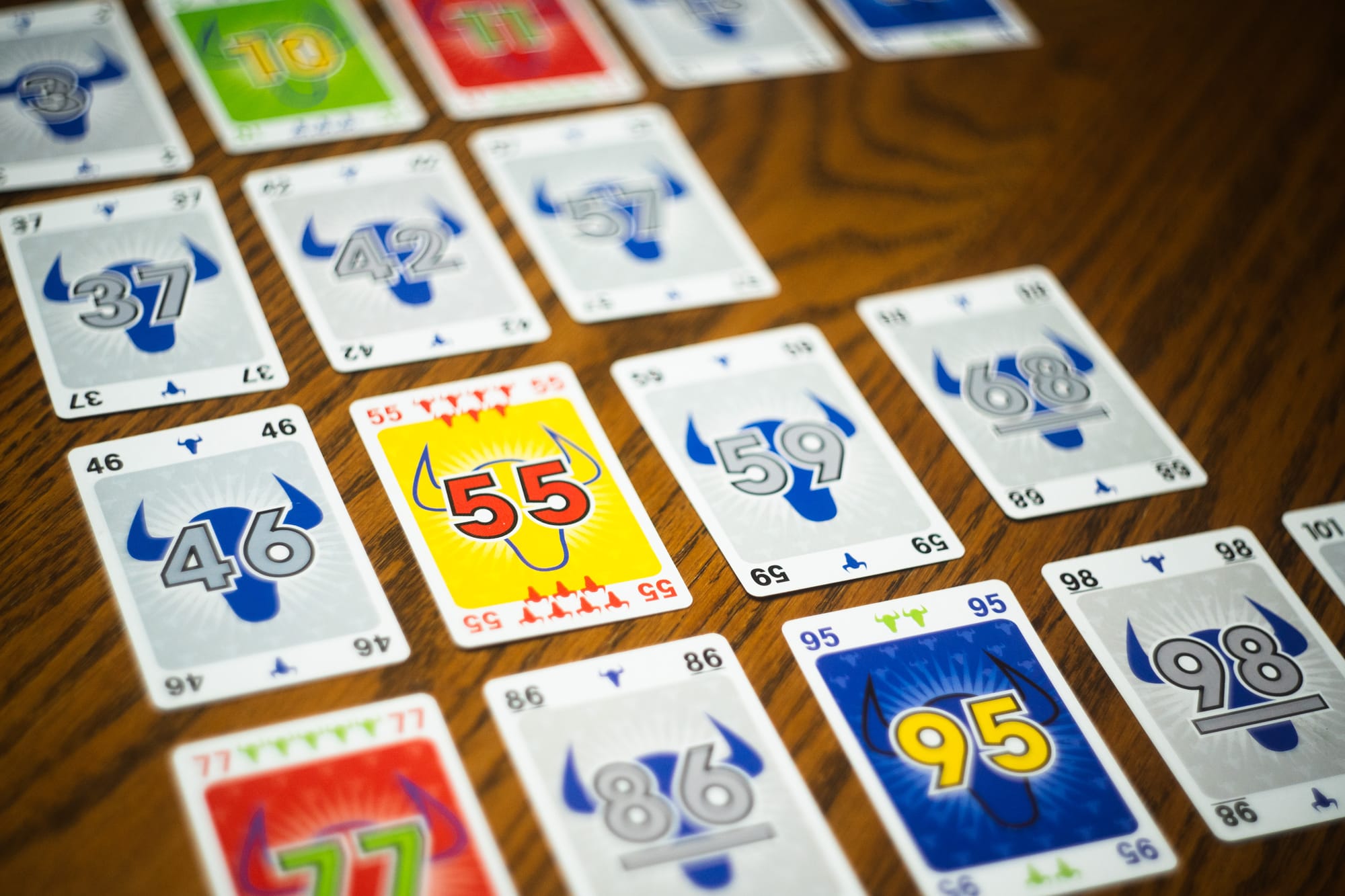
The premise is simple: Everyone plays one number card at a time, they sort into rows based on their rank, and the person who places the sixth card in a row takes the first five cards as points. As you don’t want to take the cards, points are, as you’d expect, bad. There’s a bit more nuance as you play, but really not that much more. This is a wicked little game that will make your family members just upset enough to make it interesting, but not so upset as to be a bad time when dinner’s served.
Take 5 was designed by Wolfgang Kramer and is published in the U.S. by Hasbro as Beat the Heat. It plays up to 10 players.
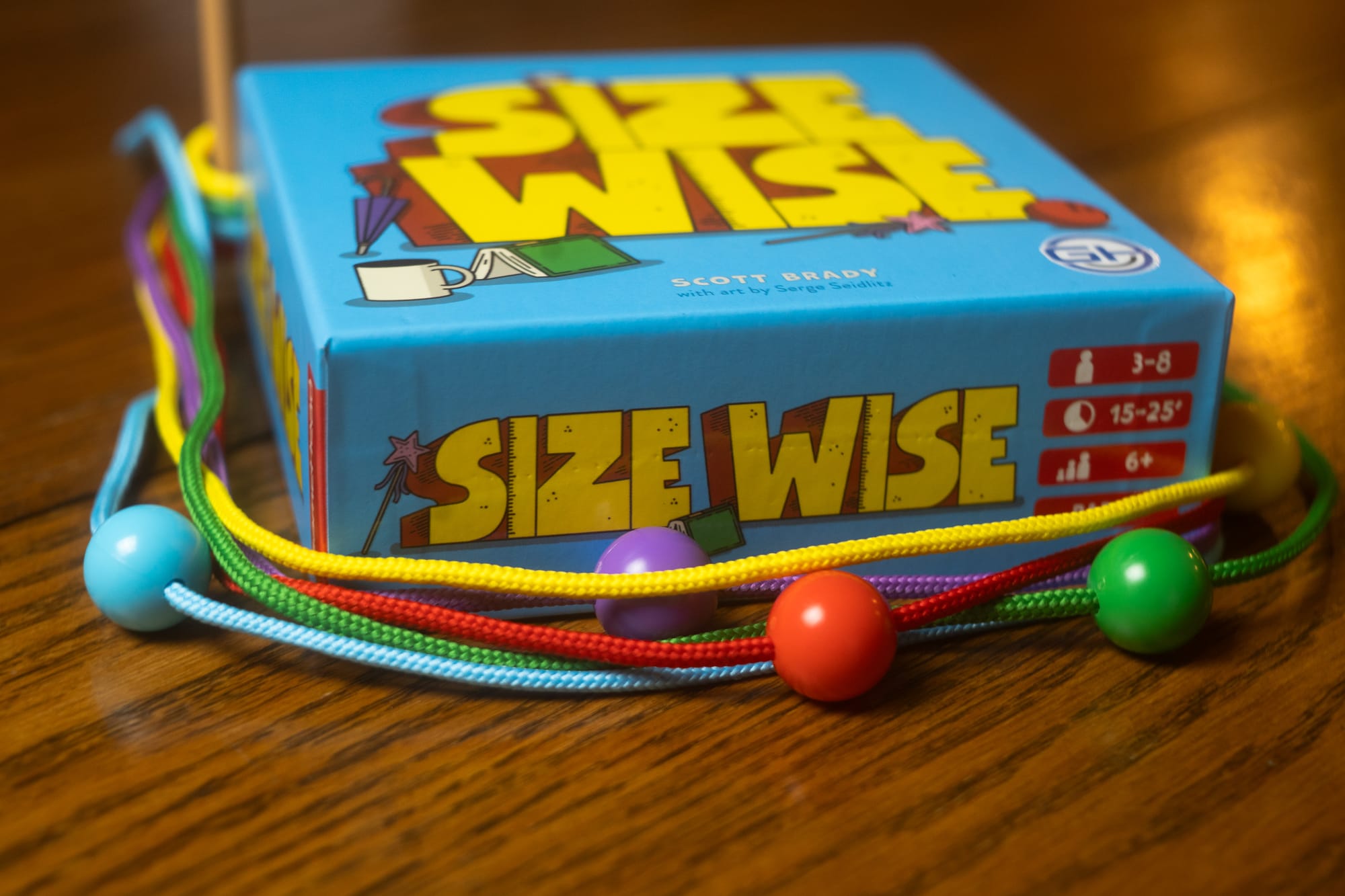
Size Wise (Brady, 2026)
You know those games where the components really make it something special? Sometimes it’s because you’re using some cool realistic-looking components, or maybe there’s just a player piece with a giant baby on it. Maybe it’s something tactile that really helps you connect with the game, like the bags in Sheriff of Nottingham (Halaban and Zatz, 2014) or the clacky wheel in Wavelength (Hague, Vickers and Warsch, 2019).
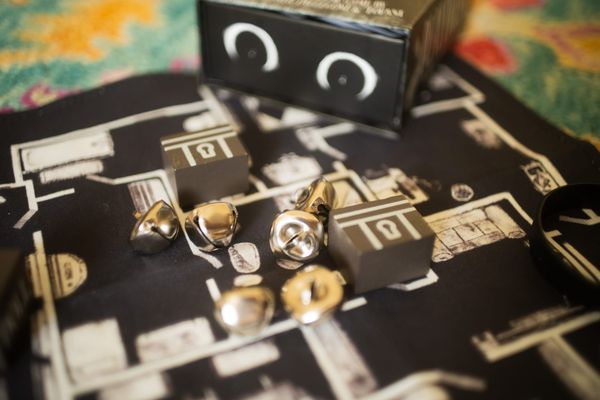
In Size Wise, that component is a bead on string. Every round, you’ll draw a card for the group, and everyone will be tasked with pulling that bead such that the length of the string from the base to the bead represents the length of whatever’s on the card. Everyone will then compare the lengths of their strings, and the players with the longest and shortest strings lose a token. If anyone ever loses all their tokens (and the number you start with depends on the number of players), the game ends, and they lose. It’s delightful, because largely, it feels like it shouldn’t work. It notly works, but it works incredibly well. The drama you’ll feel turning in your string for comparison, married with the comedy of seeing somebody’s much, much longer than yours, gives this game a real classic feel.
Size Wise was designed by Scott Brady, illustrated by Serge Seidlitz, and published by GameHead. It plays up to 8 players.
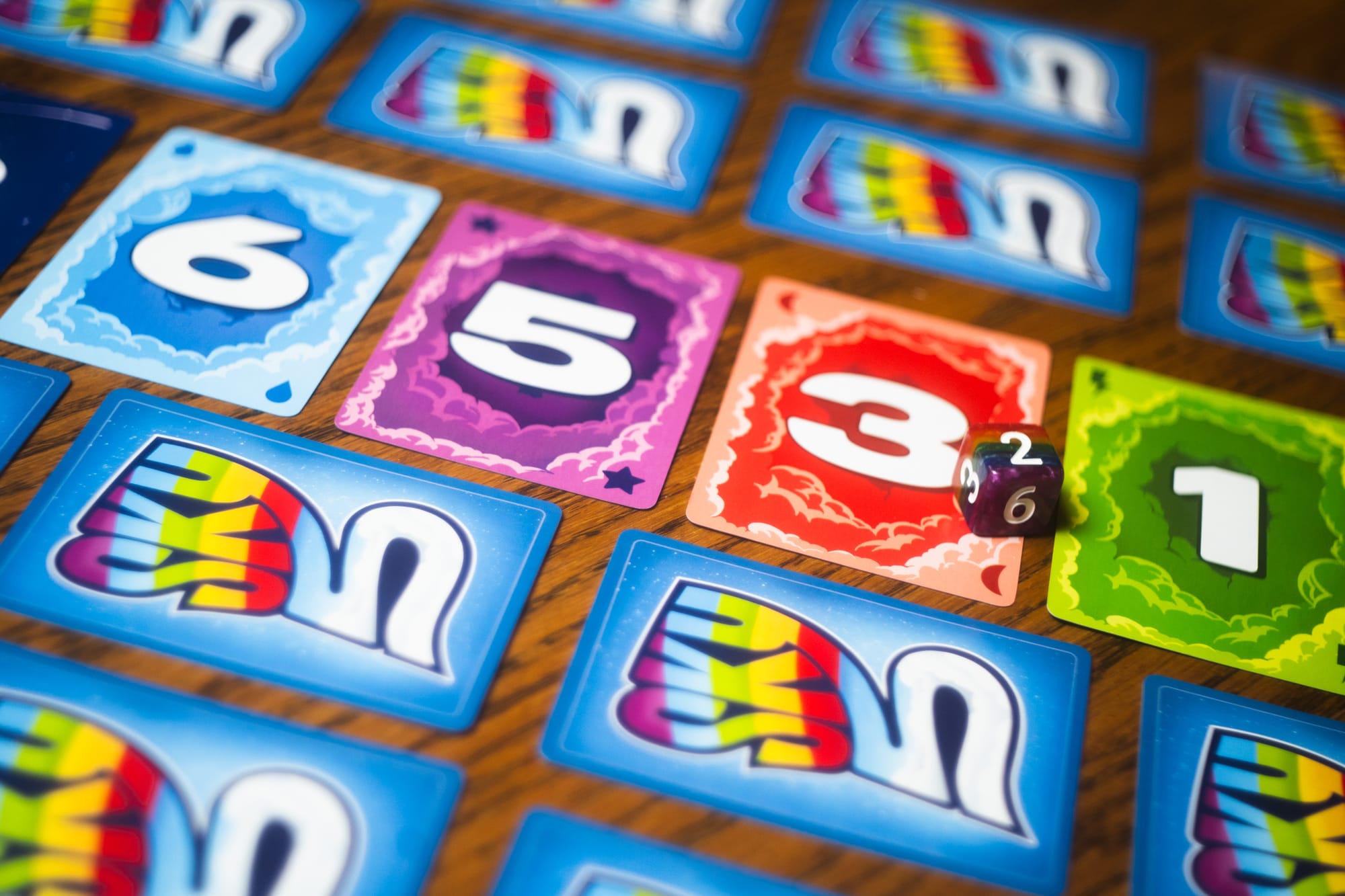
Sky 5 (Belsole and Kendall, 2026)
In the wake of the hit Flip 7 (Olsen, 2024) it was perhaps inevitable that there would be a bit of a wave of push-your-luck, light card games. Flip 7 has everyone going around the table deciding if they want to keep going, hoping to flip seven cards and get a ton of points, or if they want to stop, banking their points. It’s a game where folks get quite excitable at the table, with that classic gambling feel permeating.
Sky 5 (Belsole and Kendall, 2026) makes use of that same core premise. On your turn, you’ll flip a card, adding it to your tableau of cards — that is, unless you draw a color you already have in front of you. If that happens, you’ll just give your card to another player who doesn’t have that color, and if that’s not possible, you’ll discard all the cards in front of you. The decision to stop and bank your cards (and thus your points) is less straightforward here, because at that point you’ll roll a die, and if you roll a number you already have, you’ll bust.
I actually really like the twist here, where drawing a color you have means another player benefits. It makes the weighing of your options a bit more nuanced than “hit or stay,” because I love that potential to help an opponent (an unfavorable outcome) instead of losing all your points (a very unfavorable outcome). Now, you might draw a low-value card that you have to give away, and maybe that’s actually a favorable outcome. I don’t know. Shades of grey, all that.
Sky 5 was designed by Mike Belsole and Grace Kendall, illustrated by Ben Daniel, and published by Druid City Games. It plays between 2 and 6 players. Druid City Games sent me a press copy of this game.