Jibber Jabble: Spell with your friends
A spelling party game, and it's highly unusual and very funny

Every now and again, I play a game that just doesn’t feel like anything else I’ve played before. That feeling has become more rare over time, which I don’t say to make myself sound jaded — it’s just that as one accumulates a greater wealth of experiences, you notice patterns with greater frequency. It’s a beautiful thing, and I feel fortunate to have so many rich experiences in gaming.
Ahem. As I was saying. Every now and again, I play something that just feels — I don’t know — different. The first time I played a ‘modern board game,’ it felt different, exciting. The first time I played a six-hour game that kept me engaged the entire time, it was a revelation. The first time I played The Mind (Warsch, 2018), I was surprised at what a game could bring out of a group.
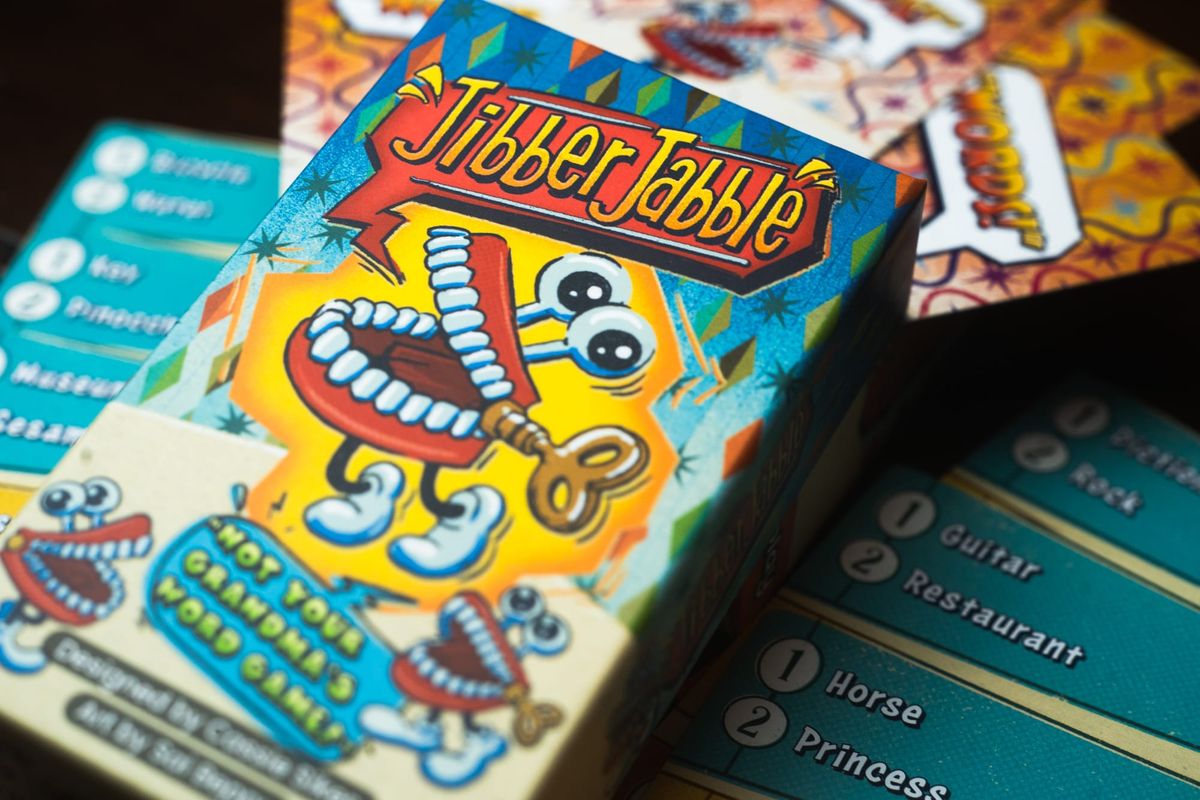
The first time I played Jibber Jabble (Sikes, 2026), I was presented with high comedy. Or was that low comedy? I forget which. The entirety of the game was filled to the brim with laughter, or it certainly feels that way in retrospect. The premise of the game is deceptively simple: You’re going to be taking turns around the table saying letters, hoping that at some point you’ll spell a word, or at least something approaching one.
Jibber Jabble is a cooperative game. Each round, one player gets to act as a guesser, and all the other players will spell out three words that help guide them toward a secret word. That’s all reasonable, right? The big twist isn’t that you have to know how to spell well, though it probably helps. The twist is that you don’t know what word you’re going to be spelling, and the only way you’ll be able to figure it out is by hearing the other letters your fellow players have said.
You know what? We need an example.
Let’s say as a team, you’ve been given the word ‘bear’. The first player to give a letter is trying to provide a clue to the guesser that isn’t the word bear, because spelling bear is straightforward, and that’s not much of a game, that’s a spelling bee around a table. The first person might be thinking ‘ursine’, so they give the letter U. The second person might not know they’re going for ‘ursine’ — they can’t communicate, so they’ll give a different letter. Maybe a ‘p’, thinking the clue might be ‘upright’. Maybe the third person caught on to ursine, and they want to try to get the word back on that perceived track, so they give an ‘r’. The fourth person? Well, that sure looks like it’s spelling ‘upright’, so they’ll give an ‘i’. And so it continues until somebody decides to stop.
There’ll be three clues given that way, and sometimes, you might just end up with a jumble of letters because nobody caught the vision. The change of that happening in Jibber Jabble is so strong that it almost becomes a guarantee. Your fellow players are going to shift your expectations out from under you constantly. You might think you’ve caught on, only to realize that you have no idea what everyone else is spelling, and maybe it turns out you’re not the only one in that position, but you’re not allowed to communicate.
That’s the brilliance of Jibber Jabble. This is a cooperative game where the only communication is given a letter at a time, and you can operate under a guarantee: Try not to plan too much, it might not work out right.
Jibber Jabble is not concerned with being subtle. It’s not trying to teach a lesson about how humans struggle to communicate; it’s not an educational game. It is, however, deeply intertwined with how humans communicate without feeling like a business seminar.
There are a few games that have felt like this. The Mind, with its silent say-a-number play, is the closest relative. Sound Box (Hach and Silva, 2022), too, as a cooperative game where everyone’s making a sound that one player will be guessing.
Above all else, I do recommend playing this game with a three-year-old who is obsessed with learning his letters, and all he does during the game is shout ’S’ when he thinks it’s his turn. He doesn’t know he’s not playing, but if he’s actively participating around the table, isn’t that what really matters, anyway?
Jibber Jabble was designed by Cassie Sikes, illustrated by Sai Beppu, and published by Allplay.
Cooperative party games are an interesting thing. They now regularly rank at nearly 20 percent of party games rated at least 50 times on BGG. I’ve played a bunch of them, and I’ve really enjoyed them — maybe a topic for a future newsletter? I do wonder what tipped things over — was it The Mind? Just One (Roudy and Satter, 2018)?
I hope you’re all doing splendidly! I’ll see you again soon. With the holiday season rapidly approaching, I’ve got some writing to get back to — that gift guide isn't going to write itself.