A brief history of Bohnanza
The enduring legacy of the bean-farming game

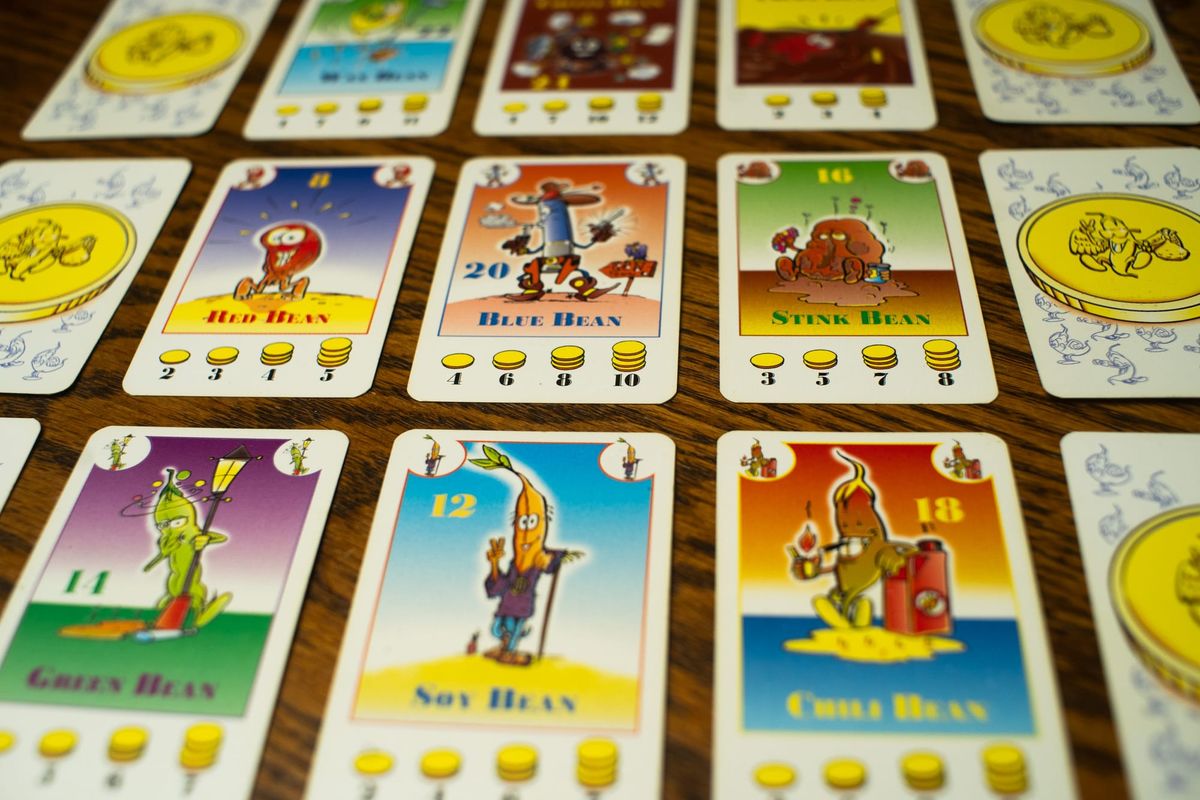
Bohnanza, or as you might have heard it described at one point or another, “the bean-farming game,” has a rich history among modern board games. It’s sprung up plenty of reprints, had a crop of expansions, and sprouted the career of one of gaming’s most enduring figures.
Released in 1997 and designed by Uwe Rosenberg, Bohnanza could well be described as the game that launched the career of one of the greatest game designers of our age. Rosenberg later designed Agricola (2007) and Patchwork (2014), both of which presented considerable shifts in the gaming landscape. Bohnanza was no different: This was a trading card game that was smooth, streamlined and efficient. The general play loop was easy to teach: On your turn, plant between one and two cards from the front of your hand. Don’t rearrange your hand. Trade beans from your hand and from the deck. Easy.
Bohnanza remains a game that’s invaluable in a collection. Many editions of the game bundle the seven-player expansion, and that player count is dreadfully hard to appease. You can play Bohnanza at seven players, and everyone can be involved throughout. It’s a game that works magic. And yes, it’s long been the bean-farming game.
Through the magic of Usenet, we can actually understand early reactions to the game. Steffan O’Sullivan, who is best known for writing RPG books for the GURPS system, attended the 1997 Gathering of Friends put on by Alan Moon. He wrote about Bohnanza on rec.games.board, reporting about his experience of the event.
Bohnanza was a hot new game at the Gathering - probably inexpensive card game about collecting different types of beans. (Bohn is bean in German). Very good game - I did play this and will be picking up a copy sometime. The only complaint I heard about it is that it seems to end a tie too much. Could be: in our game, the final scores were 13-13-13-12!
This is the first recorded reference to Bohnanza in Usenet, and it’s likely the first time anybody wrote about the game on the internet. In 2021, I wrote about the history of the word Meeple — a term dating to the year 2000 and to Carcassonne (Wrede, 2000) directly — and finding the truest origin of that took some crawling through Usenet archives as well.
Daniel Blum writes in that same thread:
Bohnanza - the bean game. You'll probably hear a lot about this one, so I won't bother with a description. It's a cute little card game which at the very least uses a novel mechanism (i.e., not just another trick-taking game with a difference). How much strategy is involved I'm not sure yet, but it's probably worth the $12 or so it'll cost you.
A tangent here: The “just another trick-taking game with a difference” (or, if you will, with a twist) slight is clearly not new, as we see here. It’s funny that nearly 30 years later, trick-taking detractors said the same thing. I wonder what Mr. Blum thinks of the movement now. (And nothing against him — I’ve never met him, and I certainly wouldn’t begrudge him his opinion here. He’s really just an interesting figure in this historical look at Bohnanza.)
The praise, of course, continued. You know that, given the game’s success today. It received a nomination for the 1997 Spiel des Jahres prize, but opinion at the time was that it would almost certainly get passed over, with commenters citing 1994’s 6 Nimmt!, later Take Five, (Kramer) as a card game that deserved the prize in its group but was passed over. Ultimately, that thinking proved prescient, with a more traditional board game (in that it had a board) winning in Mississippi Queen (Hodel).
And so it continued for some time, with discussions about where to obtain the game through importing, how to get the game in the United States, discussions about games for large player groups, and all the usual discussions you still see today around games on BoardGameGeek. It’s a bit funny, actually, because in some key ways, the trick-taking fan community reminds me a lot of the early days of the board game community.
Not long after release, the expansions started rolling in fast.
- Bohnanza: La Isla Bohnita (1998) added shipping and, uh, pirates. Reception was decidedly not particularly positive at the time, and only part of this one survived to the modern era.
- High Bohn (2000) adds special abilities.
- Mutabohn (2001) adds bean mutations.
- Ladybohn (2002) adds female-coded beans, and it does add some new play with those cards. Still, is it questionable, and should they maybe have not just used male-coded beans? Probably.
- Bohnaparte (Rosenberg and Girke, 2003) adds a map and war.
- Telebohn (Rosenberg, 2004) adds hostile bean field takeovers.
- Bohnröschen (Rosenberg, 2007) adds Sleeping Beauty. (Yes, really.)
- Auf der schwäb'schen Eisenbohn (Girke, 2008) adds a train game to the mix.
- Bohnedikt (Rosenberg and Steininger, 2009) adds Catholicism. (No, again, I’m not joking.)
- Bohn Camillo (Rosenberg and Hendriks, 2011) is a two-player bean battler.
- Marco Bohno (Rosenberg, 2018) gives players special tasks to complete.
- Bohna Nostra (Rosenberg, 2019) expands trading to include offers (presumably theat you can’t refuse.)
And, of course, there are the slew of Bohnanza offshoots, each of which can stand alone.
- Space Beans (Rosenberg, 1999) isn’t a trading game at all.
- Al Cabohne (Rosenberg, 2001) is a solitaire take on Bohnanza, where you fight against the mafia.
- Bean Trader (Rosenberg, 2002) is Bohnanza: The Board Game.
- Rabohnzel (Rosenberg, 2005) adds magic spells.
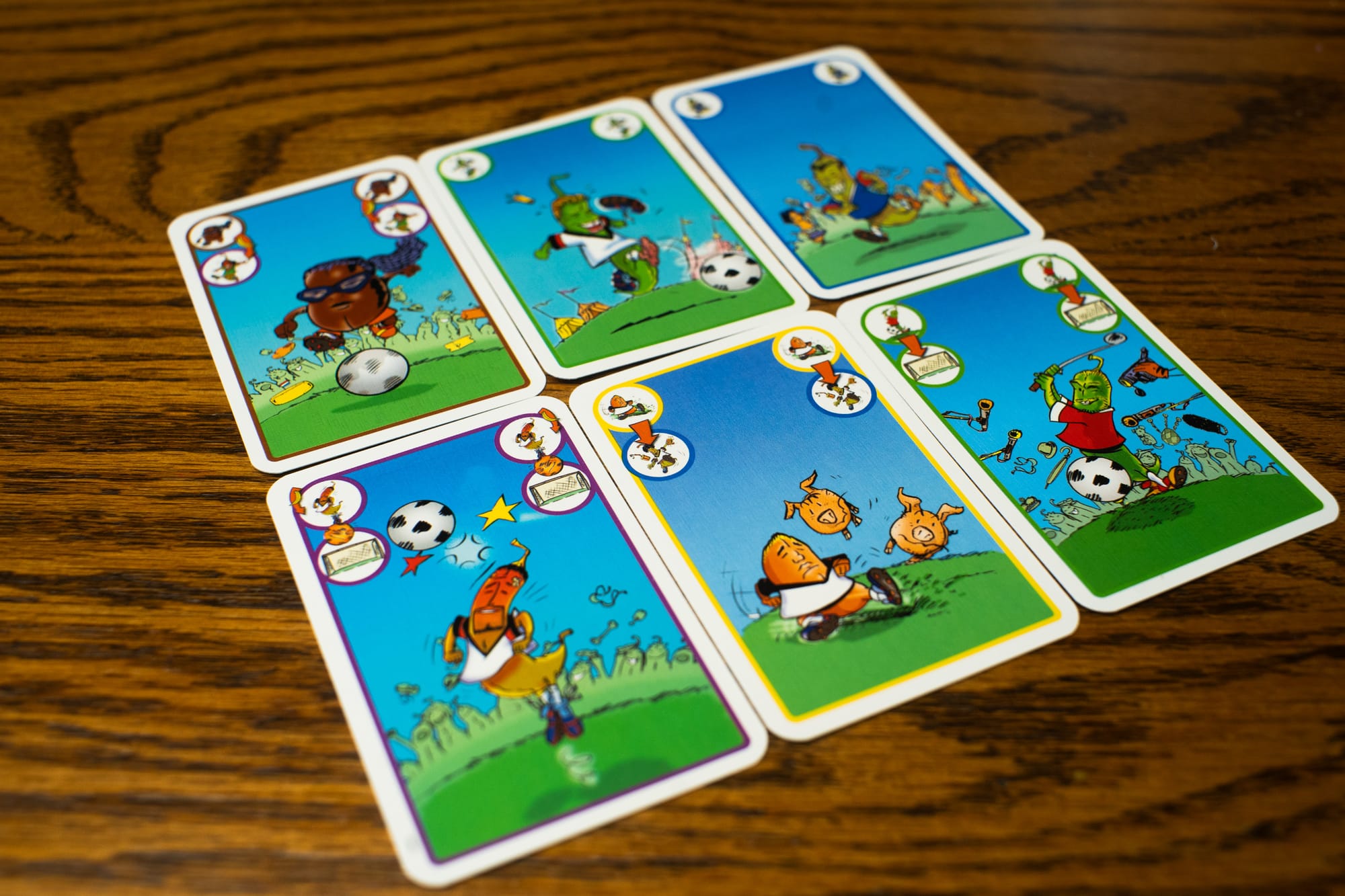
- Bohnkick (Rosenberg, 2006) is a game made for the 2006 FIFA World Cup, which took place in Germany.
- Kannibohne (Rosenberg, 2006) adds … cannibalism?
- Bohn to be Wild (Rosenberg, 2012) adds a bunch of new bean types, including some ‘wild’ beans.
- Würfel Bohnanza (Rosenberg, 2012) is a dice game based on Bohnanza.
- Sissi!: Die Bohnenkaiserin (Rosenberg, 2013) adds Sissi beans, which you’re forced to alternate with your other beans.
- My First Bohnanza (Rosenberg, Kiefer and Siemsen, 2015) is Bohnanza for kids.
- Bohnanza: The Duel (Rosenberg, 2016) is the canonical two-player Bohnanza these days.
- Excalibohn (Rosenberg, 2020) is apparently basically just Rabohnzel? Or at least it’s a reimplementation.
- Bohnanza: das Würfelspiel (Rosenberg, 2022) is another dice game. I’m not sure if it’s just Würfel Bohnanza.
Exhausting, right? That’s how I felt reading about all of thse. Plenty of them got repackaged later on in other forms. I didn’t even mention Horse Bohnanza: Wendy Pferdebasar (Rosenberg, 2009). I’m pretty sure I’ve missed some expansions here. A bunch were released in short print runs, so they’re very difficult to find now, too.
Throughout it all, Bohnanza came packaged in that distinctive yellow box. Outside of Horse Bohnanza, they all did, except Space Beans, which is purple, and Bean Trader, which is green. It persisted through various international publications, too. Whether it was Amigo publishing the original games in Europe or Rio Grande Games in the U.S., it was rare that there was significant deviation. Occasionally you’d see something like Gigamic in France departing from the yellow. There’s even one version of the game, Landleven Spel, from 1997 that doesn’t feature beans at all, which brings us to today.
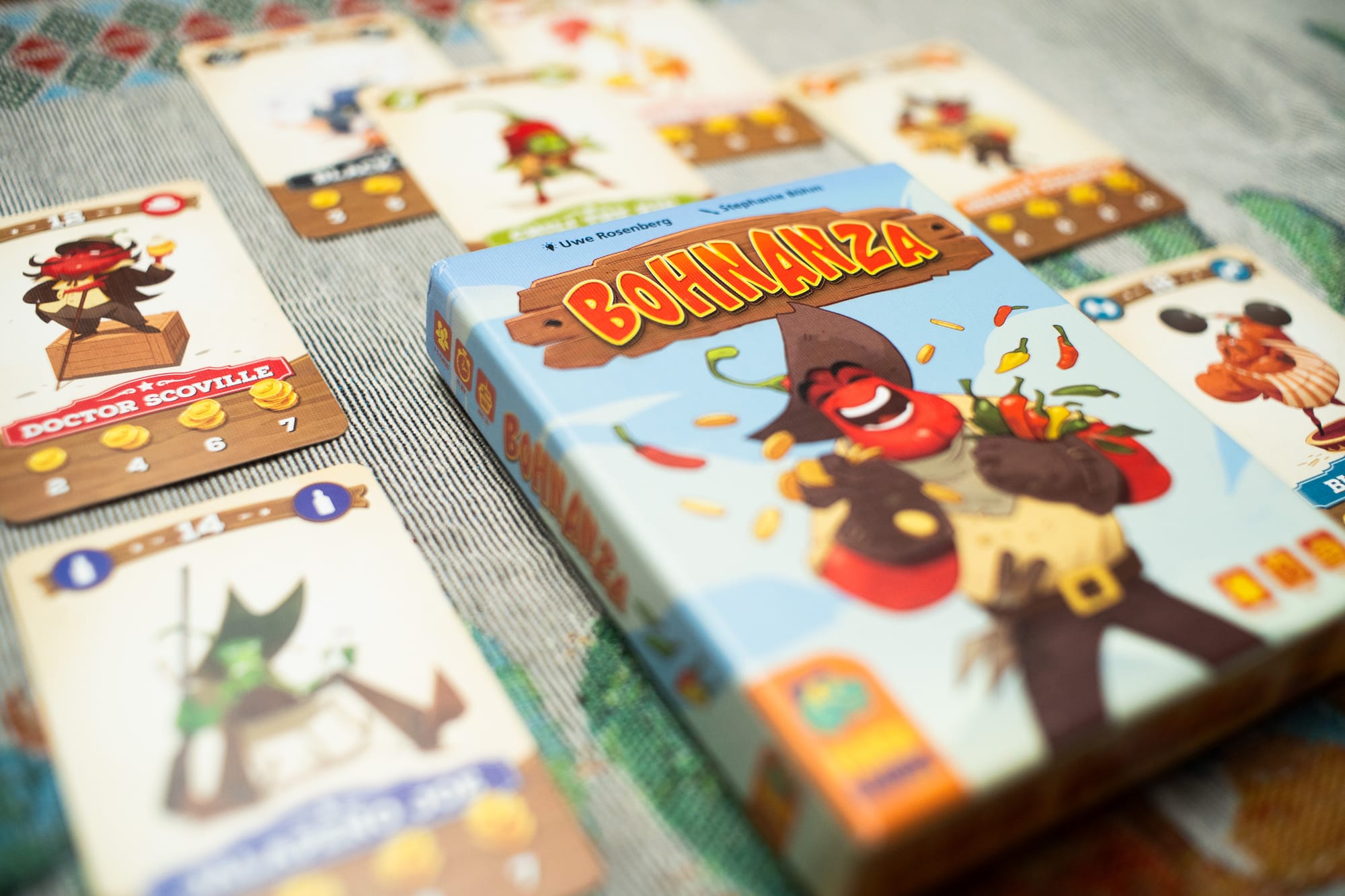
Pandasaurus Games, who sent me a review copy of the new edition, have departed from the yellow box, but they’ve also departed from beans. See, their take on Bohnanza is a chili trading game. And it’s a “Wild West” themed game: You’ve got Sheriff Pimento, Granny Peri Peri, Chili the Kid, Black Cobra, Big Robusto, Jalapeño Joe, Dr. Scoville and Josephine Pepper. (The balance of male-coded to female-coded beans is off, though not as poorly as the original.) Why chilis? I wonder if it’s because the green bean has been confused too many times for a chili.
It’s an interesting thing. Amigo themselves published Bohnanza: Dahlias, which pastes a flower theme atop the original. But I’m forced to stop and ask myself: If there aren’t beans, why are we keeping the bean pun going? It’s funny, though. Going with that wild west theme fits with the TV series Bonanza, so abandoning the beans but introducing a new take on the pun is at least something. It’s probably not a major issue — Pandasaurus released this one in the U.S. market.
While I’m not a huge fan of the new art style, the contrast it draws with the original is worth calling out. Some of the depictions through the years have arguably included racist caricatures, and that isn’t really present here. It’s a big plus. The base game didn’t really suffer from that, but the art had started to feel dated. Nearly 30 years on the market will do that, I suppose. With the growing prevalence of board games (or least the perception that there’s a growing market out there to capture), having a game on the shelf that looks modern might just make the difference.
Still, I’ll miss the beans.