Playthings: An approachable oddball
From design collective Jasper Beatrix with Jerry Bright and Joey Palluconi, Playthings is one of the more unusual games I've played this year.

I’ve made no secret of the fact that I appreciate games that do things a bit differently. If a game’s strayed off the beaten path, I’m there for it. I love the surprise when a game does something I didn’t expect. I love laughing when a game moves in a different direction than I expected.
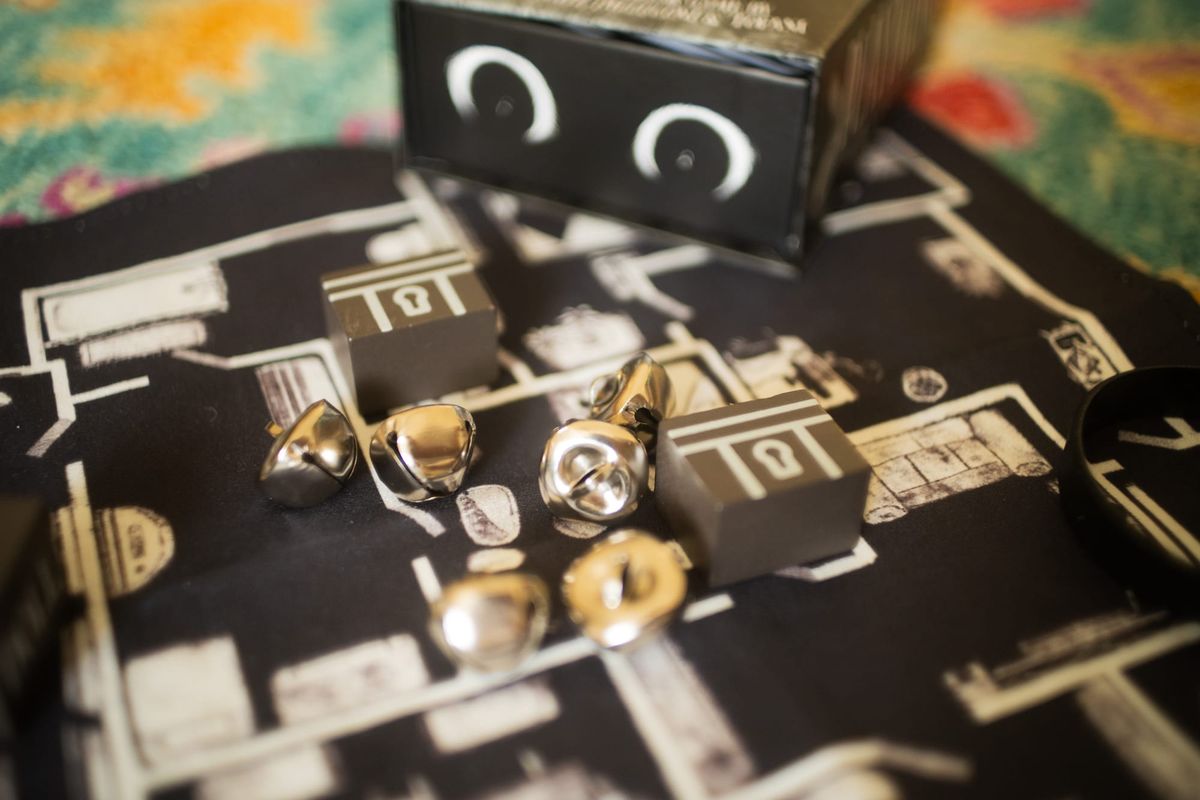
Playthings, released this year, is that sort that game. Designed by Jerry Bright Jr., Joey Palluconi and the pseudonymous collective Jasper Beatrix, Playthings is a game about secretly placing toy chests in a house for your friends to find. The thing is, that’s not really the theme, but that’s what it is, really. This is a sensory game, says DVC Games, the game’s publisher and the home of Jasper Beatrix. The theme, as described by the publisher:
As it is time to prepare for bed, a group of friends discuss their plans. It seems a being of the nightmare realm will come again to steal their toys, and only by setting traps of their own do they have a chance of getting even.
With one player acting as the night terror, the remainder get to set those aforementioned traps. Each round has the other players collectively drawing three ‘friend’ cards, which give them some conditions the night terror player will have to work around. Maybe it gives them a handful of bells they can use to set traps. Maybe the night terror will have to drop toy chest tiles instead of placing them on the board. Maybe you’ll even get to place your fingers under the play mat, allowing you — you think, at least — to guess where the night terror is operating.
And all of that is fine and good. This is an interesting game on its face, and you’ll be trying to make some interesting educated guesses. The night terror player, if they’re careful enough, can exercise some real secrecy about their actions. They can avoid almost complete detection. But here’s the thing: the other players can, uh, cheat. Sort of. It’s more that they can peek at what the night terror is doing, and it’s all sanctioned by the game.
At the end of the round, the night terror player will make guesses — not at who peeked and who didn’t, but at who has told the truth about peeking and who hasn’t. It’s the only way the night terror gets points, even. Each player will, one by one, declare whether they peeked or not, and if the night terror is correct about their truth-telling, they get points. If they’re wrong at any point, they’re done guessing, and they get no further points. The players get points for guessing the correct toy chest tiles, regardless of whether they peeked or not.
This is a fascinating little game. It incentivizes peeking, and if you peek successfully, you’ll earn points, simple as that. If you’re all too obvious, though, it becomes trivial for the night terror player, and they’ll get just as many points as you. Some level of deceit is essential for all players.
Playthings is an unusual game, and it thrives in the half-spaces between where the usual games leave gaps. There’s a little bit of deduction (and more induction than that) with the traps you get to set, but it’s limited to just three types in a turn, and they’re all largely avoidable by the night terror player. There’s a little bit of bluffing, but again, it’s limited, because being too obvious about peeking (or not peeking) means you won’t end up in an advantageous position. Those two things together make for a strange little combination.
Thanks for reading Don't Eat the Meeples this week! I'll be back again in the next couple of weeks with something, though exactly what, I'm not sure. We'll see!