Five great two-player card games
They're not just trick-takers — plus 13 more great card games to consider

Sometimes, on a week night, after the kids are tucked in bed (and hopefully not screaming as our three-year-old is wont to do), it's nice to just pull out a card game for some quick gaming with my wife. These – um, 18, I guess — card games are all what I'd consider great options for that. (OK, technically, one of the secondary recommendations is a board game, and you could make an argument with another. Anyway.) Let's just jump right in.
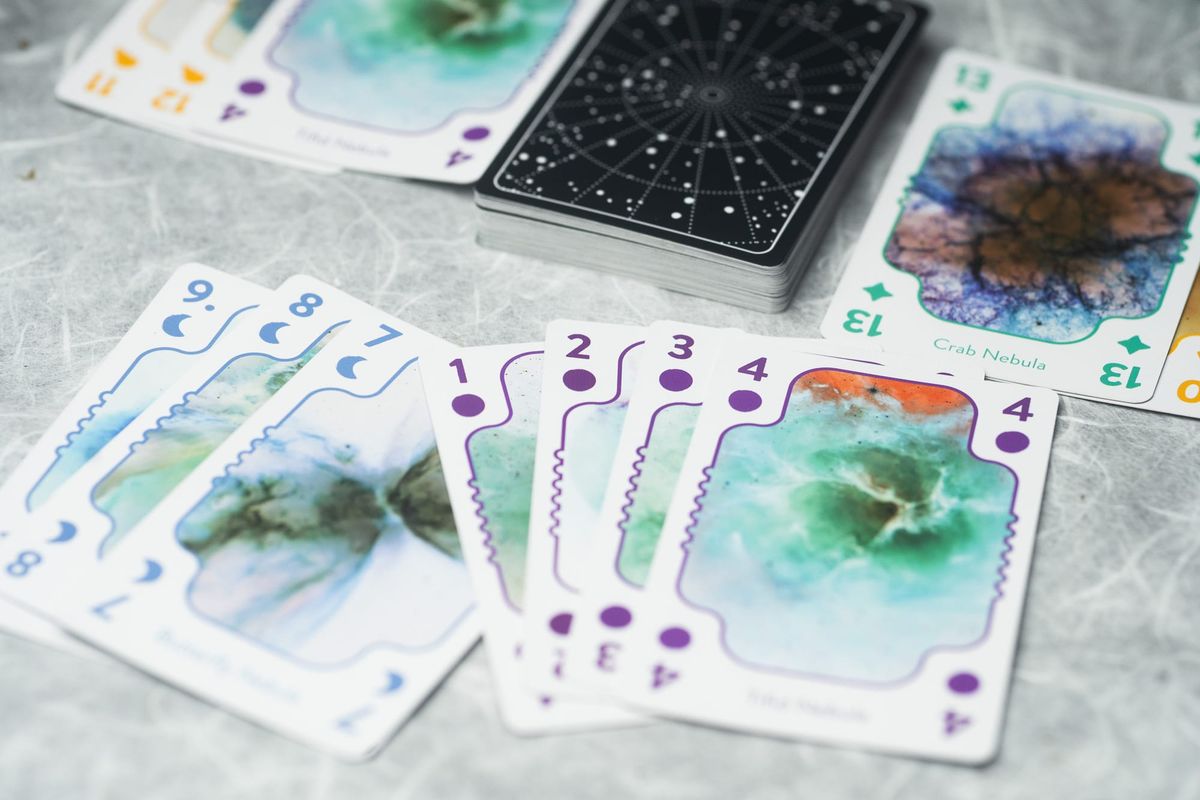
Nebular Colors (Leiman, 2026) was self-published by Marceline Leiman in November last year at Indie Games Night Market, albeit in a very small print run. It's since been released under the same name by Korean outfit Playte, who have been making some really interesting signings lately, and this one's no exception.
Nebular Colors is a Rummy-style game, and while I admit I'm not too familiar with rummy games, I realize I've played a few of them. I know I've played Rummy itself, which dates to the 19th century, and I've played the Canasta variant Hand and Foot (1982), though almost entirely as very short-term stand-ins for one of my parents when playing with family. The basic idea with rummy games is that you're making melds with the cards in your hand, by which you'll score points in one way or another, or maybe you try to go out before other players. There are a lot of variations on that theme, and the theme is absurdly broad.
Nebular Colors has players making melds in a bid to score five or more points. Melds, which must be made within a suit, are only worth points once you've passed a card threshold for that suit, and they're worth more points if they're larger than the base three-card size. The construction of the deck is interesting here, because suits correspond to sets of ranks — so 1 to 5 are in the purple suit, 6 to 9 are in the blue suit, 10 to 12 are in the yellow suit, and 13 is alone in the green suit. Because melds must be made within a suit, it really limits some of your options, and not particularly in a way that makes the game easier.
On your turn, you'll either draw from the draw pile, or you'll draw all of the cards from one of two discard piles, make melds with what's there, and discard the rest of that pile as penalty points. That means there's always some deal of thought that goes into your discarding,and it also means that your opponent may be discarding in ways that are specifically designed to make your life difficult.
End-of-round scoring has a great twist, too. Once a player hits five points, they can choose to end the round immediately and score a point. They can also choose to continue ('nova' in the game's parlance), and if they earn ten points before their opponent earns five, they'll earn two points. The game plays until one player hits four points, so going nova could be a really fruitful endeavor. Or it could backfire spectacularly. One of those two.
Also consider:
- Another two-player game from designer Marceline Leiman: High Tide (2025), an abstract game in which you're stacking sea creatures
- Gin Rummy (Baker and Baker, 1909), which is a stated inspiration for Nebular Colors — as with most traditional card games, you have to live within the randomness.
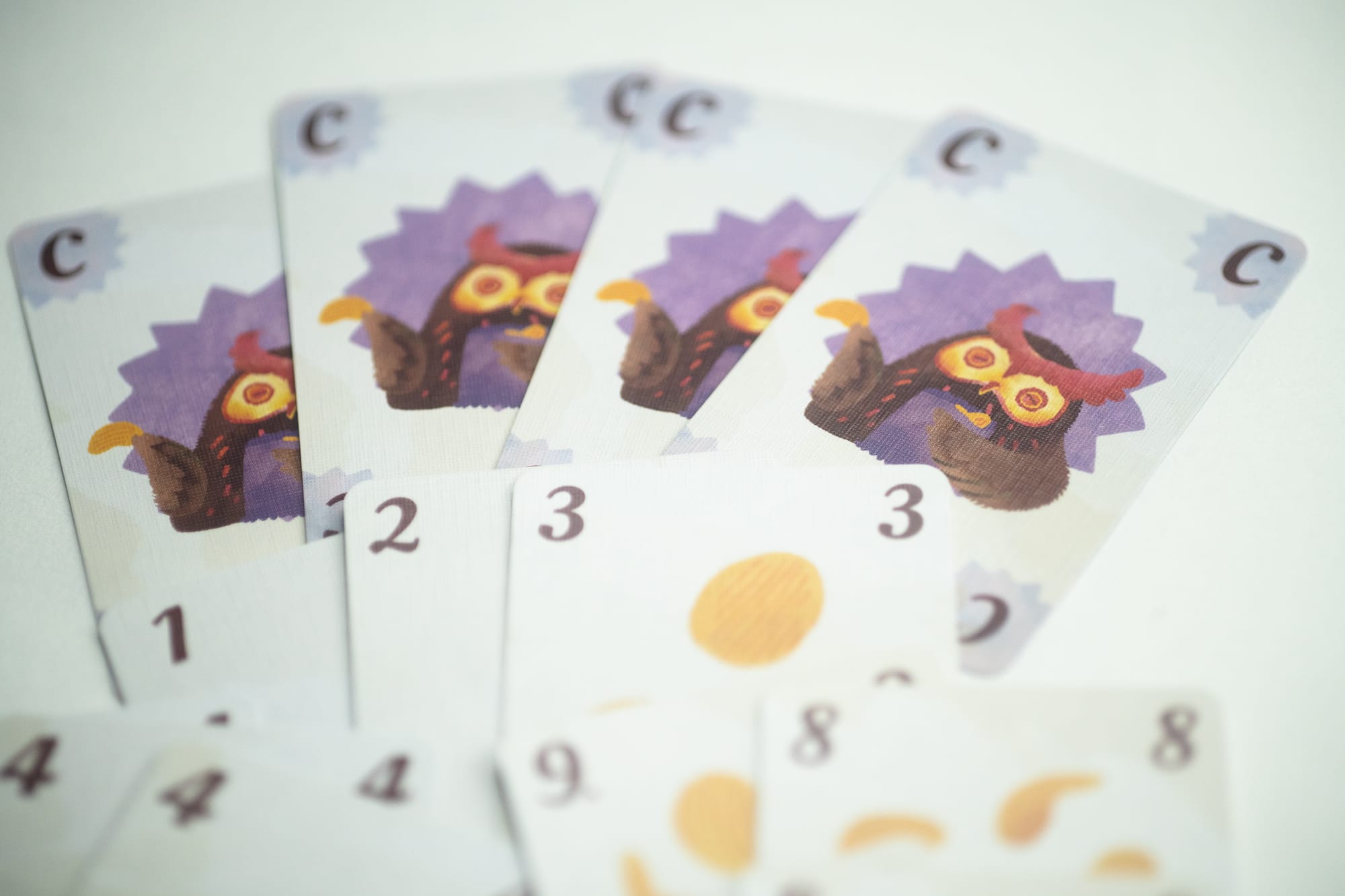
Crisps (Bhat, 2025) is a game I've talked about a lot in this newsletter, and I think with good reason — it's a blast to play. It's also regrettably out of print, but we're in luck, because this is a game you can easily play with a standard deck of cards. Crisps is a climbing game for two where you're dealt a healthy-sized hand of cards, and you'll be drawing a card every trick, win or lose. It's also a game that will actively deceive you about what you should do, because there are no suits, and melds can be flexible — singles, pairs, runs of at least three cards, stairs of at least two sets. Add in Crisp cards, which let other players play bombs, and you have a cornucopia of choice.
That flexibility of what you can play, married with a hand that starts on the larger side, means that you will be tempted to play lots of cards early on. If you do, you'll be swimming upstream, because passing in this game, especially in the first few tricks, will often put you in a stronger position.
Still, the goal is to get rid of your cards, right? You might think you can just play a few cards and be done with it, but true to the name, you'll be fighting to stop after just a few. (Though I guess thematically that means you're trying to be the first to eat your whole bag of crisps or something, which I must say, I'm particularly good at.)
Also consider:
- Bespoke (Bhat and Carter, 2025) is a two-player compendium climbing game from Shreesh Bhat. I haven't played it, but I intend to. It's also playable with a standard deck, so there's really nothing technical holding me back.
An earlier version of this newsletter omitted co-designer Bryce Carter.
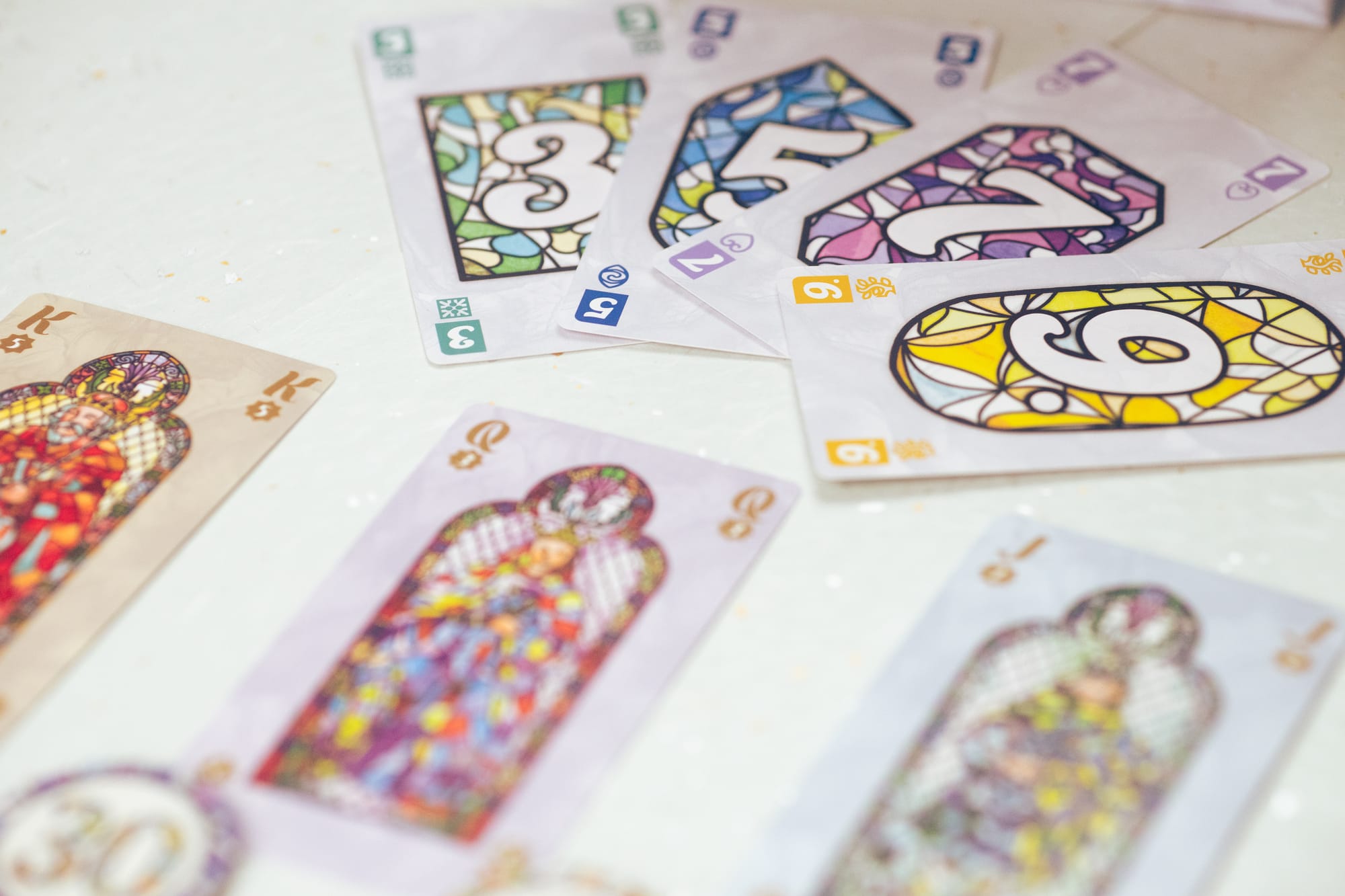
Haggis (Ross, 2010) isn't explicitly a two-player game, as you can play it at 3 and 4 players, but it absolutely shines as a two-player climbing game — and it also helped establish designer Sean Ross as one of the best two-player designers out there. I've written about it in more depth, so I'll actually just send you there instead of diving in further.
 Matt Montgomery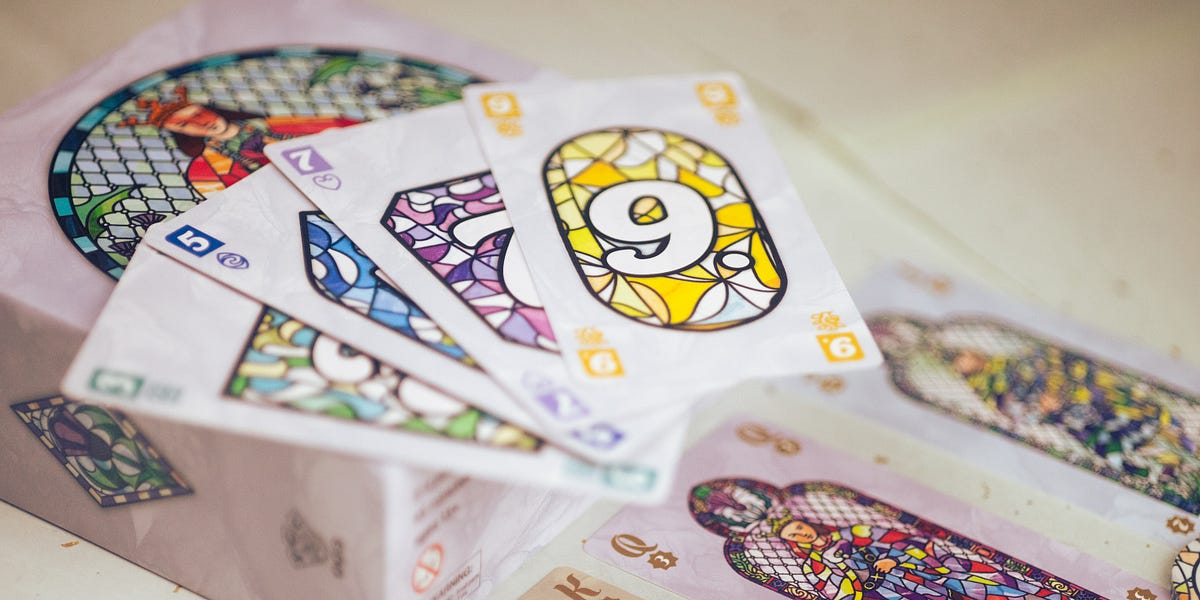
Also consider:
- Greasy Spoon (Ross, 2023) is a climbing game where each player has their own deck they're shedding through.
- Dickory (Ross, 2021) has a rotating rank hierarchy system that I just adore.
- Trifle (Ross, 2026), which I'll mention here for completeness' sake mostly, given it's hard to find right now — it's a two-player trick-taker inspired by the Italian traditional card game Briscola.
- Butterscotch (Ross, 2026), an unpublished two-player climbing game from Sean Ross (of Haggis) and Shreesh Bhat (of Crisps) — rules are available under a Creative Commons license on BGG.
- Yokai Septet (Yokouchi, 2018) is a fantastic partnership trick-taker, but it also makes for a remarkable two-player trick-taker thanks to Sean Ross's official variant.
Before we move on, here are a few more card games to throw into the mix:
- Lazy Bellboys (Shibu, 2024) is a trick-taking game where your cards' values change based on where they are in your hand. It gets weird.
- Lepidoptery (Karesh and Vasudevan, 2025) is, roughly speaking, Connect 4 (Strongin and Wexler, 1974) as a climbing game. It's good, even if you're thinking it sounds a little weird. It is weird, and that's great.
- Jekyll vs. Hyde (Geonil, 2021) — a two-player trick-taking game where one player tried to take some tricks (not too many, not too few), and the other wants to take either as many or as few tricks as possible.
- Lost Cities (Knizia, 1999) is a veritable classic game of expeditions, taking risks, and playing cards in ascending order. Every time I play, I find I'm taking far more risks than I need.
Fugitive (Fowers, 2017) pits two players against each other in a cat-and-mouse game, with an agent chasing a fugitive. It's a simple game, really: There are three decks, divided among the ranks of the cards. Each player will have be drawing from one of those decks, and the fugitive player will be playing cards from their hand in ascending order to escape. There will be gaps, and while you're generally restricted from playing cards with a distance greater than 3, you can use other cards in your hand to sprint further. The agent player will guess which cards have been played, and given they have some of the cards in their hand, there's a nice bit of deduction involved here.
Also consider:
- RUN (Dressler, 2023), also published by Fowers Games and set in the same universe. Rather than just cards, you're dealing with a two-dimensional map.
Splendor Duel (André and Cathala, 2022) disproves one of my hypotheses about two-player games. See, after a lot of thought, I'd decided that two-player takes on existing, successful games was unnecessary, and I thought the outcomes were generally worse. Azul Duel (Kiesling, 2025)? No thanks, I'll take the original. Agricola: All Creatures Great and Small (Rosenberg, 2012)? Sure, but why does it need to exist? 7 Wonders Duel (Bauza and Cathala, 2015)? OK, that's a great game.
Splendor Duel, though? That's a great game. It's slimmed down, but it also feels like a new game altogether. In Splendor (André, 2014), you're taking gems, biding your time, taking cards, biding your time, and then biding your time some more. In Splendor Duel, you're taking gems — but they're from a grid and you're both more restricted and more free than in the original. The cards you're purchasing may have abilities, too, which brings a certain richness to the game. Maybe you'll save up so you can take an extra turn when you purchase a card, or maybe you'll try to move quickly to get additional tokens in the early game. There's a lot to love here.
 Matt Montgomery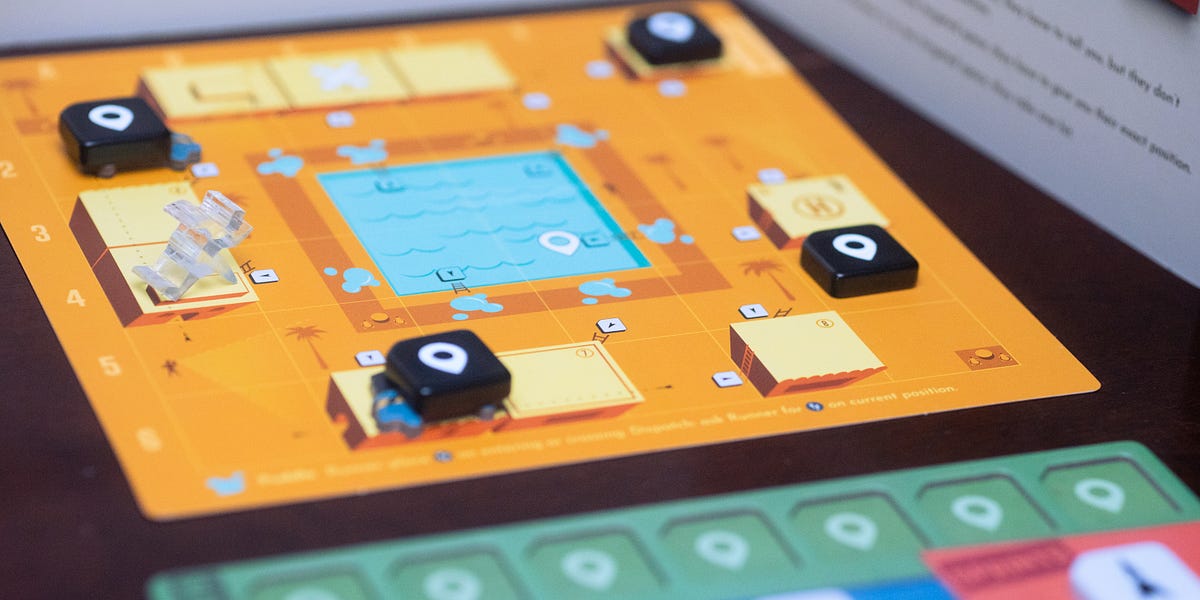
Thanks, as always, for reading Don't Eat the Meeples! The summer's always a chaotic time, so thanks especially for bearing with me as we switch ad-hoc to a bi-weekly schedule.
Next time: Games from 2016! (I think.)