The 27 trick-taking games I played at TTUTCON III
Year three of Utah's premier trick-taking convention had me playing plenty of incredible games.

Another year, another TTUTCON (the Trick Takers of Utah Convention), and I’m here once again to tell you about the plethora of trick-taking games I played.
We’ll start as usual with the pre-convention games, and this year, I played two games with my friends Dave and Rick, who stayed at the convention hotel this year. We started Thursday night with two great trick-taking games.
3 Witches (Young, 2025) is a quick two-versus-one (should I call it a variable partnership game? Perhaps! Is that overstating it? Yes.) trick-taker where players bid to be the lead witch, and they’ll play against the two remaining players, who are the lesser witches. The lead witch plays two cards, which face off against the lesser witches’ cards. You’ll only play five tricks, and it’s perfect for those moments when you have three players for a game.
Tandem Trick (Shinohara, 2026) is probably my game of the convention. It features a mid-hand bid, where you’ll place a bid using one of your cards instead of playing to the trick, which is a feature I’ve enjoyed in trick-takers. See also: Nokosu Dice (Matsumoto, 2026) and Xylotar (Wray, 2024), two great examples of the mechanism in action. It’s pretty generous with scoring, as you get points even if you miss your bid, but the rest of this game feels anything but generous. Well, sort of.
See, in the must-follow Tandem Trick, if the player to your right has played on suit, and if you are playing on suit, you can combine the card you play to the trick with their card. And if you do that, and the combined value of the cards is higher than any other card in the trick, then you win the trick, and so does the person with whom you’ve joined forces. If that just happens to make them miss their bid on the last turn while you hit yours? Well, that’s just Tandem Trick.
A great way to start the weekend, and starting it in a hotel lobby at 11 p.m. was exactly the way to get fired up. And maybe to not get as much sleep as I needed, but, uh, what’s new, right? Let's move to the start of the convention on Friday.
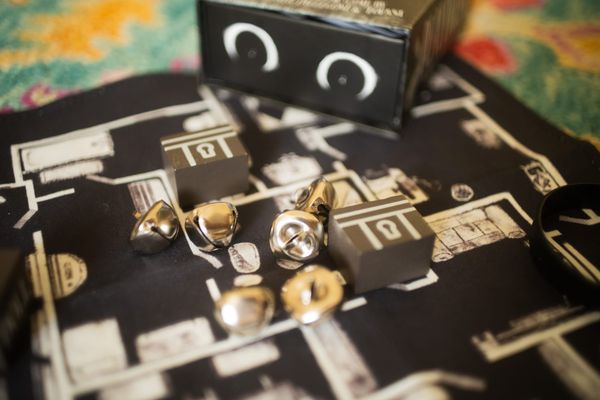
Many Stories Mansion (Kim/Reader on Jupiter, 2026) is the latest outing from the oddball publisher and designer behind titles like Match Fixer’s High / Too Sloth to Win (2025), The Magic Shop (2025) and Quack-Quack, Corrupt Ducks (2022), among others. Like many of their efforts, the game comes packaged in a non-traditional way. Some of their games come in DVD cases; this one comes in a little plastic container — maybe the sort you’d get some whole spices in or something. (I’ve bought cardamom in a container very similar.) All that’s not really about the game, but presentation is part of a game, right?
It’s the game I played most at TTUTCON, so it’s worth talking about the actual gameplay and not the plastic in which it’s packaged. This is a climbing game with rankless cards, with each suit showing a three-square shape. Each meld you play, each of which comes from sequential spots in your unsorted hand, will end up placed to form a house that grows through the course of the game. At the end of the game, you'll count each of the shapes you’ve fulfilled then multiply that by the height of your house (er, mansion!) to get your final score.
There are two reasons this ended up my most-played game of the convention. First, I played it early and taught it a few times later. It has a unique look on the table, and it’s one of the big games of the last Tokyo Game Market release cycle. There were plenty of people that wanted to play it, and I was happy to play it again. Second, it’s just a good game — why not play it a few times? I felt like I didn’t crack it the first time, and I never quite did after four plays. It didn’t feel like an “it’s not possible” problem, but an “I’m not good at it yet” problem, and that’s such an important difference.
Trickarus (Cannon, 2024) is a game I’ve played a bunch of times now, and I’m typically excited to play it every time it comes out. It’s a must-follow trick-taker with two big pieces of interest. First, each card has two values, a night value and a day value. The game starts in the day, when the day suit is trump. When any 5 is played to the trick, it flips to night (or day, if it’s already night), and the trump suit flips, too. And that would probably be enough for a good trick-taker, but Trickarus is a great trick-taker. It features a tricks-won track, and at the top of the track is the sun. If you ever win more tricks than the track, you fly into the sun, and you plummet below the lowest player. The game ends in any round in which a player has flown into the sun, and you jump each other on the track. As a result, this game can get mean — you might force somebody into the sun, or you might leave somebody well behind the pack, or maybe you’ll even try to fly into the sun early in a round, only to return and claim the victory after you reach the top again. The possibilities are endless.
Dickory (Ross and Sonderegger, 2021) is a two-player climbing game with a rotating rank system and a little conveyor of cards. The rightmost card in that conveyor is the top rank, but you can also take cards from that conveyor (this really could have been sushi themed, though a clock is also a nice metaphor) to add to your meld when you play it. Now, when you take cards, you could also be adjusting the ranking of your cards, so there’s a bit going on here that you have to weigh at any given moment.
Nirvana (Chikasuzu, 2022) is a shedding game, and the card play is straightforward: Get rid of your cards first by playing singles and sets, following with sets of the same size and higher values. The rest is anything but: You have a board on which you’ll be writing numbers from three rolled six-sided dice, and then you’ll be summing numbers in columns. Those summed values become the cards you have to play in the round. When you ‘play’ a card, you just cross off a number. Nothing about this game should work particularly well, but it’s actually a great deal of fun when somebody comes flying in with a single 21 after you play a single 4, especially if you somehow have a 22.
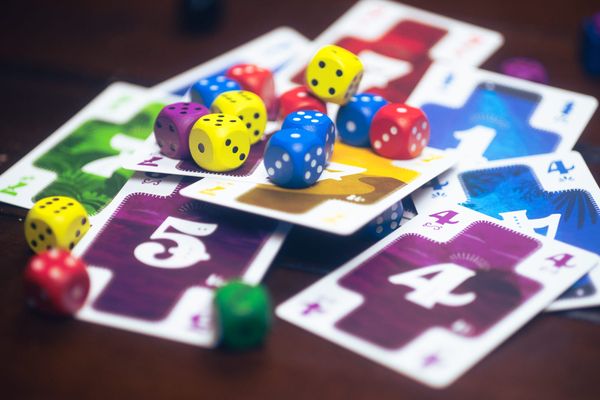
Piplus (Kuji, 2025) I wrote about this climbing game after attending T3C in February, calling it one of the games of the convention. It’s a card game with dice (more of these, please!) where you can strengthen your melds with those dice you rolled. It remains one of my favorites of the last year, not least because plays made stronger by using dice immediately become weaker, and I think that’s just a lot of fun. You might think you’re out of contention one second, and the next, you’re right back in the mix. That’s such a fun feeling.
The Tricktaker’s Guide to the Galaxy (mor!, 2025) remains the best-ever implementation of No Thanks! (Gimmler, 2004) in a trick-taking game. It’s also the only one, but it’s still great. I played this at T3C in February, and I was pleased to play again. I’ll also be pleased the next time I play, and I’m starting to think that maybe every game deserves to have No Thanks! as the first half of play.
Neko Neko Racing (2019) was perhaps a bit of an odd duck amongst the otheres at TTUTCON, partly because it did have a little racetrack board you move pieces around. The rest is honestly kind of a blur. I think I won. Having checked my plays, it appears I definitely did. Alright!
Karaoke Trick (argent, 2025) is such a lovely little game. You’re reserving cards from your hand to act as lead when you win a trick, and if you don’t have any cards when it’s your turn to lead, it passes to your opponent. We did have a funny moment where we all scratched our heads about why our card count was uneven, but we eventually stumbled on the answer: it’s by design; when you reserve a card instead of playing to a trick, it’s still something in front of you, and you might end up playing from it. Anyway, great game.
Hattori Trick (Mukai, 2026) is a five-player-only trick-taking game with a may-follow approach, at least to a certain extent. Each trick can have only two suits, so it’s really only absolutely a may-follow game in the first two cards played to any trick, but just because we don’t have a specific term for this doesn’t mean it’s not also may-follow. Ahem. Anyway. One of your suits of cards you collect becomes your points-earning suit, and the rest you collect are points-losing suits. Your highest-ranked card in your winning suit — after removing as many cards as you have in other suits, starting at your highest rank — is your score for the round.
Skull Queen (Dorra, 2024) was, I think, my favorite game of the convention at TTUTCON II in 2025. (It might have also been Fishing (Friese, 2024), but it was certainly close. I did write that Fishing was it, but for the purpose of conversation, we’ll say it was Skull Queen.) It’s still great. You’re playing tricks that will move little wooden folks up and down a plank, and if you’re lucky, none of them will fall off. Or maybe all of them will. You never know.
Dead Channels (Newman, 2026) is a trick-taking game where you alternate between playing a must-follow and a must-not-follow game. Whenever you can’t obey the rule of the game, it flips rules back the other direction. It’s fast, and it’s pretty clear it’s designed for trick-taking afficionados. (Or as they’re more commonly known, trick-taking sickos.) It’s a perfect breather between bigger games, and I think there’s just enough meat on the bones to make it an interesting game, but not so much that it overstays its welcome.
The Women Zeus Loved (Shibu, 2026) is from the designer behind Bid Coin (2024), and there’s sort of a throughline here that I find interesting. It’s not as good as Bid Coin (that’s a great game), but I think there’s something here. (I haven’t confirmed that, because I think this might be best at four players, and I played at three.) In this one, you’re trying to win tricks in specific suits at specific times. You’ll track your won tricks, and every time you win a trick where, after counting the currently won trick, the number of tricks you’ve won matches one of a set of cards (for example — for one suit, it’s 2 or 4 tricks, for another, it’s 3 or 6, and so on and so forth), you’ll flip the top card of that trick face-up. (It’s easier to explain with a visual aid.) If the rightmost card of your set of tricks is face-up at the end of the round, you’ll take no points. Given points are bad, that’s a great accomplishment.
Sumidagawa Red Town (Mashikamaru, 2026) is a climbing/shedding game that reimplements the cult classic Sumida River (2023), and it’s sure nice that this game is (at least slightly) available, with the original being very much out of print. (Tangentially, it’s a bit funny that Sumida River hit cult classic status after just three years — but it did. I wonder how much we see that moving forward.) It’s also one of the more difficult climbers I’ve played, and I just can never seem to come to grips with it. Interestingly, while the ranks keep climbing, the meld type doesn’t need to — in a way, it’s a must-not-follow climbing game, because you can’t play the same type of meld as another player in a single trick, you just need to have higher cards. I suppose I need to play this one more to really get good at it, but there’s just something about the way you work your melds that’s throwing me for a loop.
Le Plateau (Brown and Gallardo, 2021) is my favorite convention game. At some point, I’ll write about this game on its own, because there are layers here. It’s a must-follow, must-trump trick-taker played with a French tarot deck, and you’ll be playing an abstract area control game on a board based on the cards won in a trick. You’re bidding to take control in the area control portion, and unless you’re very ambitious, you’ll be making a bid with a partner. This one’s just such a perfect game for trick-taking wonks.
Quaternion Trick (Lepka, 2026) is a self-published trick-taker for three players, except it’s actually a compendium of four trick-taking games that all follow a base set of rules. Cards range from -2 to 6, there are three suits, and if two cards of the same suit (with one off-suit) appear in the trick, the two cards cancel each other out. If there are three different suits, they all cancel out. We only played one of the sets of rules in the game, and it was after 11 p.m., so it’s a little hazy still, but games with friends is always nice.
We'll move here to Saturday, which was a bit less jam-packed — though I did play plenty of games I really enjoyed.
Riffifi (Dorra, 2000) is, I think, great evidence of the progress made in the board game hobby over the last 26 years. It’s sort of a combination between a climbing game (high cards turn over low cards of the same suit) and a may follow trick-taking game (you can play any suit you like), though it certainly wasn’t designed with that intention. Stefan Dorra is one of the more interesting trick-taking designers, but I think 2003’s Die Sieben Siegel — most recently Sluff Off! — has quite a bit more to offer.
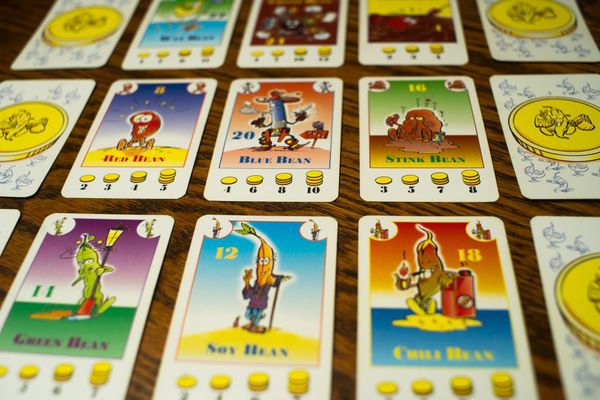
Dealt! (Stremmel, 2018) is one of the earliest climbing examples of a card game in which you can’t rearrange your hand (though we shouldn’t forget Bohnanza, which I’m now going to call a beanstalk climber, even though it’s not a climbing game at all — anyway). You can only play cards from your hand that are adjacent, but if you pass, you’ll grab one of two cards in front of you. When you’re out of cards, you have to discard a life token. Discard all of them, and — guess what! — you’re the single loser.
Stich-Meister (Friese, 2010) is begging for an English-language release. There’s a German edition, a Japanese edition, and a Korean edition, but there’s not an English one. That’s important because in this trick-taking game, you’ll be starting each round by playing a rule card, which are shuffled then revealed. The rules you add might add a scoring mechanism, one or more trumps, what cards can legally follow, and so, so much more. This game is full of surprises, and now that I’ve got a copy, I just need to figure out how to read Korean. Easily the most laugh-filled experience of the con.
Shadow Cards (Haviland and Kamp, 2025) is a game with secret bids. Who doesn’t love a secret bid? The secret bid is made with cards from your hand. And who doesn’t love making a bid with cards from your hand? There’s a fun trickiness here, as I was left uncertain how to bid every round. Giving up high cards to my bid meant that I’d have to work harder to make a high bid — but the same can be said of giving up low cards, too. Such a tricky little thing. Anyway, Mike told me I won a couple days later, and I thought that was 1) very noble of him, and 2) surprising, because I had forgotten I was even close.
DuvidaÊ! (Martin and Torselli, 2026) is a bluffing game. It’s also a climbing game. The premise is simple: Play sets of higher cards or larger set sizes, and you can either do it by having the cards in question or pretending to have the cards in question (or, like in every great bluffing card game, pretending to not have the cards in question.) Only the top card of each meld is played face up, so there’s not even an option in which you publicly tell the truth. If you’re accused (and you will be) of lying, the player who was in the wrong, whether it’s you or your accuser, will draw as many cards as were played, plus any bonuses on the cards. I dunno, I think this one could easily make it into the family games rotation.
Doppelganger Tricks (Mashiu, 2025) has three suits and one ‘doppelganger’ suit that can be played at any time of the player’s choosing. The doppelganger suit takes on whatever suit is led, which can lead to one slightly troubling (or exciting!) outcome: If a doppelganger card and a lead-suit card with the same rank are played in the same trick, they cancel each other out. Or, in the game’s terminology, they annihilate each other. (I once thought I saw a doppelganger of somebody I knew at the grocery store. It turned out to be his brother, which is a relief, as I don’t think either deserved to be annihilated.) I don’t think there’s any historic precedent to that, which makes me think the doppelgangers here exist in some sort of closed-time-loop paradox or something. I do understand there’s a Poe story that might correspond here, but I haven’t read it. “William Wilson.” I think it’s probably in the Poe collection I have in the basement.
Oh, anyway, yeah. I really enjoyed this game and am already plotting an opportunity to play it again. See, there’s a real excitement when things happen in this game. It gives you a very clear opportunity to impact your opponents’ attempts at meeting their bids. That’s such a fun feeling.
Fisherman (T, 2022). Did not finish, but we played around, and it felt — I dunno, fine? For so many of the other games being remarkable, this one felt like it just didn’t quite have a grasp on its unique qualities. Each round features players choosing scoring suits, rank order, trump suit, and a pain suit. Maybe the shifting rules just didn’t feel that great in comparison to Stich-Meister, which hardly feels fair.
Crisps (Bhat, 2025) had me feeling like Worf in “Parallels.” I failed to retain my 2025 crown, and I should have recorded a video talking about coming in fourth to send home. (OK, except Worf talked about an illegal maneuever in one of the universes, and there was none of that here.) I made it out of the group stage, but I got whomped in the first knockout round. Tragic, really. Congrats to the winner!
Maskmen (Sasaki and Shinzawa, 2014) is still a cool climbing game, what with its no-ranks and professional wrestlers. And I think it still has something cool to offer, but I think maybe at six players it’s just gone a bit too far. Too oten, play would get caught up several times before it made its way to me, and I just had a couple matching cards to play. I’d probably cap this one at four or five in the future. (Still, I enjoyed playing — it’s both a fun time and always interesting to see the roots of the designers we love.)
Tournament at Avalon (Boginski, Boginski-Barbessi, and Shannon, 2020) is a trick-taking game that sometimes feels like it’s uncomfortable being called a trick-taker. Tricks aren’t tricks, they’re melees. Cards canceling each other ount are feints. Being unable to follow is being shamed. It’s not a bad thing, per se, but it’s a funny thing at a trick-taking convention to feel a little tangled up in the language around trick-taking itself. Anyway, I don’t mind this game, and I’d play it again, but I think it might actually be a better game to play with folks who aren’t really into trick-taking.