Scythe, a decade later; some 2026 Tokyo Game Market trick-takers
How does one of the top games of 2016 fare a decade later? Plus a look at some interesting trick-takers in my bag this week.

Somehow, I completely missed writing a newsletter last week. And by somehow, I guess I mean that the causes are all pretty well known: We celebrated our kid’s third birthday, my parents visited, and all of that conspired to have me just not thinking about Don’t Eat the Meeples.
And you know what? I’m actually really happy about that. I’m happy that I can take a week off and there’s not an algorithmic beast to feed. My only goal is to write a newsletter that you enjoy reading, and I’m also hopeful that other people can find the newsletter and subscribe if they think they’d enjoy more. That’s it. I recognize I’m lucky in this regard. Anyway, that’s a bit of a detour, and if we’re being honest, it might also be a little bit of procrastination, because I’m still sort of figuring out what I’d like to write about. And as a result, I’ve got a little bit of a grab bag for you today.
How does Scythe hold up a decade later?
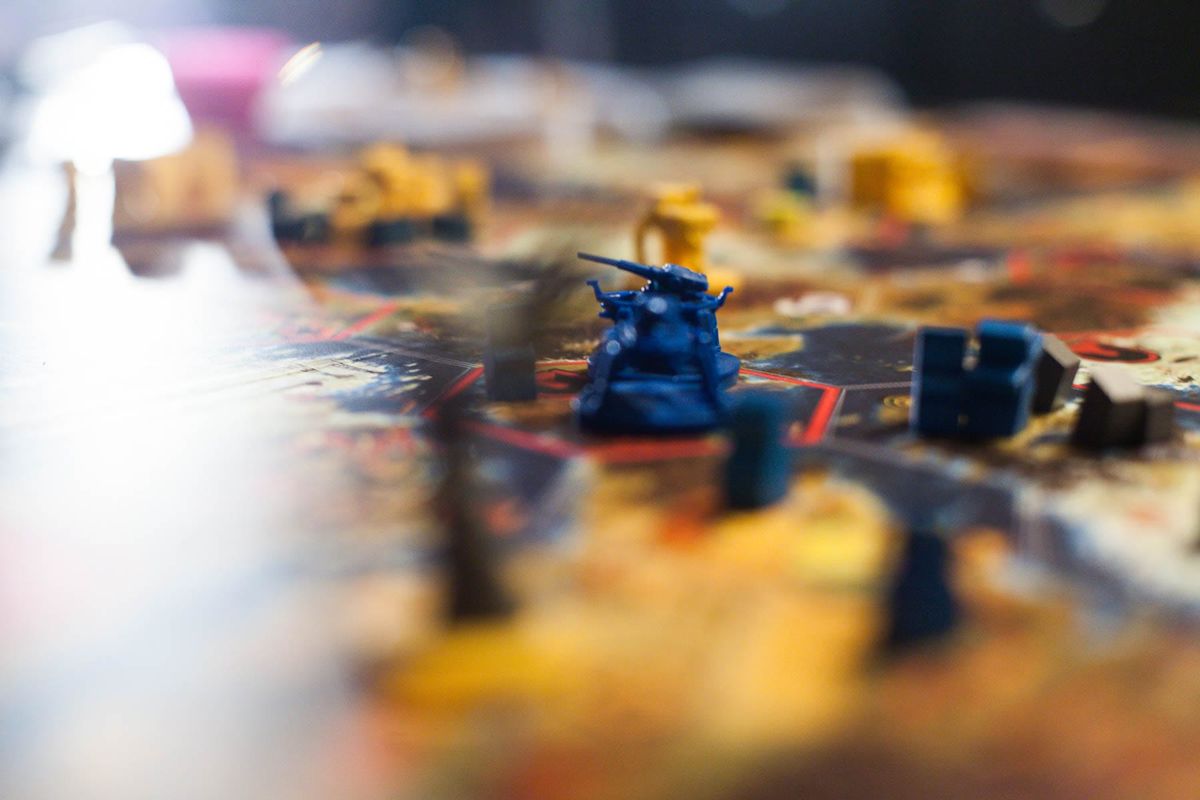
It can reasonably be argued that Scythe (Stegmaier, 2016) is one of the games that really helped cement Kickstarter as a place to find exciting new games. Fundamentally, it’s sort of a resource management game, where the resources you produce allow you to improve your abilities moving forward. It’s also a game that looks like it’s a bit intense and conflict-heavy — I think that’s a bit of artistic magic, though, because outside of some key moments, Scythe doesn’t feel like a game where conflict matters all that much if nobody at the table pursues it.
All that’s a little inconsequential to how the game holds up, though. I think the answer is: “Well enough,” but I also think it’s clear why the game isn’t really a hot commodity anymore. If you’re looking for a game with great resource management, you’ll find it. If you’re looking for a game where you build up your resources over time, you’ll find that, too. Those aren’t exactly hard things to find in these medium-heavy-ish-weight games. There are a fair amount of moving pieces, but each turn is pretty simple as you’re just selecting from one of four (or five, if you’re trying hard) actions to take. That’s a difficult balance to strike — you can teach Scythe to somebody who’s not super experienced in games, if they’re particularly interested — and I think that’s much to designer Jamey Stegmaier’s credit.
I think if anything doesn’t hold up well, there are two things I’d consider. First, I think the art and design is a bit muddy on the table. It can be a little tough to see what’s going on at a glance. This is an area where Stonemaier Games has really improved, and I think it’s fair to say that the whole of hobby board gaming has improved on average. Still, it’s something that I’d change about Scythe, given the opportunity.
Second, I think the encounter cards, which present three options, each of which benefits you, just don’t quite work for me. I understand the intention, but they can be pretty swingy, and happening upon the right encounter card at the right time can really give you a boost. They were some of my favorite game moments when I first played it, but having seen them all, I’m often prioritizing them for a bit of a hopeful moment. They’re just not that immersive, especially compared to what Stegmaier did later with Vantage (2025).
Still, I think it’s a very effective game, and I still like to break it out. I don’t really ever play with the expansions, aside from the ones adding additional starting points on the map. It’s not that they’re not great, it’s just that I don’t really feel the pull. If I’m going to play Scythe a few times a year in person, I’ll probably just want to play with the base game.
The trick-taking games I brought for a work game night
I’ve traveled recently for a work gathering, and I thought it would be worthwhile to put together a work game night — it hasn’t happened yet, so this isn’t an accounting of what I played, but rather the games I bought with an eye toward maybe playing a few of them. Several of these games are new releases from the Spring 2026 Tokyo Game Market, an event where there’s a ton of trick-taking experimentation happening. Those games are as follows:
- The 32nd Day of the 13th Month (6jizoGames, 2025) — a climbing-shedding game where the deck runs 1 to 32, melds can loop around (a 1-2-3 would beat an initial 20-21-22, for instance) but only once, and the last player to play collects all of the played cards. Once a player runs out of cards, everyone scores (bad) points for the cards remaining in their hands. A fun bit of balance here.
- Bested Another Time (Reiner, 2025) — a climbing-shedding game where you’re incentivized to pass early by being given a chance to pick from a set of player-count-specific incentives. Even when all players but one pass, the round doesn’t immediately end — the last player can continue to climb. You might want to pass to get a great ability next trick, but at what cost?
- Chocolate Mint Trick (Yuya, 2025) — Once you get your hand of cards, you’ll rearrange them as you’d like. You’ll only get to play cards to tricks from either end of your hand, though, so you’ll need to arrange carefully. After each round, you’ll take part in a draft to add cards to your hand, starting with the player with the least points, so winning might not always be in your best interest. (Or will it?!)
- Daytime Minutes (Babakitis, 2026) — a trick-taking game that makes me a feel a bit old, having lived the ‘daytime minutes’ era of cell phone plans. There are two types of tricks, daytime and evening. Cards played during evening tricks are discarded face-down, but cards collected during daytime tricks contribute to your minutes usage. Go over and you’ll lose a SIM card. Use the fewest minutes and you’ll lose one, too. It’s such a novel theme, but I do wonder what a young person who’s never gone through that (very minor) pain of metering their cell phone usage will think.
- Hot Dog (Babakitis, 2025) — a four-player variable partnership trick-taking game where your cards have a bun value and a hot dog value. You might end up in a 3-versus-1 game, a 2-versus-2, or even a free-for-all. And perhaps most wildly, the trick will always alternate bun-hot dog-bun-hot dog, your partner might be sitting next to you, and hot dogs have suits but buns don’t, so they’re always on-suit. Bit of a wild one, this.
- Karaoke Trick (argent, 2025) — a trick-taker where you’re playing cards to the trick or to your face-up reserve. When you lead, you always lead from your reserve, starting with the oldest card played there. It’s got a great scoring concept, too: The player who wins the most tricks gets a point per trick they win, and every other player gets a point per card they won. And because players can play to their reserve at their whim, you might get folks trying to set you up in the worst of ways.
- Pop Art Trick (Hashimoto, 2026) — a trick-taker where you bust after collecting eight or more cards. This has a couple great twists: First, the deck construction is unusual in that there are three fives, the highest-value card in each suit, but fives played of the same color cancel each other out, so somebody else might unexpectedly win a trick. Second, you’ll play a bid card from your hand, and you earn points if you exceed your bid, but your bid card can also be played to the trick, giving you an opportunity to set a new bid. Clever little game.
- Silent Guardians (Nakata, 2026) — a cooperative trick-taker where you’re playing sword tokens atop tricks to ‘seal’ them. The sword tokens are distributed at the beginning of the game, and you seal the tricks you win, so there’s a lot to try to figure out here. Oh, and you don’t actually see the values of your cards — it’s a bit luz (Shinzawa, 2014) or Xylotar/Magic Trick (Wray, 2024). I clearly love cooperative trick-takers, and I’m excited to give this one a go.
- SQUARE (Sato, 2026) — a shedding game where you play sequences of cards, including multiples of whatever numbers you’d like — but let’s say you play 2/3/4/4/5/6 (totally allowed!), you’d have to draw four cards, one each for 2/3/5/6. I’m really looking forward to trying this one out, because the concept is pretty straightforward, but the consequences of your actions might not be.