Why Vantage fits in the canon of classic adventure games
Vantage belongs on the shelf next to the King's Quest games.

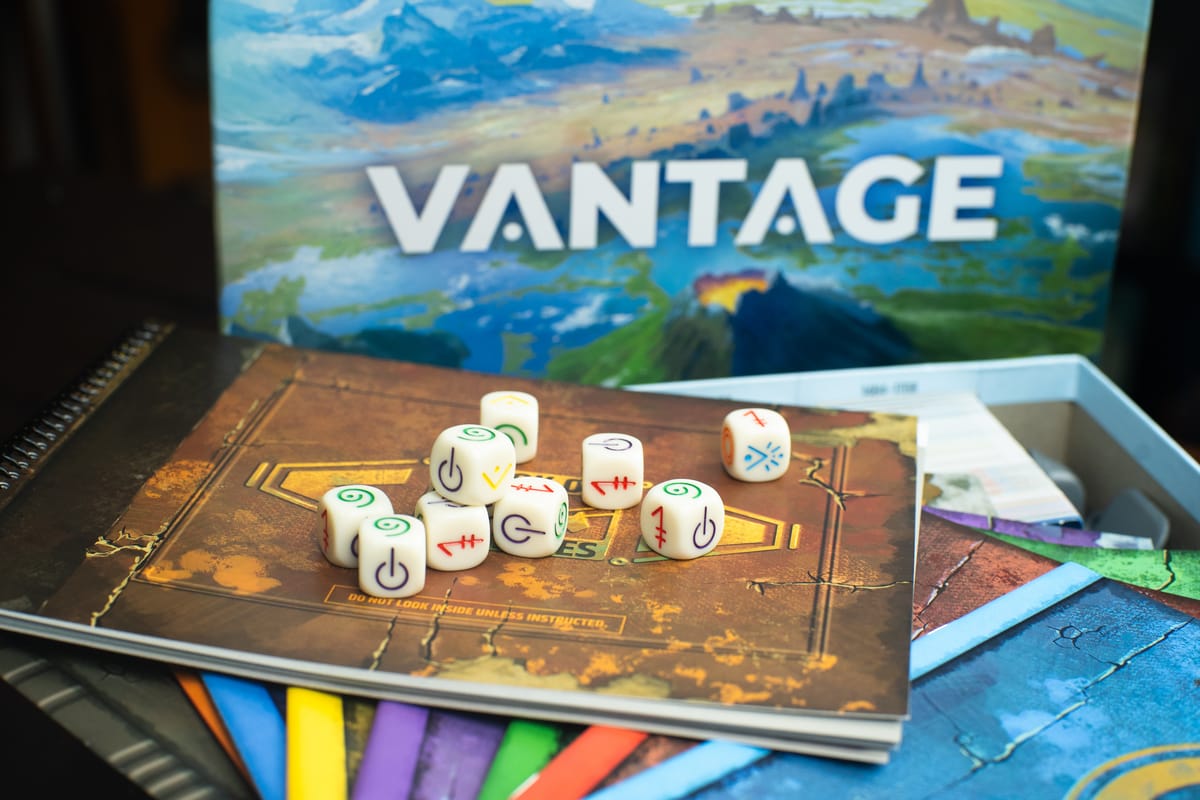
Every so often, I play a board game that reminds me very distinctly of my childhood. Not in a board-game-playing sense — I loved board games as a kid, but the games I played typically weren’t great. (The wealth of great games my kids will have available as they grow up gives me hope that they’ll not befall the same fate, playing disappointing games of Mouse Trap and tedious games of Monopoly.) It instead makes me think about the many, many hours I put into point-and-click adventure games and graphic adventure games, the save-load-save-load pattern during difficult sequences, the time spent hunting for just the right object to solve a puzzle.
I grew up a Sierra kid. I loved the King’s Quest and Space Quest series. I was so excited to get into Quest for Glory; as a 10-year-old, I learned how to play Mancala from Quest for Glory III: The Wages of War. (I also clicked on a wall hundreds of times to increase my climbing stat. It was not a perfect game, but I loved it.) Myst was a fascinating game to play on my grandmother’s computer, though I never knew what I was doing as a preteen and mostly just clicked around aimlessly, marveling at the art. I fell in love with Zork’s first graphical outing, Return to Zork, though I was never attentive enough to play through the text adventures preceding it. (I should go back and play more LucasArts games — one of these days.) These are games that have stuck with my throughout my life, with specific moments just sort of floating around in my thoughts on a near-daily basis.
Every so often, I play a board game that reminds me of these adventure games. Sometimes it’s a game that explicitly calls back to the idea, like the entries Adventure Games (2019–present) series from Matthew Dunstan and Phil Walker-Harding or the Cantaloop trilogy (Findeisen and Kobiela, 2020–2023). Sometimes it’s the puzzle construction, like the EXIT (Brand and Brand, 2016–present) or Unlock (various, 2017–present) series. It might even just be the mechanical talk-to-folks-and-investigate feeling, like the Detective series (2018–2022) or Chronicles of Crime series (2018–present).
Even more rarely, a game captures the feeling of adventure those games gave me. I didn’t know the worlds were so severely limited as kid; the 35 screens depicting Tamir in King’s Quest IV: The Perils of Rosella might as well have been numbered in the hundreds. That sense of adventure, the feeling that I was exploring a world — that feeling was elusive. The best open-world video games today can bring that feeling back, but none of the board games I’ve mentioned here have quite hit the mark in terms of those old feelings. They lack that adventuring spirit, despite featuring a mechanically similar approach to play. Those old adventure games existed in those forms to work inside the technological limitations, not because point-and-click or text-input was the best way to tell those stories. When new games adopt those same limitations unnecessary, we’re left with something that just doesn’t quite reach those same heights.
One game I played last year felt like a classic adventure game in spirit, and it was one of the top games of the year on a number of lists. Vantage (Stegmaier, 2025) is a game with hundreds and hundreds of cards and more than a half-dozen story books.
The world you explore in Vantage isn’t shifting, it’s not changing, but your view of it is. When you visit a location, you’re faced with a selection of actions you can perform, as well as corresponding entries storybook entries for each. Those actions come in seven varieties: move, look, engage, help, take and overpower, and navigate. Each action will lead to a new location and a new set of actions available to you. You might gain new objectives or a new mission. The decisions with which you’re faced will materially impact your game — will you stumble into a trap, face off against a foe bigger than you expected, or discover a wealth of information that’ll guide your actions? Will you come across an unexpected puzzle?
When I play Vantage, I feel like I’m playing an adventure game again. It’s not that it’s built like a point-and-click game, but almost more like a classic interactive fiction game. I’m not literally typing ’N’ for north and being given a description of my new locale — but it’s not far off. When I decide to perform an action, I’m not literally typing ‘search room’ or ‘take towel’, but again, it’s not far off. You don’t know what will happen in advance of your performing the action — that discovery is the game.
Vantage is an unusual board game. It’s a game that feels like it perhaps shouldn’t work. A game with over 800 locations to explore seems like a game that’s bursting at the seams — and it is, but it’s more graceful than that. A game with another 900 cards — items, discoveries, missions, things I cannot describe for fear of spoiling the secrets covered here — isn’t the sort of thing that you’d expect to just, you know, work. But when I’m wandering through the desert, I feel like Gwydion in the desert west of Llewdor. But where that desert had four regions to explore, and you quickly saw them all, Vantage features an untold number. (Really, I have zero idea how many desert locations there are. Have I spoiled something by telling you there are at least some? I don’t think that’s a big spoiler.) When I climb through the mountains, I feel like I’m exploring some vast, unknown region, and that I better pick up any interesting items I find there, because I surely won’t be able to find my way back.
That’s the feeling the game aims for, that sense of discovery, that sense of having a vantage over the land you’re exploring. There are stories to be told here, but equally, Vantage isn’t interested in telling those stories long-term. Each time you play, you’re starting completely fresh. Items don’t carry over, you don’t get experience, and you don’t get to upgrade anything in your play. It’s where I thought the game might have the greatest difference from the classic adventure game, where the story is the reason you’re exploring at all. I thought that, but I think writing about it changed my mind.
When you’re exploring in Vantage, you’re coming to an understanding of the game world around you. You might have a completely new experience each time, exploring new locales and not coming close to areas you’ve been before. But sometimes, you might end up near somewhere you’ve been before — you might stumble in the desert across something you’ve seen before. You could follow the same path, if you remember it. You could go the opposite direction. You could just try things you didn’t try before, seeing what happens when you interact with the game in a different way. There’s something deeply satisfying about encountering a place you’ve seen before and knowing what you would do differently this time around.
Each time you play Vantage, you’re getting a glimpse (a vantage, you might say) of the story the game’s holding inside. It’s easy as an adult to look back at a Space Quest game and see a linear story that I could now just waltz through, but the reality is so different. We might look back at the endless item puzzles as a design flaw, but it never felt like that at the time. It sometimes felt annoying, having to go back to the same location and try something totally new, but a flaw? I don’t know. Vantage is a game that rewards you for coming back and waiting for the eagle feather to drop.
It can be tempting for me to describe Vantage as an open-world game. It might even at times feel like a roguelike game, in that you’re starting fresh in the same world each time you play. But I think all of that ignores that this game is, at its heart, an adventure game. It’s not just that you’re moving around, collecting things, and interacting with people through scripted readings, though that is a clear ancestry for the game. (If it’s a coincidence, and designer Jamey Stegmaier is coming at this game without adventure game experience, then I’ll be greatly surprised. Of course, he describes it as an adventure game himself, so I think we’re probably safe here.) It’s that sense of exploration, that necessary patience, the trial-and-error that really makes this an adventure game — it's just an extremely ambitious analog take on the genre.
Vantage is designed by Jamey Stegmaier, illustrated by Valentina Filic, Sören Meding and Emilien Rotival, and published by Stonemaier Games.