Three things on my mind this week
A bit of a grab-bag Thursday for you


Hello, hello, and a good morning to you if you’re reading this, well, in the morning. If you’re not, then you are welcome to insert your own, more appropriate greeting in its place, or you can just assume I am wrong about the time of the day. It is your choice, and I’m not too bothered either way.
I don’t have a long-form, in-depth look at anything for you today, so I thought I’d take a little bit more of a grab-bag approach to this week’s newsletter. I’ll start by looking at three games I’ve played recently, then I’ll talk more broadly about a subject (playing games with my kid), and we’ll close with a look at some data around the ‘trick-taking renaissance’.
Three games I’ve played recently
I love games where I get to build something. TEAM3 (Cutler and Fantastic, 2019) gives players a set of blocks, a stack of cards with difficulty rankings, and three roles. Those cards depict a structure that must be built throughout the turn. One player will be building, but they must have their eyes closed. Another will be describing what the first player must build, but they can’t see the schematic. The final player can see the schematic, but they can’t speak. The structures, even at the hardest levels, aren’t overly difficult or taxing to build, but that’s not the point here: The difficulty is in the communication restrictions, not in the outcomes. It’s one of those rare games that’s designed specifically for three players, and there’s not really any way to do it otherwise.
I’ve been knee-deep in a game of Dead Cells: The Rogue-Lite Board Game (Bauza, Lebrat, Maublanc and Rivière, 2024) on Board Game Arena, and while I’m sure it’s a good game in person, there’s so much to love about playing it virtually — even beyond the normal setup-teardown constraints. I feel like I’ve seen so much of the game in the last week or two, and it’s a highlight of my BGA time. The game itself is a take on the side-scrolling roguelike action game of the same name, and while the two share an identity in many of the accoutrements, the board game is a totally different experience. The board game has players cooperatively fighting through various levels, earning cells and golden teeth (it’s thematic, I guess), earning game-start upgrades, and fighting enemies in a nice turn-based system.
With an all-star design cast like this one, I shouldn’t be surprised. Antoine Bauza has designed a ton of beloved games, like 7 Wonders (2010), Tokaido (2012), and Hanabi (2010); Corentin Lebrat co-designed Faraway (Goupy and Lebrat, 2023); Ludovic Maublanc designed Cyclades (2009) alongside Bruno Cathala Theo Rivière designed Sea Salt & Paper (2022) with Bruno Cathala; and all of the designers together did Draftosaurus (2019). There’s a wealth of experience here, and I might just have to talk about this game more. I haven’t even really expounded on why I love it virtually — I guess it’s that I think this game benefits from playing a few turns each day,
I’ll talk about it later in this newsletter very briefly, but I played a game of Cats Knocking Things Off Ledges (Killing & Lim, 2026), which fits neatly into the “dexterity games I’m poor at” category. That category seems like it’s actually quite extensive, but that’s certainly no complaint. In this game, you’re building cat towers out of small and large pillars, on which you’ll place little cardboard landings on which you’ll be placing a cat. Once you’re there, you’ll also place a toy, and then you’ll knock that toy onto a little ledge. Of course, you’ll be doing that with a pair of wooden makeshift tweezers, because what is a dexterity game if not some elaborate way to frustrate players?
Play games with kids
As my toddler grows into a kid, I’ve been afforded lots of opportunities to play games with him. Whether it’s Animal Upon Animal (Miltenberger, 2005), Teetering Treetops (Schiefelbein, 2024) or Wiggle Waggle Geese (Anja Wrede, 2009), there are games out there that benefit from adults playing alongside children — not least because somebody needs to actually play by the rules.
In Animal Upon Animal, you’re stacking animals atop each other on a wooden alligator, and you can make things tricky for everyone, or you can make things easier on the children with whom you’re playing. The choice is yours, but it’s a fun choice. The point, of course, is that you’re probably better off not playing to win for two reasons: first, you’re probably going to be surprised at the confidence your opposition has when placing an animal, and second, part of being a fun person with whom to play games with is finding the fun. It’s not about letting other people win. I can’t really speak to the childrearing aspect of that — my wife’s a staunch “don’t just let kids win” person, but I figure if we’re all having fun, it’s not a big deal? I don’t know, we sort of treat all games as roughly cooperative at this point.
Teetering Treetops is similar, but it’s cooperative. You’re placing leaves balanced on a stump and the game box (I think it uses the game box in a pretty interesting way, actually!), and you’re placing eggs along those leaves based on the results of a die roll. It’s not the most difficult dexterity game, but you know what? It’s still fun. Wiggle Waggle Geese is ridiculous, in that it’s basically a physical-movement game, which is great for kids, and realistically, it’s also great for me.
But I’ve also found some joy in playing more involved games with my older kid, too. He’s still very young for these games, and he’s not really grasping what’s going on entirely (he’ll sometimes declare himself a winner at the end, and then he’ll excitedly tell me that I won, and that we both won. It’s great.) Over the last week, we’ve played Magical Athlete (Ishida & Garfield, 2025) and Cats Knocking Things Off Ledges (Killing & Lim, 2026).
Magical Athlete transfers well enough — at its very core you’re drafting characters then rolling dice to move those characters. It’s not complicated. Yes, there’s more to it than that, but there doesn’t strictly need to be more than that, and that’s what made it a perfect game to play with my kid. Was it as fun as I know it can be? Absolutely not. Was it miserable? No, it wasn’t. We got to move characters around, we practiced taking turns, and good times were had. That’s all that I needed that game to be.
Cats Knocking Things Off Ledges was a different case. It worked really well, but I quickly discovered that it’s a game I’m not good at, and my son and I did really about as well as each other. In this new release, you’re building a miniaturized cat tower, placing a cat on that tower using strange wooden tweezers, and then knocking a toy off your ledge of the tower onto another. You get more points for knocking things from higher ledges safely, so the game rapidly became a push-your-luck endeavor. Not for my son, though. We let him use his fingers to place things, and it was a good thing, too. I dropped my cat and collapsed the tower multiple times. He actually did well not knocking over the entire tower (though he did knock over his just-placed pieces a few times), and his playing only heightened our experience, largely when he would get excited every time a new piece was placed.
I’m excited for the next few years of gameplay with my kid — we haven’t yet really gotten into cards, though I did give him a cheap deck he could call his own. And over the years, I’ve seen how it’s given me a way to build connections with other children in my life and to foster those relationships.
What is the trick-taking renaissance?
I’m going to cover this topic in more depth soon (maybe next week? We shall see!), but I wanted to talk about it briefly from a data-driven perspective. First, I think it’s worth separating this into two categories. First, we’ll look at the topic from the perspective of a deeply involved enthusiast — somebody who’s really into the trick-taking scene and tries to keep up on new releases. (I certainly fit into this category.) Then we’ll take a look at it from the perspective of somebody who’s not as deeply involved and is experiencing trick-taking games as part of their entry into the broader board gaming sphere.
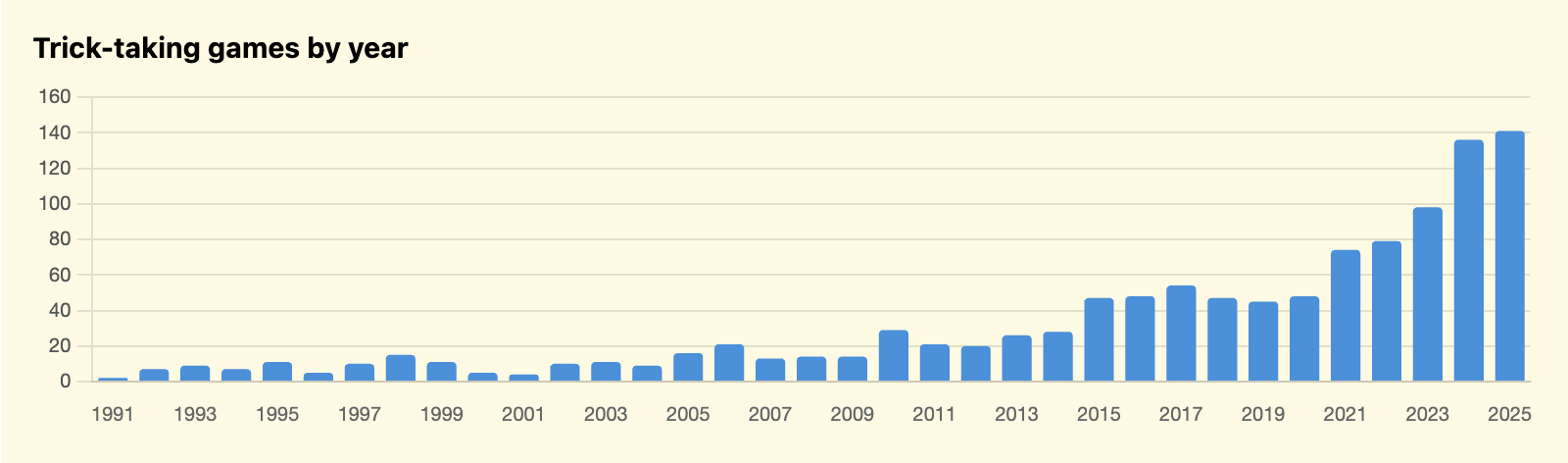
First, the enthusiasts. If we look at this chart, we see a clear uptick starting after 2020. We talked about how Scout (Kajino, 2019) influenced climbing games, and I think we see some similar reaction among trick-taking games to games like The Crew (Sing, 2019), and we see further upticks later.
I’ll present three charts for your consideration. These are all five-ratings-or-more charts.
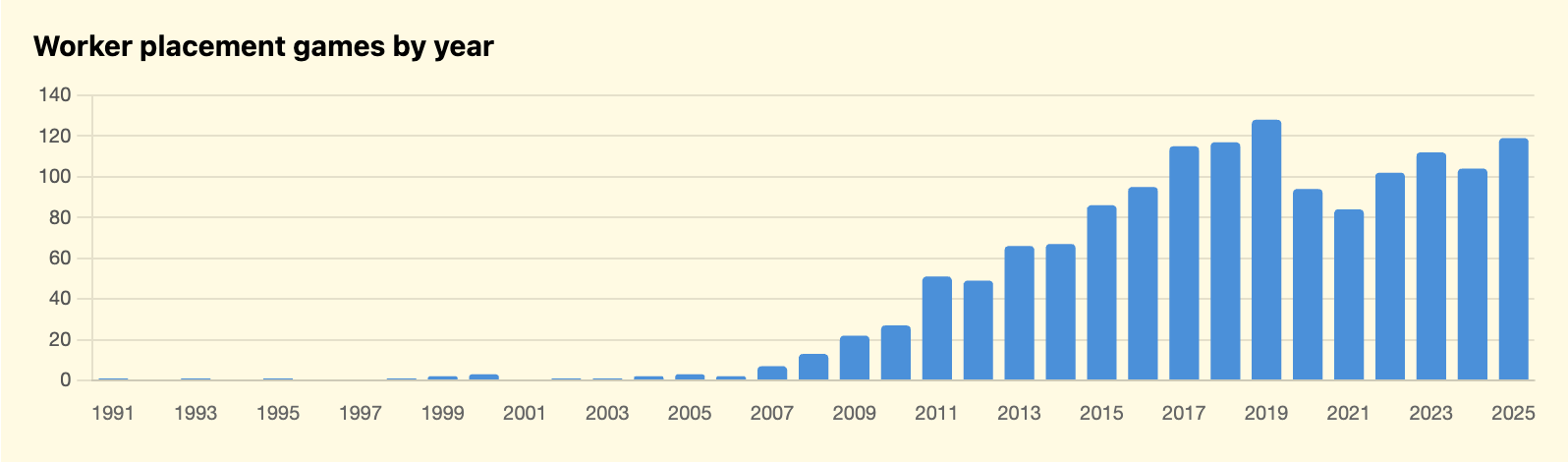
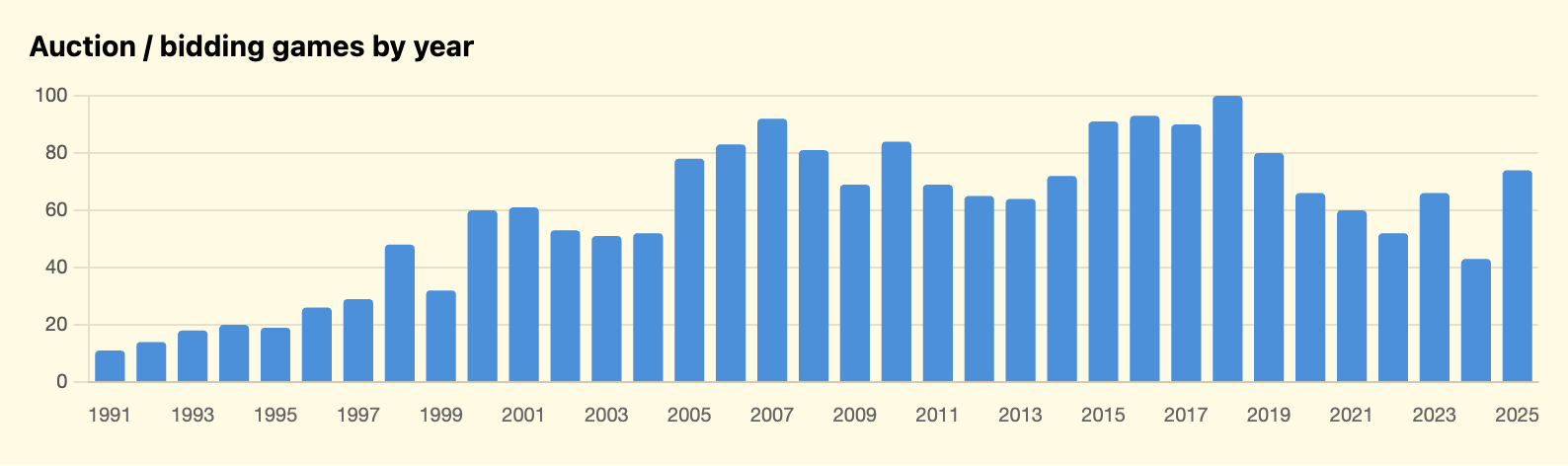
I’m not really trying to compare the genres, but I wanted to find one ‘hobbyist’ mechanic (worker placement) and one more historic mechanic (auction/bidding). We see a few interesting things: First, the growth curve for worker placement games is fascinating, and I’d love to write something about that someday. Second, the drop-off in 2020 and 2021 likely speaks to broader industry trends around the COVID-19 pandemic and its impact on the global shipping crisis. It became easier to get card games through that process than larger board games, and that may speak to the number changing. With auction games, we see a relatively clear trend away from them, which is an interesting thing to consider — is it cyclical? And if we removed Reiner Knizia games, would the shape of the data change significantly?
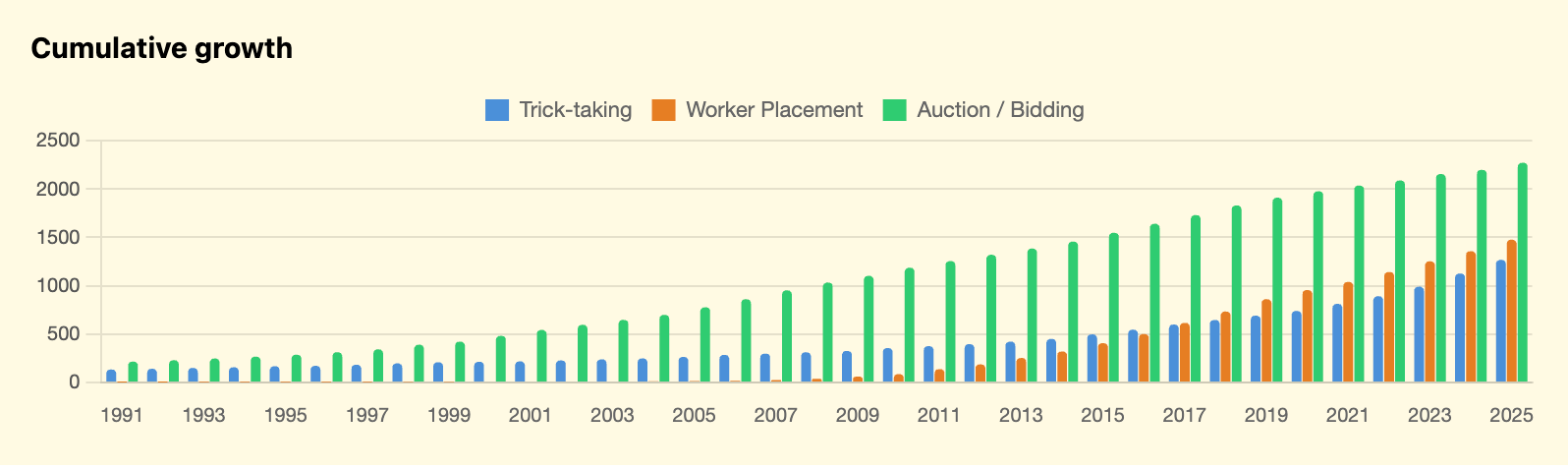
We’ll end with a look at cumulative growth for the three mechanics, as seen above. I actually wonder if the trick-taking renaissance is actually a course-correction. I wonder — and this is where I’ll leave things, because A) I need to do more research, and B) I want to write about it next week — if trick-taking somehow got ‘left out’ of the more general board game renaissance.
I do wonder if gamers defaulted to “board games” with bigger boxes, bigger boards, and generally at least slightly more involved components. You don’t need to look any further than the Wirecutter’s recent cooperative games recommendations, none of which are card games, and we certainly know there are some really brilliant cooperative card games out there.
There are many types of cooperative, or co-op, games, and we already recommend a few of them in our guides to card games and two-player games. But for this guide, we focused on conventional board games.
“Conventional board games.” Hmm. Hmmmmm. I may be biased, but I think if we’re trying to separate board games from card games, we’ve perhaps gone wrong somewhere along the way. (Maybe I’ll write that ‘great cooperative card games’ list that’s been on my mind.) And I know that’s focused on a different audience than, say, this little newsletter is, and the scope is vastly different, but if they’re not willing to recommend, say, The Crew or the Exit series, to a general audience interested in cooperative board games? I don’t know about that.
Well, that was some note to end on, wasn’t it? I’m excited to explore the data further, and I’m excited to get a bit miffed about things, too. Long and storied traditions, all that.