Six great cooperative games from 2025


Hello, and a happy Wednesday to you all! I hope the day's found you well. I'm continuing to recap some of my favorite games from 2025, and today, I'm talking about some great cooperative games I played. Last week, I wrote about my favorite trick-takers from 2025.
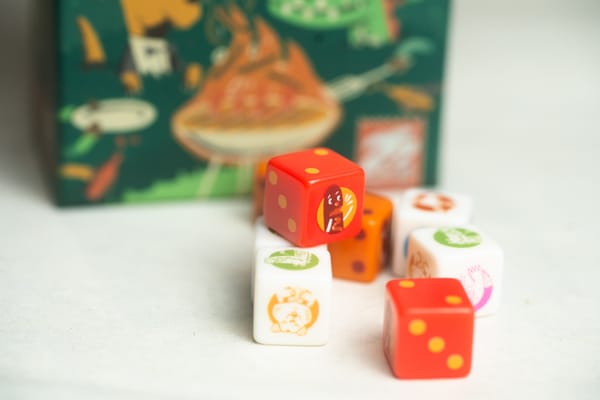
My parental leave at work is coming to a close this week, and I spent part of the morning playing Wiggle Waggle Geese (Wrede, 2009) with my toddler, marching around the living room, flapping my arms, and running away from an imaginary fox.
It's not the most strategic cooperative game, but I had a good time playing with my son. I've also had a great time playing Animal Upon Animal (Miltenberger, 2005), Rhino Hero Junior (Frisco and Strumpf, 2020), and Teetering Treetops (Schiefelbein and Schiefelbein, 2024), the last of which is fully cooperative — but you know, there's something about playing with a two-year-old that makes the whole experience an exercise in cooperative play. Anyway, none of that's why we're here today.
Topping the list, without any question about it, is Fate of the Fellowship (Leacock, 2025), which is a reminder that there are some thematic tie-in games that just work. Fate of the Fellowship starts as an extension of the Pandemic system, but it moves into a deeper, more strategic game. There’s an incredible cast of characters, and you’ll be playing two of them. Each of them has two or three unique abilities, and they’ll all help you complete objectives in one way or another. There are 24 objectives to work through, and you’ll see just four per game. This is one of my favorite cooperative games of the last decade, as it feels simultaneously fresh and like a refinement of existing systems. Designed by Matt Leacock, illustrated by Jared Blando and Cory Godbey, and published by Z-Man Games.
 Matt Montgomery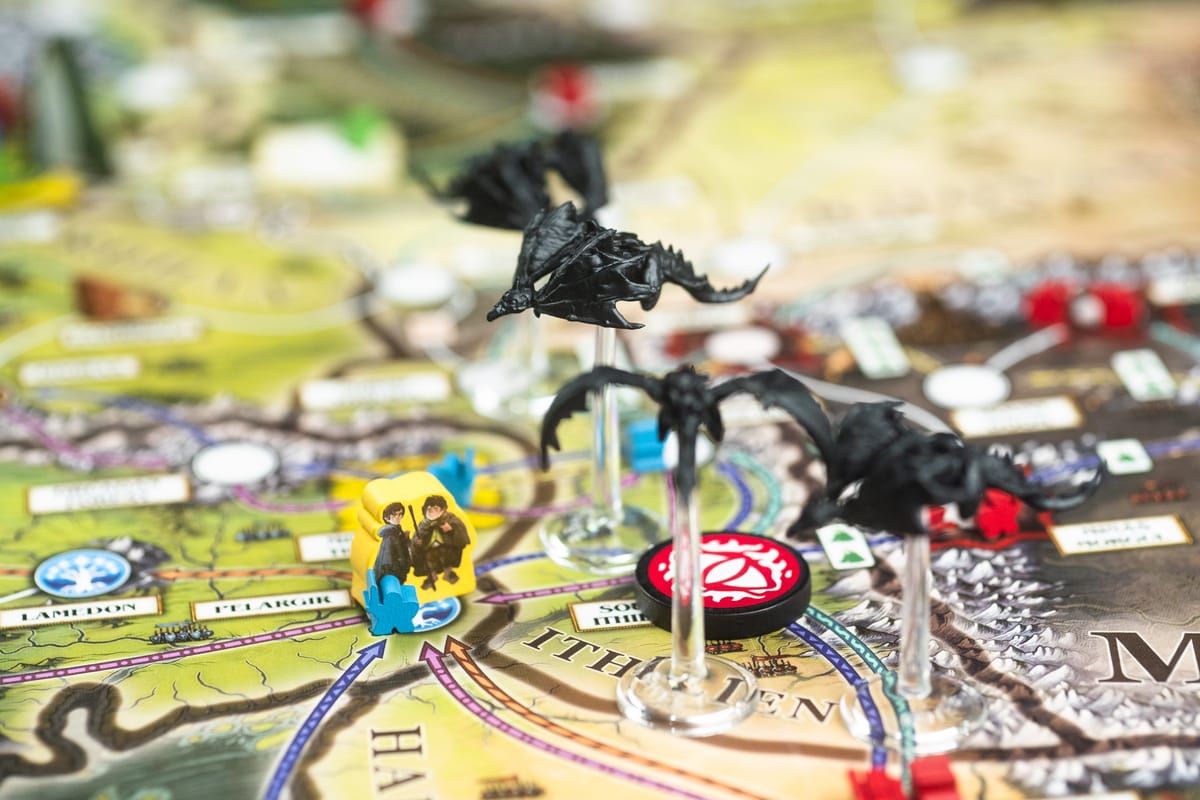
I’ve played about half of the Flash Point: Legacy of Flame (Franklin, Lanzing, Leder and Rogers, 2025) campaign, and while it’s not the most seamless legacy game I’ve played, it does scratch the itch of the original Flash Point: Fire Rescue (Lanzing, 2011) — you’re fighting fires as a team, saving folks from the flames, and trying to navigate flare-ups and hazardous material. It’s long been a cooperative game I’ll come back to every so often, and while I don’t think it’s as timeless as, say, Pandemic (Leacock, 2008), it’s held up pretty well. The legacy campaign is sort of what you’d expect, but the extra content it adds to the original has made it worth putting time into.Designed by Ken Franklin, Kevin Lanzing, Chris Leder and Kevin Rodgers, illustrated by Douglas Duarte, Luis Francisco and George Patsouras, and published by Indie Boards & Cards.
Eternal Decks (Hiroken, 2025) has been a bit of a sleeper hit. It’s a bit of a cooperative deck-building game, where you’re using your very small deck of cards to revive Eternals, at which point, you claim a deck of cards that’s more powerful than what you started with. It’s a little bit of an odd one, but it not only works well, but it’s exciting. Often I’ll play games that are interesting but not exciting, or exciting but not all that interesting, but I find a nice mix here. I’ve played it a few times since I picked it up, and I’m looking forward to playing more of it in 2026. Designed by Hiroken, illustrated by MUJUNSHA, and published by Tricktakers Games in Japan. It’ll be published soon in the U.S. by Portland Game Collective.
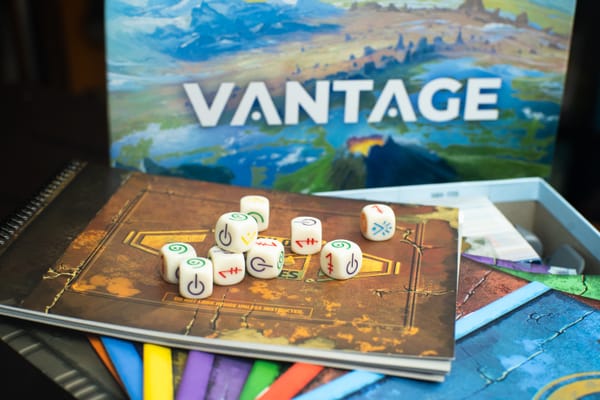
One of the surprising games that came from 2025 is Vantage (Stegmaier, 2025), an open-world game with something like 1,800 cards in the box. There are something like eight books of story you’ll read paragraphs from, and the game purports to have basically anything you can think of somewhere in the mix. So far that seems true — I’ve played it a few times and it’s surprised me with what it pulls off. It’s all operating under one very large map, and you’ll move in cardinal directions from location cards, so there’s plenty of opportunity to explore the same location twice, but the path you take and the actions while there might shift radically. I’ll be honest, this game is a little weird, and I think it might be best played solo, but even with another player, it still felt like were were working together, even if our journeys were completely separate. Designed by Jamey Stegmaier, illustrated by Valentina Filic, Sören Meding and Emilien Rotival, and published by Stonemaier Games.
The Four Doors (Leacock, Pinchback and Riddle, 2025) is a game in the mold of Pandemic (Leacock, 2008) and Forbidden Island (Leacock, 2010), and it’s aimed — I think — at a younger demographic. It’s got that ‘gather four cards of a type to complete something’ idea and the ’if things escalate too much, you lose’ idea, and it feels like a smart take on established tropes. It’s at once simpler than Pandemic and a bit more strategic than Forbidden Island, but it sits really comfortably under Forbidden Desert (Leacock, 2013). There’s a great puzzle here, and I’d happily play it again with the right crowd. For context: My eight-year-old niece did a great job figuring out what she should do on her turn without coaching. She’s good at games already, but hopefully that provides a modicum of understanding. Designed by Matt Leacock, Ben Pinchback and Matt Riddle; illustrated by Zachary Hoel and Asher Israel; and published by Happy Camper.

Figment (Warsch, 2025) is a reimplementation of designer Woflgang Warsch’s earlier Illusion (2018). They’re both games with a bunch of cards with four-color geometric artwork, and your goal in both is to correctly guess the percentage of a specific color on an artwork card. In Illusion, your goal was to place your artwork card in the right order in sequence with the other players’, gaining points if other players fail, and in Figment, it’s to correctly sequence five pieces artwork, earning points as a team for getting it right — it’s essentially the same game, but it’s cooperative by default, and it’s a much better mode for the game. This felt like it was begging to be a cooperative game from the outset. It’s a simple game, and it’s very light, but those games have real value in my library — besides, it’s fun to look at the cards. Designed by Wolfgang Warsch, illustrated by SMLXL, and published by CMYK.
 Matt Montgomery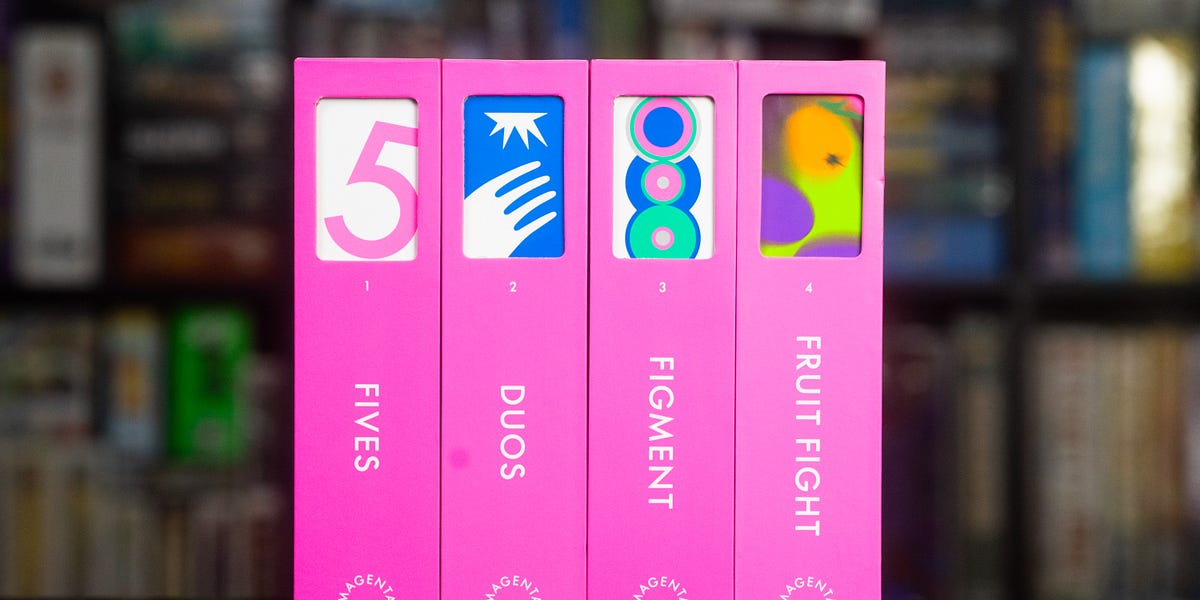
The great word-association game Alibis (Sato, 2025) rounds us out today. Players are presented with a grid of characters, each of whom has a word on it. Each player has two character cards, and they’ll be tasked with giving a single-word clue that communicates a relationship between the two words on those characters — that’s their alibi. Once everyone’s communicated their alibis, the one remaining character is the guilty party. It caps out at six players, but it’s one of my favorite word-association games for groups of four to six players. Designed by Yusuke Sato, illustrated by Albert Monteys, and published by Allplay.
Cooperative games included in the trick-taking list:
- The Lord of the Rings: The Fellowship of the Ring — Trick-Taking Game (Bornmueller, 2025)
 Matt Montgomery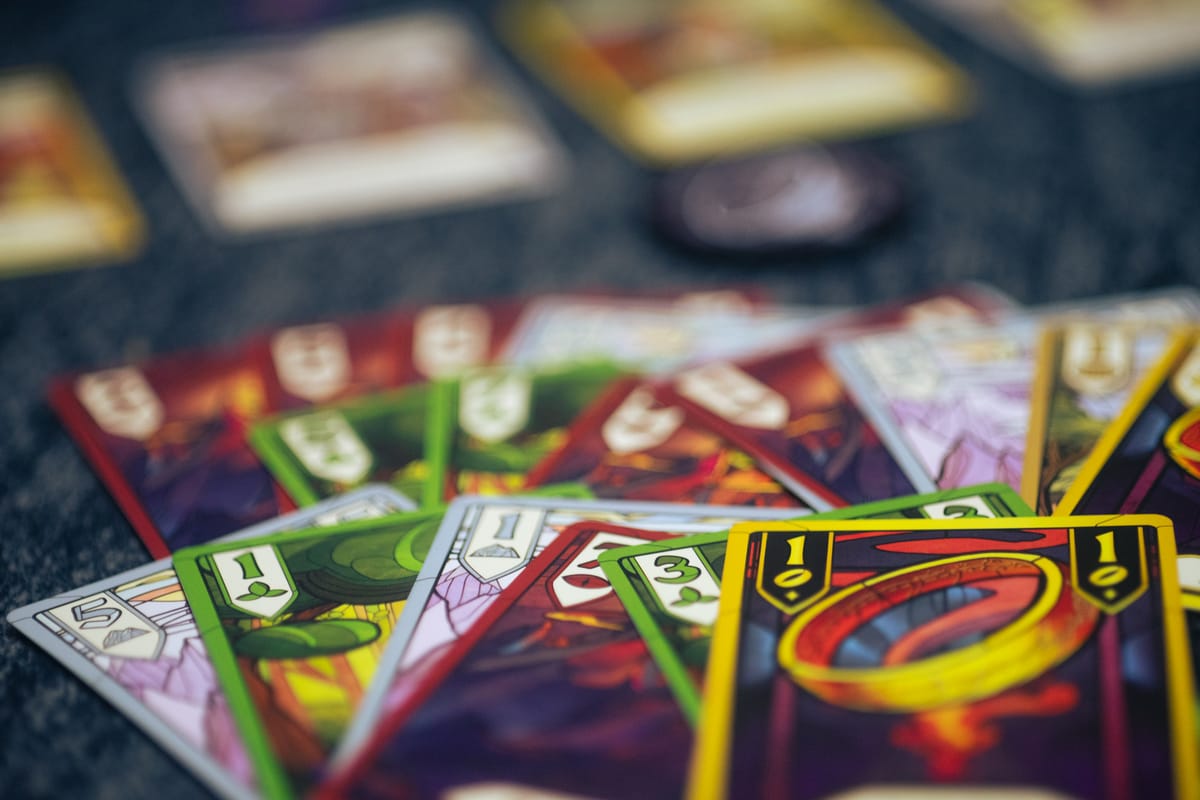
Thanks, as always, for joining me this week! Next week, I'll be talking about some of my favorite non-cooperative, non-trick-taking games from 2025. (I'll probably just say "some more great games from 2025," which seems much simpler.)