How Scout influenced climbing games
Did the 2019 climbing game lead to an influx of climbing games?

One of the most remarkable things about card games is that you can more easily track the direct influence of a game than other types of games. This is for two distinct reasons: First, the design space for a card game is typically smaller. This impacts play testing and the design phase, lessening the need for intense shaping of your design and speeding up the process. Second, production is more straightforward, and there are more ways to print card games than, say, a game with wooden meeples and thick cardboard tiles. Understanding that influence is made possible by the absolute reams of data we have at our fingertips in regard to card games and board games.
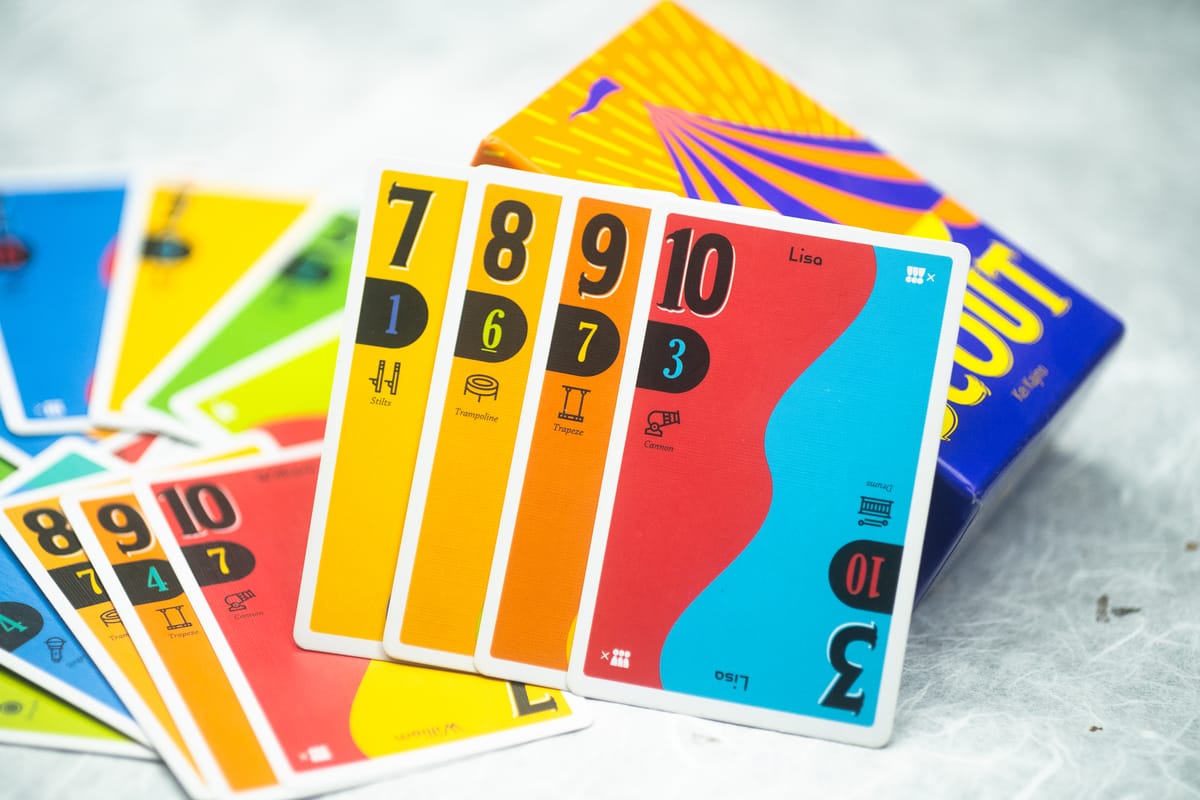
That’s the hypothesis, at least. What I’d like to explore today is the impact the card game Scout (Kajino, 2019) on card games. Released in Japan in 2019 by One More Game!, it wasn’t until Oink Games released the game in 2021 that it started picking up significant steam. That isn’t to say nobody knew about it. In trick-taking circles, Scout was in at least some respects a known quantity even before Oink’s publishing of the game, owing in part to a confluence of a collecting mindset and a desire to be first to discover new games, but also to the efforts of a select group of folks in the pre-2020 Japanese import gaming landscape.
In order to quantify the impact of Scout, we should define some of its key features. While we could (and will) just look at the rate at which new climbing games are released, that will tell only a portion of the story. We should also be interested in the mechanics of the game.
The first thing you should teach somebody playing Scout — well, at least before you deal out hands of cards — is that this is game in which you cannot rearrange the cards in your hand. There’s more nuance we’ll get to, but that’s the start. There are some other climbing games in which you can’t rearrange your hand from which you can see a clear line from Scout. More prominent examples include Hachi Train (Arao, 2021) and its successors Nanatoridori (Arao, 2023) and Jungo (Arao, 2025) and Spring Cleaning (Cox, 2024); harder to find examples include Chocolate Mint Trick (Yuya, 2025), Storm in a Teacup (Tasaka, 2025), Orbita (Geonil, 2025) and Rufstock (Lacerda and Sia, 2025).
This of course isn’t an innovation of Scout’s — you can see it earlier in a climbing game with Dealt / Combo Up (Stremmel, 2018 / 2024), though I’ll hesitate to call it as influential, given the spread of Scout. And, of course, games where you can’t rearrange your hand all owe a great debt to Bohnanza (Rosenberg, 1997), the bean-farming-and-trading card game that forces you to plant bean cards from the start of your hand, and you can never rearrange that hand. (Perhaps ironically, I usually play Bohnanza as a shedding game. I don’t think it’s a great strategy.)
Next, we’ll consider games in which you will add cards to your hand. The earlier-mentioned Hachi Train and its successors, as well as Spring Cleaning, all do this, but they’re not alone. Ghost Lift (Onegear, 2025) and Greasy Spoon (Ross, 2023) are two climbing examples that have players add cards to their hands; the former has you add cards upon passing, and the latter has you draw cards from a personal deck after playing a meld. You could also look at Fishing (Friese, 2024) as a trick-taking-not-climbing example, where you’re drawing cards from a shared deck each round. In L.L.A.M.A. (Knizia, 2019) you’re drawing a card, playing a card, or ending your involvement in the round. Crisps (Bhat, 2025) has each player drawing a card at the end of a trick.
I think it’s fair to say that adding a card to your hand is only directly relevant in our consideration here when it’s a passing action — when it’s an opportunity, upon passing, to supplement your hand. Ghost Lift and L.L.A.M.A. meet this criterion, but they miss something important about Scout: You’re adding to your hand from the played meld, so what’s played matters deeply. This is shared with the games initially outlined with the inability to rearrange your hand.
The final consideration is that your cards have two values each — one on top and one on bottom. In Scout, these numbers range from 1–10, with a value on both the top and bottom of the card. When you add cards to your hand, you decide how they’re rotated and at what position they enter. The double-sided cards are one area where it does rightly seem that Scout has been a big influence. Well-regarded trick-takers like Trick-Taking in Black & White (Dejima, 2021), Trickarus (Cannon, 2024) and Prey (Toru Ii, 2024) all exhibit this trait, and some newer games like Panda Spin (Chudyk, 2024) and Malabares (Arthur Lacerda, 2025) make use of it in some interesting ways. We even see it in the bafflingly named DNUP (2026), another Kei Kajino game that originally had the less-confounding name Revolve.
This feels like the biggest innovation in Scout, and it’s perhaps a little surprising that we haven’t seen the mechanism itself used with more frequency. To really get a look at how Scout has impacted card games, I think we need to zoom out. Rather than looking at the specifics of Scout, perhaps we should look at the prevalence of climbing games altogether.
This is where things immediately get interesting. I’ve built some charts in a little data application to help visualize the information with which we’re dealing. The first chart looks at the percentage of eligible games with the ladder climbing mechanism on Board Game Geek. There is a bit of a categorization issue here, but the data will serve our purposes well enough, and I think it’s (largely speaking) accurate enough. When I call a game ‘eligible,’ I’m doing so to narrow our scope to games that have at least five ratings on BGG. It’s an extremely low bar, and we’ll look at how that influences the data. (Additionally, the data doesn’t list climbing games with no listed year — Big Two is a notable example. We will concern ourselves largely with ‘modern’ games here at any rate, so it’s not a major hiccup.)
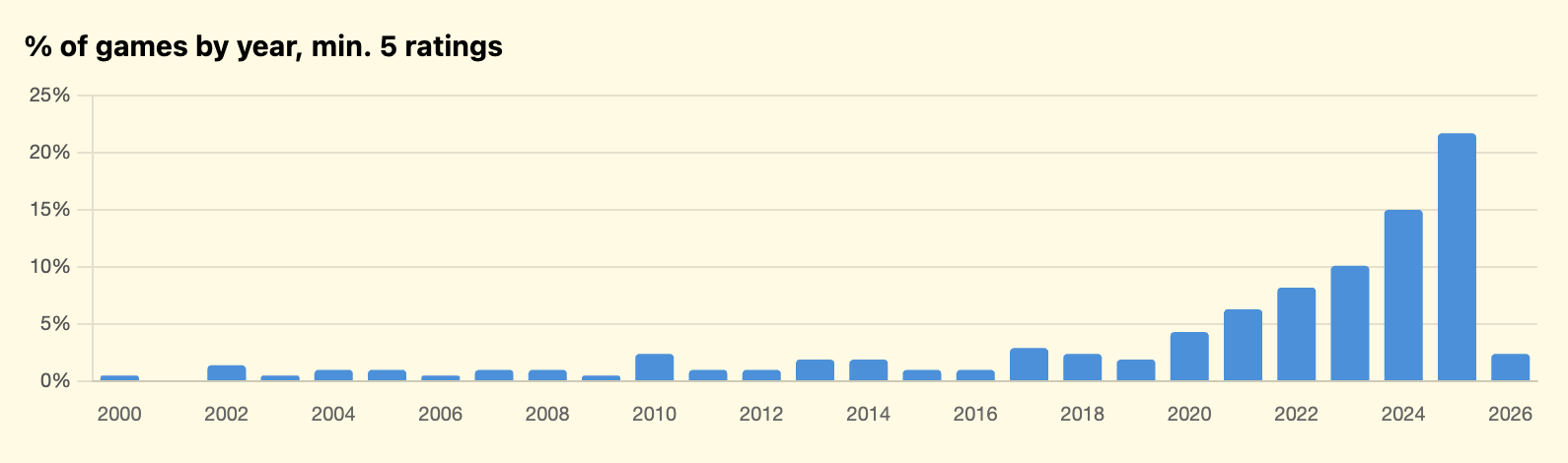
What we see is a steady ramp; the number of games released that have at least five ratings, when considered as a share of all climbing games released. When using the very low bar of five ratings, we see that more than 20% of climbing games on BGG were released in 2025, and we see a clear upward trend after 2019 to get us there. (The very small number is 2026.)
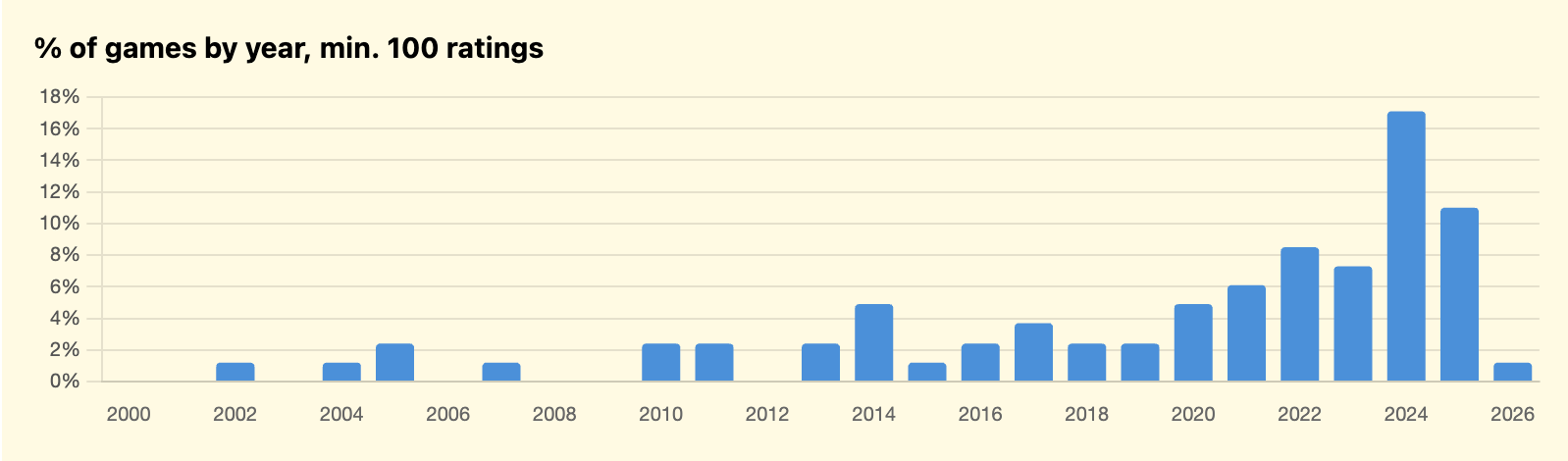
When we filter the data more stringently, looking at games with at least 100 ratings rather than just five, we still see a massive jump after 2019. Every year from 2020 forward has at least as high a percentage as the previous highest year (2014 at 4.9 percent), with 2024 sitting with over 16 percent of 100-rated climbing games having been released that year. (A side note: It’s really quite remarkable that we have access to all this data. BGG really does make the hobby more interesting.)
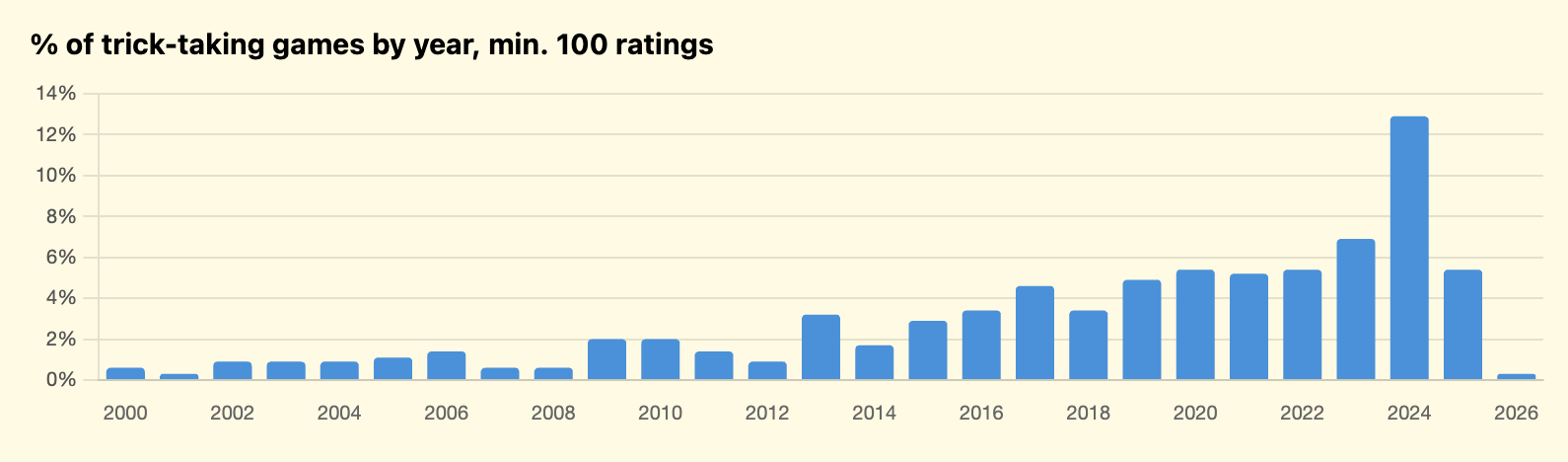
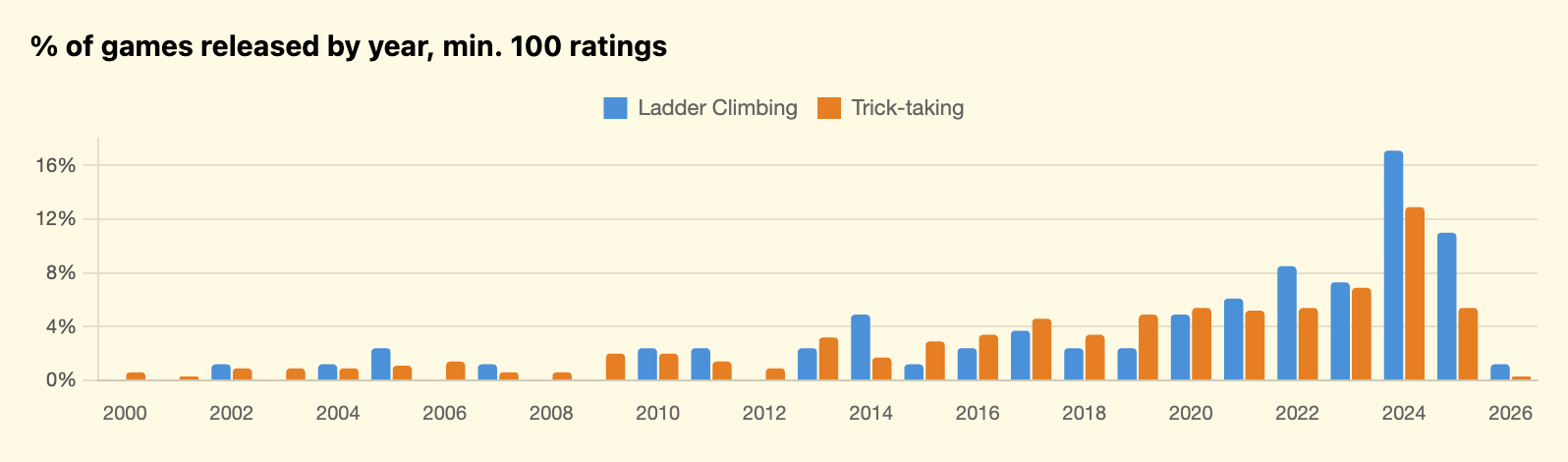
You could probably successfully argue that all of these charts just show the “trick-taking renaissance,” which I think would be a fair argument against my hypothesis. The data, however, doesn’t display quite the same type of climb. (Ha.) It does feature the same peak in 2024 (and that’s something I’d like to dive into even further), but it tells a story about a genre of game that’s simply been around a lot longer. And while 2024 features that same jump, climbing games in 2025 represented a greater percentage of all climbing games than trick-taking that same year. That more than 16% of 100-times-rated trick-takers (of those released from 2000 to 2026) were released in 2024 is telling a whole story. (I’m sorry about all those numbers jammed up in there.)
Back to the question at the top: How has Scout influenced card games? The best answer isn’t about individual mechanisms within the broader climbing game whole, though there is certainly something to be said about its impact with double-rank cards, hands you can’t rearrange, and adding cards to your hand when passing. These features have played into other successful climbing games, but I would argue the bigger impact comes from the mere fact that Scout exists and did something new and interesting in the ladder climbing design space.
When we look at 2024, it leads one to wonder: Is there a three-year lag between a game reaching critical mass (following broad, global publication) and it having a distinct impact on published games?
Now, can we attribute that directly and solely to Scout? Certainly not. We can at best see some indicators that it’s had an influence, though we could also look at L.L.A.M.A., also released in 2019, as an influencing factor. Certainly among hobby gamers, Scout has been more successful (evidenced by its having more than double the BGG ratings), and while that won’t tell us anything about the general populous, I think it’s fair to say that it tells us something significant about hobby gamers and about hobby game designers.
The five most popular climbing games on BGG between 1988 and 2018
We’ve discussed the ways Scout influenced climbing games in some depth, but before we depart, let’s take a quick look at climbing games in the 30 years before Scout’s release. (I’ve limited it to the years 1988–2018 largely because I think there’s something interesting about ‘modern’ gaming.) We’ll be quick about all this, because frankly, it’s probably already gone on long enough.
- Tichu (Hostettler, 1991) — sort of the partnership climbing game among modern
- Haggis (Ross, 2010) — Tichu, but for two, sort of — probably the greatest modern climbing game
- The Great Dalmuti (Garfield, 1995) — a take on President, which itself was a take on the Chinese climbing game Zheng Shangyou
- Maskmen (Sasaki and Shinzawa, 2014) — suitless climbing and constantly shifting ranks — sometimes as much logic puzzle as game
- Dealt! (Stremmel, 2018) — no rearranging (and pre-Scout!) plus life tokens
I actually think we can see how each of these games influenced climbing game mechanics, but that is, perhaps, a story for another day.
Alright! I hope this was as fun to think about as it was for me to write and research. I love a good chart, and this was a great opportunity to build some software that produced these charts. I love the idea that we can learn something about how games influence the creation of more games, and I look forward to diving into that even more in coming weeks and months. (What exactly is the ‘trick-taking renaissance’, anyway?)
Thanks as usual for reading, and I’ll look forward to next week, when we’ll talk about — well, something!