Friedemann Friese's trick-taking games
One of the great German designers has some excellent trick-taking games in his roster.

Friedemann Friese is one of the truly iconic board game designers, whether it’s his F-titled games, his green boxes, or his green hair. He's imminently recognizable, and his games tend to be, too. One of Germany's great game designers, his earliest published games are from the early 1990s, and he's designed at least on game that's held in near-universal high regard.
I first knew him as the designer of Power Grid (2004), which was one of the first hobby games I considered a favorite. It’s a network-building game with variable turn order, resource production and an auction, and let me tell you, that game shaped so much of my early gaming obsessions. I found myself wanting to play games that felt like Power Grid all the time, though I quickly discovered that nothing really did.
For a long time, that’s what I knew about Friedemann Friese. I knew intellectually he designed lots of games, but Power Grid — Funkenschlag, if you want it in the original German — that defined him. I don’t know that it’s fair to define a designer by a single game, but at least it was a good one by which one could be defined. Enter 504 (2015), the game with 504 unique combinations of mechanisms by way of nine modules, of which you’ll use three in a given game. (I wonder if anybody’s played all 504 of them. Hmm.)
Today, I have no idea how to tell you what my favorite game is. I have no idea how to figure that out myself. I think that’s a very normal part of getting really into a hobby, and I don’t worry too much about it, but sometimes I wonder if I enjoyed it more when I could at a game and say, “That one, right there. That’s my favorite game.” Instead, it all swirls around in my head and I resort to things like, “I can tell you about five games I’ve thought about today,” or “This is a game I played yesterday that I really enjoyed.”
Back to Friedemann Friese, who I really enjoy talking about with his full name — he’s always double-monikered in my book. I suspect in his, too. His catalog of games is a bit like 504. He played with auctions, with networks, with tiles, but he keeps coming back to card games. Whether it’s the worker placement game Fabled Fruit (2016) or a more straightforward card game like Fuji Flush (2016), it feels a bit like he’s always got a card game he’s thinking about. I believe this is with good reason: There’s a certain ease in introducing people to a card game. Everyone’s played a card game or two, and non-gamers often have just enough context to feel comfortable sitting down for a card game. The same cannot be said about a worker placement game or an auction game — you’ll find people who of course are very happy to learn something new, but those people tend to be excited about games. (Of course, you’ll still struggle to find people who want to learn several new games in one night. When you find those people, keep them close.)
Friedemann Friese’s six trick-taking and climbing games
Like I said up there, I defined this man by Power Grid, in a way. But now, I can look at these six climbing games and learn something about the kind of designer he strives to be, what goals he has with his designs. Not all of his designs will fit that bill, but he’s both prolific and someone unafraid to try something a bit new. We’ll start with his oldest efforts and continue forward.
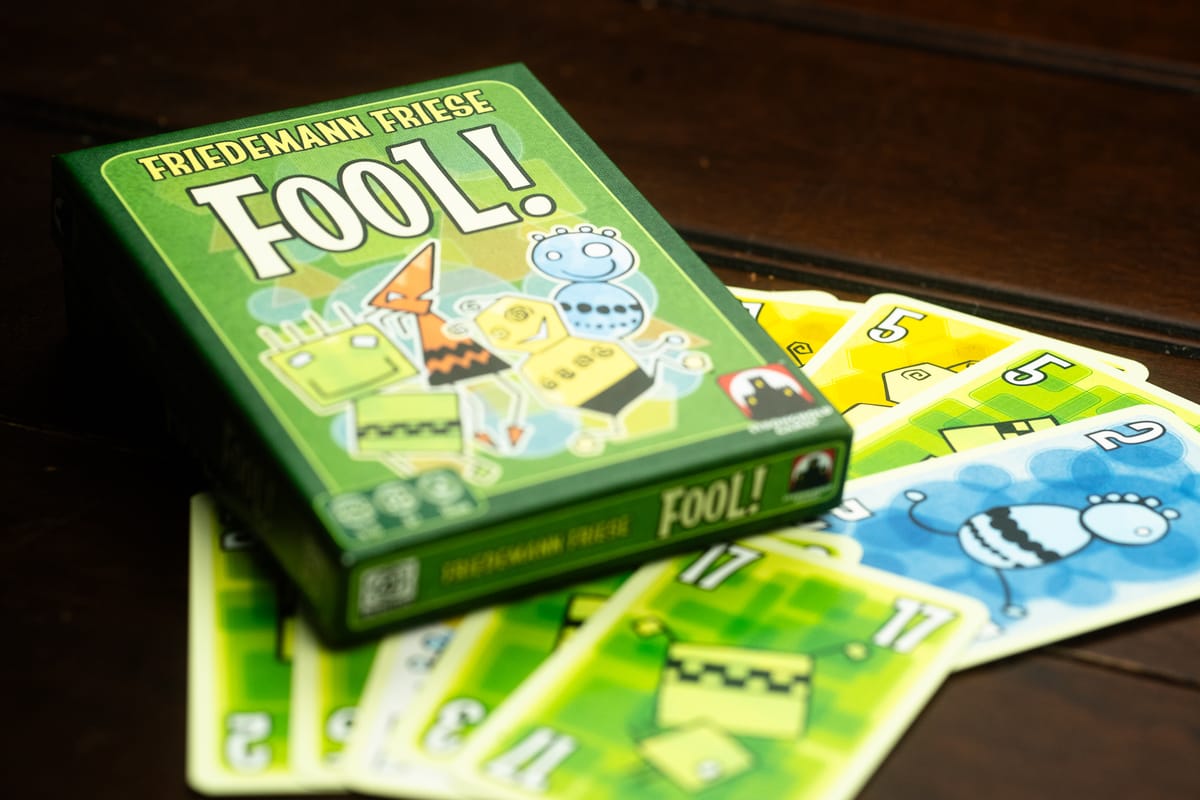
Foppen (1995), later re-released with support for more players as Fool! in 2018, is one of Friedemann Friese’s earliest games, with his design career only starting in 1992. It’s a surprisingly mean trick-taker — trick-taking games from this era often are — and it manages that with a mechanic we haven’t really seen replicated to great effect. Each trick, the player who plays the lowest card in the trick is barred from playing a card in the next trick. It’s also a shedding game, I guess, because your goal is to rid your hand of cards before anyone else. (I mean, that’s what a shedding game is, so I guess there shouldn’t really be an argument. But there’s a reason you typically see climbing and shedding going together, and you don’t see trick-taking and shedding going together. I digress.)
That one of his earliest games is this timeless trick-taker speaks volumes. There’s something about these 1990s trick-taking games — I can’t quite place my finger on the unique qualities, but when I think about Fool, Sticheln (Palesch, 1993), Mü (Matthäus and Nestel, 1995) — it’s not so much that there are common threads, though certainly there are some. It’s more that these games aren’t afraid to punish players. They’re not afraid to let a player’s hand lead to almost-certain failure — too many low cards in Fool, and you have a mountain to climb — and demand the player figures a way out. Mitigation is entirely about player skill. There are, of course, plenty of trick-taking games published in the last 26 years that do manage that feat, too, but the trend is certainly something a little different, something a bit more welcoming — at least in general cases.
Stich-Meister (2010) is one I haven’t played yet, and that’s probably because it’s just hard to find in the U.S., and it’s also one of those games with text that requires pasting-up. (Mike, I imagine you’ve got this one — TTUTCON this year, maybe?) In this one, you’ll be playing rule cards, which will set trump suits, trump ranks, trick play rules, and scoring rules. You might end up with multiple trump suits, because each player is adding a rule, and they’re doing it blind. The scoring and trick play rules each seem like they could comprise a compelling trick-taking game on their own — it seems like a great time. I’ll have to wait and see if I’m right about my supposition.
Five Cucumbers (2013) is the straightforward game in this list, and that sort of says a lot. It’s a take on the Swedish trick-taking game Cucumber, which is old enough by all accounts (the 1940s, it would seem) to count as traditional, I think. At any rate, this has that must-beat (or match) approach, where if you can’t beat or match a card, you have to play your lowest card; the highest card wins. If you win the last trick, you’ll have to take cucumbers (negative points), and you sure won’t want that. It also has a bit of player elimination, which I think designers have rightly avoided in the modern trick-taking scene. I dunno, this is alright — I think there must be some sort of connection that Friese has with Cucumber.
FTW?! (2023) is his first climbing game, and somehow it’s another one of his I haven’t played, though I think I can rectify that in short order. Maybe tonight. Anyway, your goal in this game is to have just a single card left in your hand, as you’ll score points equal to that card’s rank. You’ll want to keep a high-ranked card around, if you can. But if you have more than a single card left in hand, you’re going to lose points for every card except your highest, and yeah, it’s the combined rank of your other remaining cards. Brutal. I think. (We’ll see!)
Fishing (2024) is probably my favorite Friese trick-taker, especially because it’s a bit weird, and it delights in that fact. See, in Fishing, you’re going to start with a hand of cards, as one normally does. However, after you win tricks, you’ll be keeping those for the next round. If you ever don’t have enough cards for a complete hand at the start of a round, you’ll get to draw cards from an ocean deck, and those cards are going to be considerably better than what you had. The trump suit doesn’t even come out until after the first round, for instance. The tricks you win each round will be the points you earn, and you’ll play eight rounds. Unlike a number of games with rounds, this isn’t a game where ending early works. Those eight rounds are essential for fishing deeper in the ocean. As you progress, the game gets weirder and weirder. I love this game.
Fearless (2025) is the latest outing, and by all accounts, it’s still making it to buyers in the U.S. — so if you’re waiting to get a copy, you’re not alone. You’ll be advancing and retreating on a board, playing as a ghost wandering aimlessly on a path instead of remaining safely in the ruins of an old house. When you win a trick, you’ll move along the path a number of spaces equal to the sum of the cards in the trick. And because there are negative cards in the trick, you might end up moving backward, forward or even standing still. In a way, this feels like a little bit of a mean game: You might get a chance to send someone much further backward than they had previously intended, or you might shoot them forward on the track, further away from the ruins.
Thanks for joining me again this week — I hope you’ve had a nice week, and I hope the rest of your week is even nicer. And filled with board games. While I’m not 100% certain what next week’s newsletter will be about, I’ve got several ideas that are percolating, so here’s hoping it’s a great time.