Five great things about board games in 2025


What a year it’s been! We’ve increased the size of our family by a staggering 33%, I’ve played a ton of games, and I’ve played so many interesting and unusual games, discovered up-and-coming designers, and just generally experienced more of the breadth of board games. From more involved fare like Vantage (Stegmaier, 2025) and Fate of the Fellowship (Leacock, 2025) to lighter games like Hot Streak (Perry, 2025) and Magical Athlete (Garfield and Ishida, 2025), there’s been such a great world of games to explore.
Here are five things that I thought were great about board games (and my experiences with them) in 2025.
CMYK’s great run of family games
Publisher CMYK has produced one of the most interesting catalogs in 2025 focused on casual games, publishing the amazing Hot Streak, revamping a game long out-of-print in Magical Athlete, putting out a line of stunning card games with its Magenta line, and giving Quacks (Warsch, 2018) a new look for broader appeal. There’s some controversy there, too, but we’re not here to dwell on that.
My top five CMYK games this year might look something like this — at least right now.
- Magical Athlete is a beautiful throwback to roll-and-move games of my childhood, but it manages to feel fresh and exciting with every play. I’m left wanting to roll dice, move my characters, and trigger weird abilities. The fact that this roll-and-move game made so many end-of-year lists really speaks to its great qualities.
- Hot Streak became my go-to race-betting game in 2025, supplanting the excellent Camel Up. This game thrives when it’s wacky, and it gives players control over how wacky the race gets. When we pull a card and a racer runs off the course, there’s always a reaction. This is a really lovely game.
- Figment (Warsch, 2025) is a cooperative reimplementation of his earlier Illusion (2018), and it’s improved by that — it’s also improved by larger cards and better printing, which really allow the geometric art to be the star of the show.
- Fives (Shinzawa, 2022) brings the cult favorite trick-taker The Green Fivura to a considerably broader audience, which is huge — you basically couldn’t find the game, and without even thinking about the production, being able to play this game is such an improvement over not being able to play it. It’s a great one.
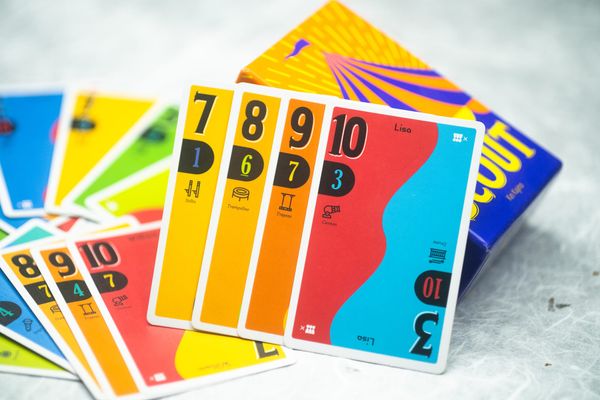
- No Thanks! (Gimmler, 2004) finally gets the production it deserves. It’s one of my favorite games to break out with a group not deep in the hobby, and this is bright, colorful and visually a little aggressive. I love that.
Taiki Shinzawa games more widely available in the U.S.
Several games from the great trick-taking innovator Taiki Shinzawa made their way to the U.S. for the first time without requiring an import, which is, I think, generally a very good thing.
I already mentioned the excellent Fives, which has a cool reverse-card-face thing going on, where you can play any card as a magenta (or green) five under some conditions. It’s a must-follow game, so this adds a very unusual twist to considerations.
No Loose Ends (2025) is a slight reimplementation of his 2024 title Shut the Books, which was as elusive a Shinzawa title as you can expect. It’s got a cool bidding mechanism where you’re playing some cards in your hand as cards to your bid, and you have to meet either rank or suit conditions when winning tricks to count your bid. It’s nice!
Quattro Trick-Taking (2025) is a cool little trick-taker with four separate bidding mechanics, with each player taking one each round. At four players, you’re experiencing each of them at once, but you’re only really worried about yours. It’s somehow still available from New Mill Industries, and I think it’s worth a try!
I’ve heard about a few more reprints coming, too — I’m especially excited about Trick to the Future (2026), a reimplementation of his Twinkle Starship (2020).
Vantage: an open-world board game without the weight of a campagin
You know, it’s been pretty trendy in video games to release ‘open-world games’, many of which legitimately fit the bill of featuring broadly explorable worlds, non-linear experiences, and a true wealth of options. That feat has been considerably harder to achieve in board games. There are plenty of story-based games, like Tales of the Arabian Nights (Gallela, Goldberg, Maroney and Shlasinger, 2009) and Above and Below (Laukat, 2015).
There are even some games that nicely fit the open-world bill, like Sleeping Gods (Laukat, 2021), Gloomhaven (Childres, 2017), The 7th Contintent (Roudy and Sautter, 2017) and Earthborne Rangers (Fischer, Flugaur-Leavitt, Navaro, Sadler and Sadler, 2023). None of these feature the innovation that I think makes Vantage remarkable: Every time you play, you’re starting fresh. You can call it a roguelike if you’d like, but the important thing is that this game opens up different possibilities by that fact.
I love a good campaign game, but there’s a commitment there. Vantage doesn’t hold that same commitment, and you can always come back to the world you’re exploring with new players. Nobody will feel like they’ve stepped into somebody else’s shoes, and that’s such a valuable feature of the game.
Board game goals
I set board game goals every year around the start of the year (I’ll do that today when I’m done writing), and it’s one of my favorite ways to keep track of the games I’m playing. I don’t think it’s an inherent good to track plays or anything, but as somebody who kept a spreadsheet of the films I watched my freshman year of college, and as somebody who created an Access database of my Star Trek VHS tapes as a pre-teen, there’s clearly something that just works for me.
Anyway, I thought I’d go over some of my goals from last year.
- I wanted to play 10 Reiner Knizia games. I set this goal in the middle of the year after writing about the good doctor’s vast catalog, and I still didn’t finish it. I got to 6 after playing Gazebo (Knizia, 2025) just a couple of days ago with my brother-in-law and niece — funny story, that’s a reimplementation of an earlier game of his, Qin (2012).
- I wanted to play 100 games that were new to me — and it took until December, but I got there. My last play for the challenge was Vegeterrors (Makaifuda, 2023), an 8-bit JRPG vegetable-themed trick-taker. That was a goal I set after hitting my 75 new-to-me games goal in September with Tearable Quest (Ono, 2025).
- I still have a big ongoing goal that I will probably not hit, but who knows — I want to play 2,020 cooperative games in the 2020s. I’ve still got a few years to hit that one, but I’m definitely not on track.
- I’m also working on my H-index — where H is the number of games I’ve played at least H number of times. I’ve got two sets going, a standard H-index and a trick-taking H-index. The former is 26 and the latter is 13, and it’s quite a task to get those up. That’s the primary mechanism by which I try to get games in my collection played more.
I’ll work on some goals today and report back soon.
Games with family and friends
This is why I play. I love games, and I will play with anybody, but I really love playing games with family and friends. Games like Hot Streak and Magical Athlete helped me play more games with family, because they’re really just so good with new players. Magic: The Gathering (Garfield, 1993) — especially with Foundations Jumpstart over the last few days — has presented those opportunities, too, Really, the holidays often remind me why I love playing games. It’s a chance to sit down together, regardless of age, and play together. Whether it’s Teetering Treetops (Schiefelbein, 2024) and Animal Upon Animal (Miltenberger, 2005) or Skull Queen (Dorra, 2024) and Fate of the Fellowship (Leacock, 2025), there’s been something for everyone.