A 2025 board game gift guide
Giving games as gifts is a time-honored tradition. Let me help.

One of my favorite things I write each year in Don't Eat the Meeples is my annual board game gift guide. It's far from the only board game gift guide you'll find out there, but it's mine. I'm not going to give too much preamble here, but I've written out some recommendations for games from 2025, some "classic" hobby board games, some trick-taking and climbing games, and a bit more on top of that.
I've included some purchasing links within, but largely if it's a smaller company whose games tend not to be available in the usual large non-hobby online retailers.
Five new games
These five entries were all released in 2025 — sort of. Four of them absolutely were, and we’ll close out with a collection of really lovely casual games that released this year, though not every game in the collection is brand new in 2025.
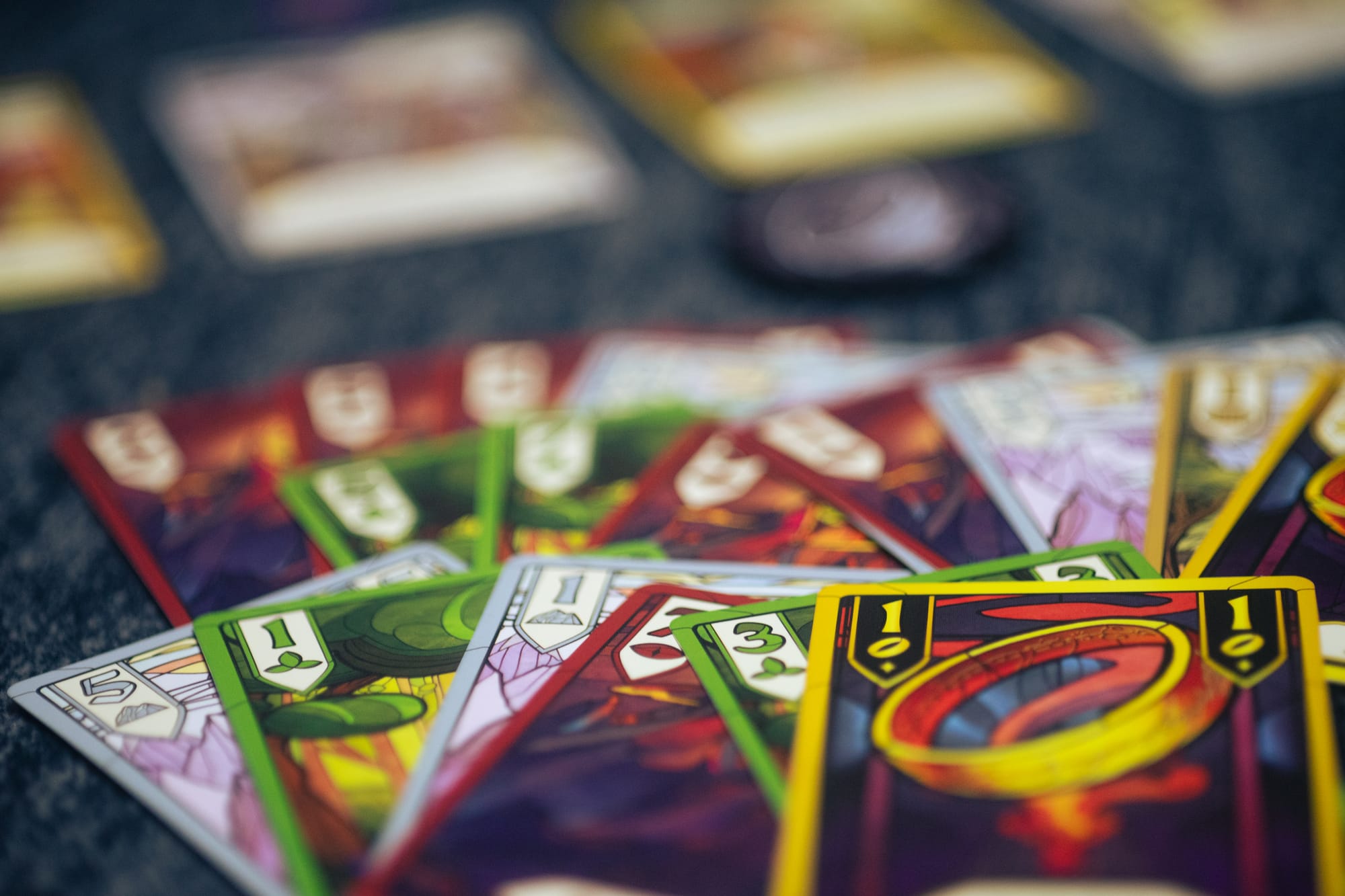
The Lord of the Rings: The Fellowship of the Ring — Trick-Taking Game (Bornmueller, 2025) is an extremely wieldy title in this context, but that’s not truly the fault of designer Bryan Bornmueller or the publisher, Office Dog. I suppose we could blame J. R. R. Tolkien for that, though I suppose that complaint won’t really be heard. It’s also not entirely relevant, but that’s neither here nor there, really.
This has rapidly become a hit in the broader hobby gaming sphere, skyrocketing up to spot 249 on the BGG rankings. I hope it’s well-received outside the hobby, too. It’s a cooperative campaign-based trick-taking game, somewhat in the vein of The Crew: The Quest for Planet Nine (Sing, 2019), but with a story that many, many people know and love. This isn’t a simple tie-in game, and it’s not another game with the theme pasted on. LOTRFOTRTTG (OK, having written that out, I think this is actually even more unwieldy) aims to tell Toklien’s story through 18 chapters, and it does so exceedingly well.
Play ramps very nicely, with chapters addressing interesting moments in the story well throughout. I can’t say enough good things about this game, but I also don’t want to spoil the campaign. You’ll probably know the story beats, but you won’t know how the game executes on those story beats until you’ve played through the chapters. There’s a real sense of progression here, and obviously that’s an important part of any campaign game. I think it’s even more vital with a trick-taking campaign game, where the basic mechanics are going to remain the same throughout. New wrinkles and accompanying mechanics will be revealed, but throughout the game, you’re really just playing a trick-taking game.
Designed by Bryan Bornmueller, illustrated by Elaine Ryan and Samuel R. Shimota, and published by Office Dog.
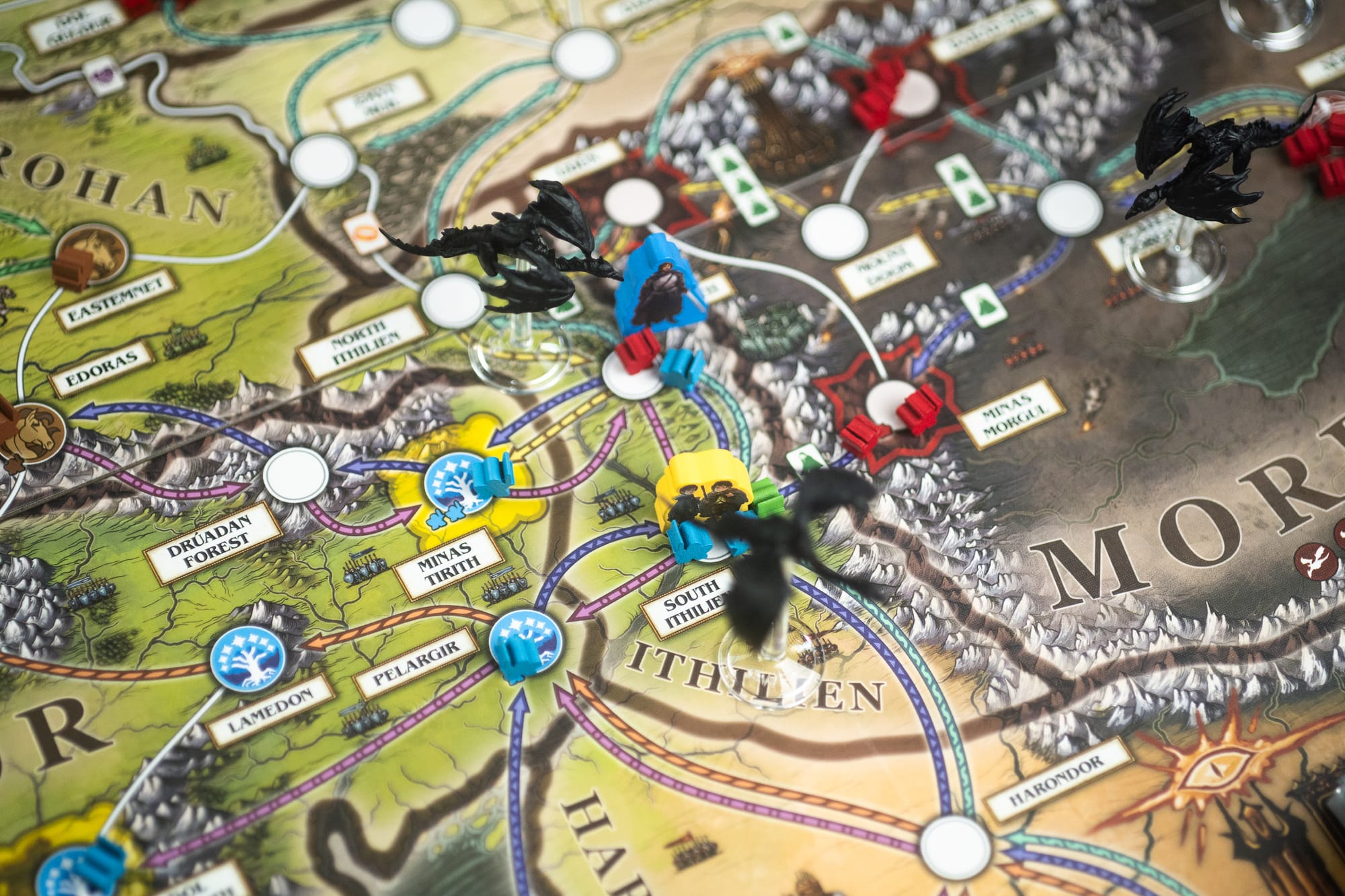
While we’re talking about The Lord of the Rings, we should touch on another cooperative game from 2025: The Lord of the Rings: The Fate of the Fellowship (Leacock, 2025). (I think cooperative games are simply a better vehicle for telling a predefined story than competitive games. I’ll write about that someday.) This is a game from the designer of Pandemic (Leacock, 2008) and plenty of other incredible games, and he’s at his absolute best with this one.
While Fate of the Fellowship is certainly a heavier game than Pandemic, it shares plenty in common — the escalating tension and difficulty, the spread of the enemy, the way things that are bad get worse. All that stuff you’ve come to associate with Pandemic, you’ll see here. There’s more, though. There are characters with multiple special abilities. There are objectives aplenty, and it never feels like each one is just a spin on a generalized type — that would make the story feel a bit like it’s just the same story eat over and over. This is more engaging than that, and while there are certainly commonalities and a system behind the objectives overall, it manages to keep that engaging quality throughout.
Designed by Matt Leacock, illustrated by Jared Blando and Corey Godbey, and published by Z-Man Games.
 Matt Montgomery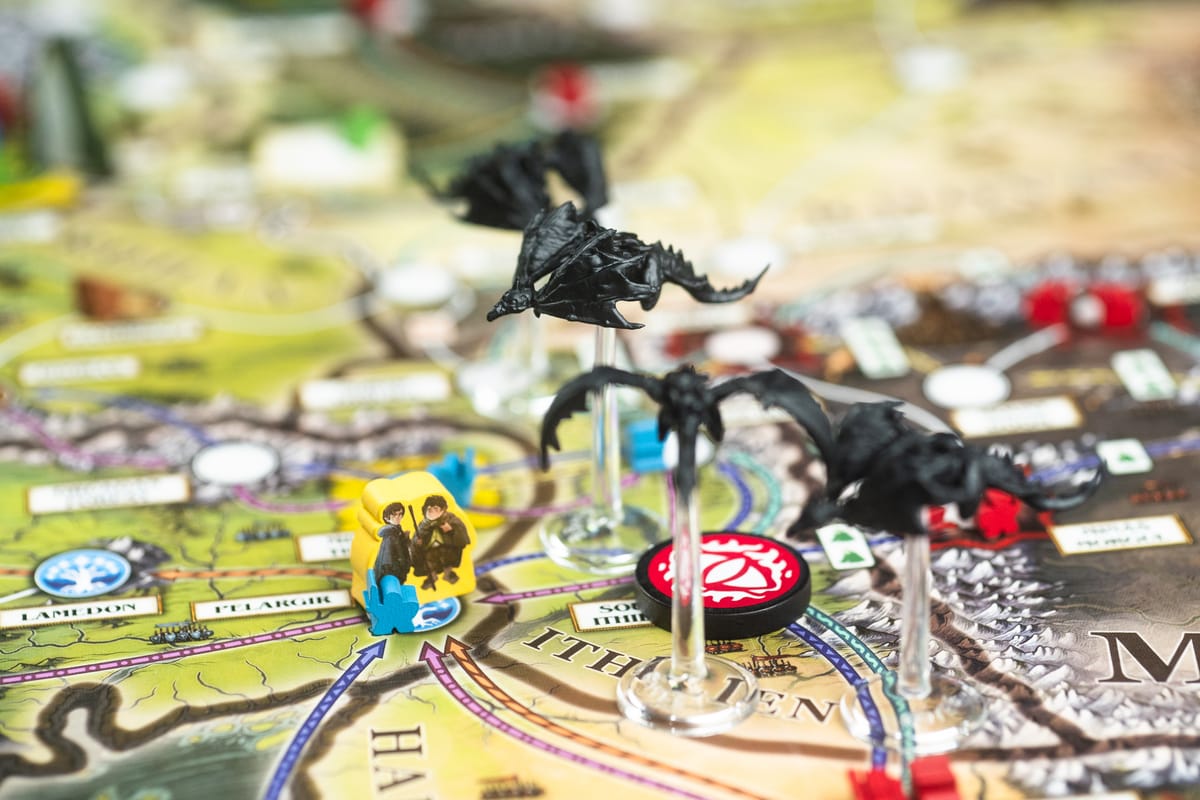
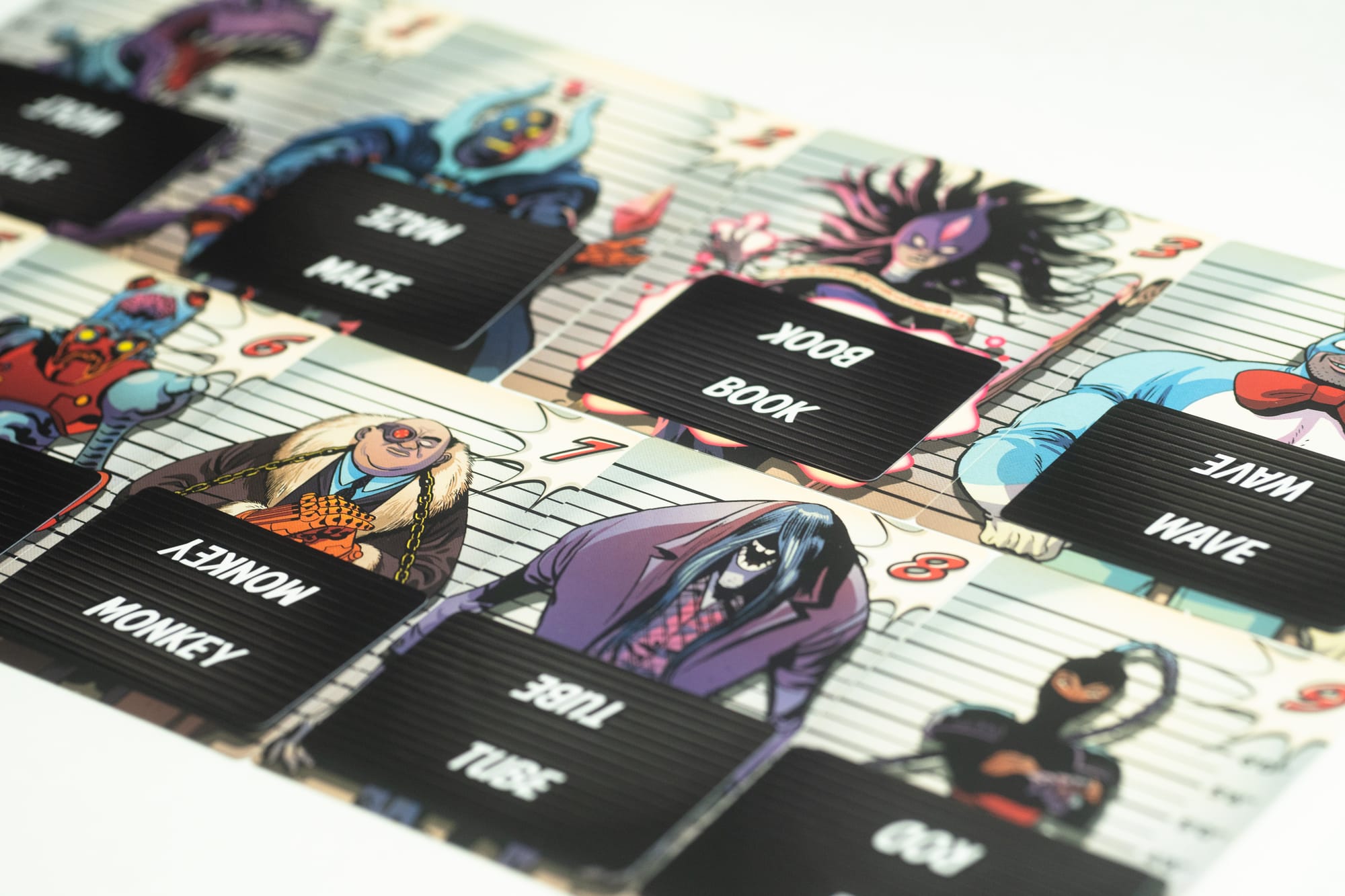
Alibis (Sato, 2025) is a one-word-clue game — you know the type, like Codenames (Chvátil, 2010) — but instead of being a game of two teams facing off, this is instead a cooperative game in which each player is presenting clues so the team can inch toward victory. Each player has two supervillains for whom they know their innocence in some undescribed matter. Something nefarious, no doubt. Each of these supervillains has a word associated with them, so in essence, you’re just finding a meaningful link between the two words.
Alibis is a solid little game, and it’s a great example of what you can do with a simple word game. The supervillain theme is sprinkled on, but that’s just sort of the way with word games. It’s also an interesting spin on the original iteration of the game, Nigoichi (Sato, 2022), which was actually a competitive take on the idea. I haven’t played that one, but cooperative word games are few and far between, and I’m always excited for another one.
Designed by Yusuke Sato, illustrated by Albert Monteys, and published by Allplay.
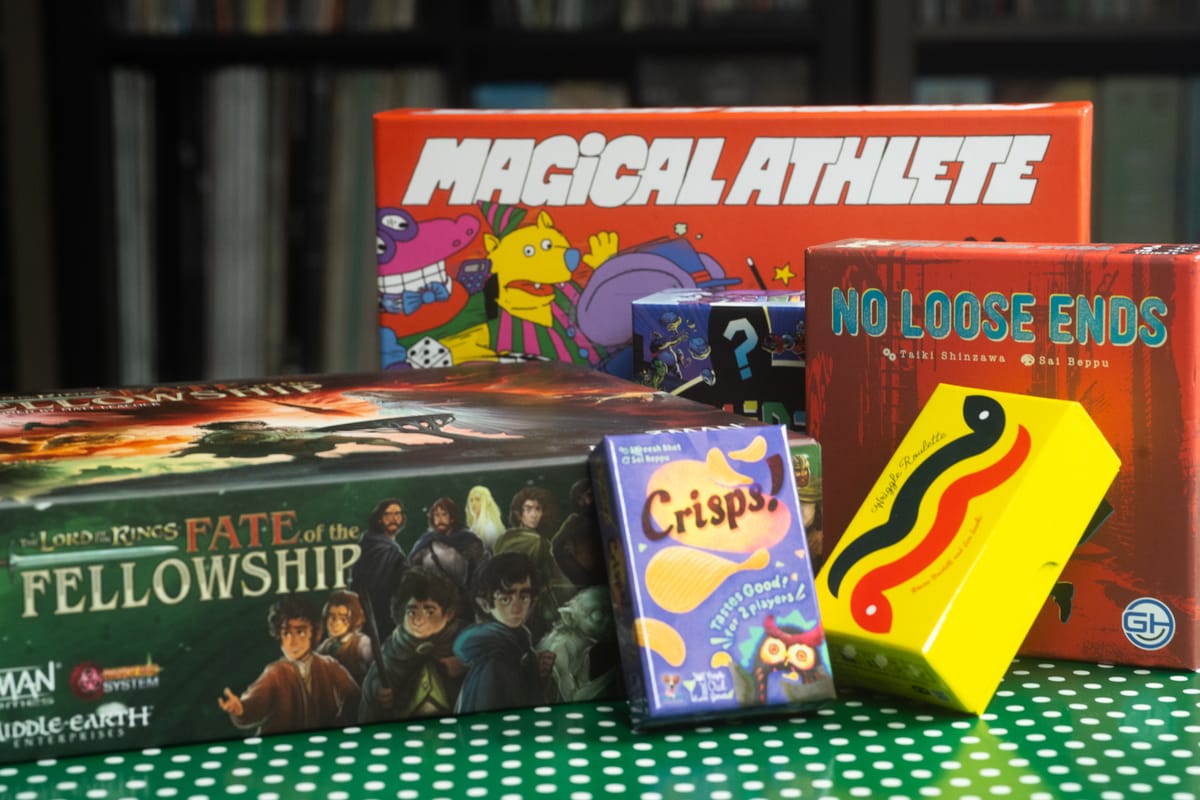
Magical Athlete (Garfield and Ishida, 2025) is a racing game with an absolutely massive cast of characters, each of whom has a unique special ability that pretty substantially changes the way the game works. The flip-side? This is essentially a roll-and-move racing game. That’s not a downside, and it never feels like a ‘classic’ boring kid’s game. The play is dead simple: Roll a die, move your character accordingly. Special abilities are typically automatic, and even though some can be optionally triggered, you’ll typically want to use them, as they’re all great.
Why does Magical Athlete work? I think it’s because it’s playful with every roll of the dice. When something weird happens among the racers — and something will — it’s delightful. Agency might be low during the course of the race, but drafting your racers at the beginning of the game (you’ll be using one each round) imbues some level of investment in race results. I don’t know why exactly this game works so well, but it sure does.
Designed by Richard Garfield and Takashi Ishida, illustrated by Angela Kirkwood, and published by CMYK.
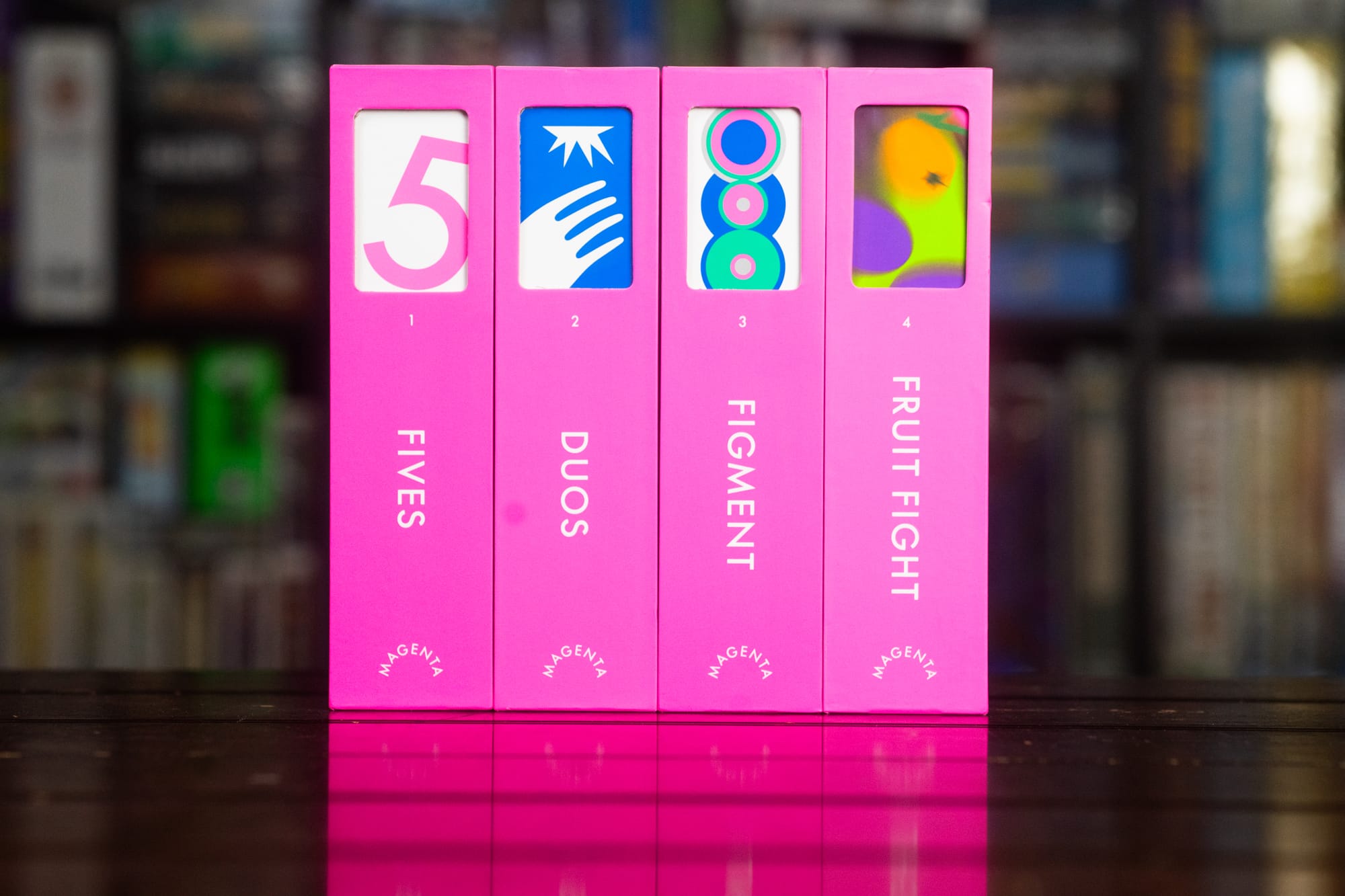
CMYK’s Magenta series is an odd one in this gift guide. It’s not a single game, and it’s not all new. The presentation is new, and some of the games are new treatments of existing games, but really, this is highlighting existing games really nicely. The presentation is beautiful, and the games themselves are nearly all excellent, and the ones that aren’t excellent are at least good. Present here is the cult classic trick-taker Fives (Shinzawa, 2022), a retuned Illusion (Warsch, 2018) as Figment (2025), an out-of-print German card game Duos (Schimdauer-König, 2015), a press-your-luck game that hadn’t made it to the U.S. with Fruit Fight (Knizia, 2021), and now No Thanks! (Gimmler, 2004) and the climbing game I’m Out, originally published as 13 Leaves, (Uesugi, 2025) as the latest two entries in the series.
All of these games had a life before CMYK brought them into their expanding line. All of them fit neatly together, forming a collection of excellent lightweight card games, each of which brings something completely different to the table. These six games showcase a breadth of design thinking. The presentation is exquisite, and with each of the games fitting neatly into this heavy magenta-styled outlay, you’re left with something akin to the old 3M bookshelf games but with significantly more visual appeal. It’s not for everyone, but this is a game series aimed at more than just hobbyist gamers. That’s one of my favorite aspects of the series.
Five classic games
These five games are at least 20 years old, which is, I think, old enough to count as ‘classic’ among modern board games. It would not be old enough (I hope) if we were talking about automobiles (my 2001 Ford Taurus SE Wagon would not count, thankfully) or about rock music (classic rock stations might dispute this fact), but it’s old enough if we’re talking about board games.
Take That / Beat the Heat / 6 Nimmt (Kramer, 1994) is a simple card game with great scaling — up to 10 players, if you can believe it. It’s a game of pushing your luck as you play cards between 1 and 104 to four rows, and there are all sorts of limitations on what you can place in the rows and all that, but you’re not really here for a rules explanation, are you? All you need to know is that it’s a pretty simple card game with numbers, that it’s addictive, and that you’ll spend time hemming and hawing only for your opposition to upend your plans.
This game was, for a long time, remarkably difficult to find in the United States. That’s no longer the case, with this 1994 classic getting a big release by Hasboro in 2025 as Beat the Heat. There’s a story there — Take That was its title when published by AMIGO in the U.S. in 2024, but with the company exiting the U.S. market, several games have found new homes — and, along the way, new names and new illustrations. (We’ll take about another one of these in just a moment.) While Take That was a good name, Beat the Heat is a great one.
This is a great stocking stuffer sort of game in its latest iteration, too. Not the AMIGO one. The box was way too big for that sort of thing. But this version? It’s a little mass market card game sort of thing.
Designed by Wolfgang Kramer and published by AMIGO/Hasboro.
No Thanks! (Gimmler, 2004) is one of my favorite simple card games. The premise is simple: Take a card or place a token on that card. There’s of course more nuance to it, and I’ve written about it before, so I don’t need to go too in-depth about why it’s one of my perennial favorites. Some highlights: It’s the rare sort of game where every group you play with will have a slightly different dynamic, and that’ll impact your play. There are few straightforward decisions you’ll make in the game, but the straightforward decisions you make will probably make other people at the table groan — they’re invested. That’s a good thing. Designed by Thorsten Gimmler and published by AMIGO/CMYK.
 Matt Montgomery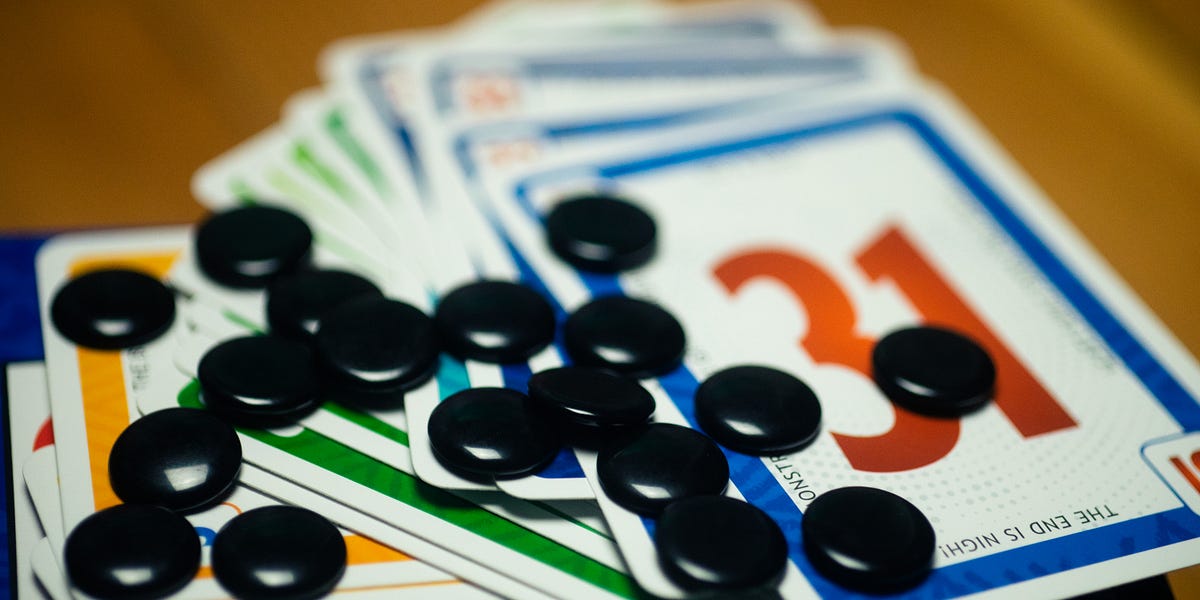
Hive (Yianni, 2001) is a standout in the abstract games sphere, offering a deeply strategic experience in a 15-minute package. It’s all played in a growing hexagonal grid, and each player has a collection of pieces with different abilities. Your goal is to surround the enemy’s queen bee with pieces, which you’ll execute through some classic abstract strategy techniques — pinning especially, that sort of thing. Designed and illustrated by John Yianni; published by Gen42 Games.
Cockroach Poker (Zeimet, 2004) is one of the great bluffing games. You’ll be passing around insect cards, claiming they’re one thing or another (only sometimes telling the truth) while trying to avoid collecting too many of a single insect type. Call somebody on their bluff, and they’ll have to take the insect if you’ve caught them in a lie. If you’ve called their bluff incorrectly, you’ll take the insect card instead. Collect too many of a single insect and you’re toast. Designed by Jacques Zeimet, illustrated by Rolf Vogt, and published most recently in English by Devir.
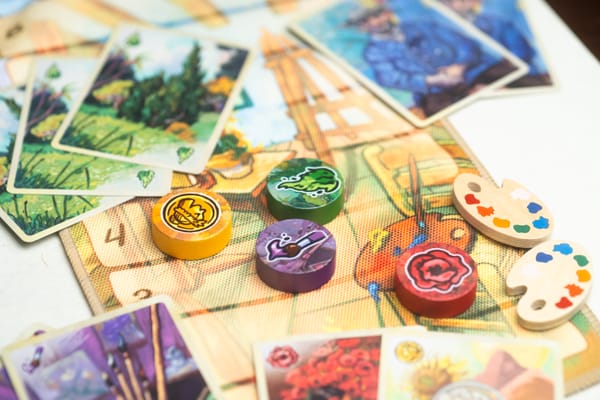
Modern Art (Knizia, 1992) is the ultimate in auction games, in part because there are several different types of auctions that will take place throughout the course of a round. Each painting on offer might be auctioned as a free auction, in which all players can freely bid without a turn order; as a once-around auction; as a blind auction; or as a set-price auction, in which an auctioneer sets the price. Knizia has long been regarded as one of the greatest auction-game designers, and this shows those roots in fine fashion. Designed by Reiner Knizia, published most recently by CMON.
Interested in other great games from the legendary designer Reiner Knizia? Consider …
- Cascadero (2024)
- Lost Cities (1999)
- Ra (1999)
- Through the Desert (1998)
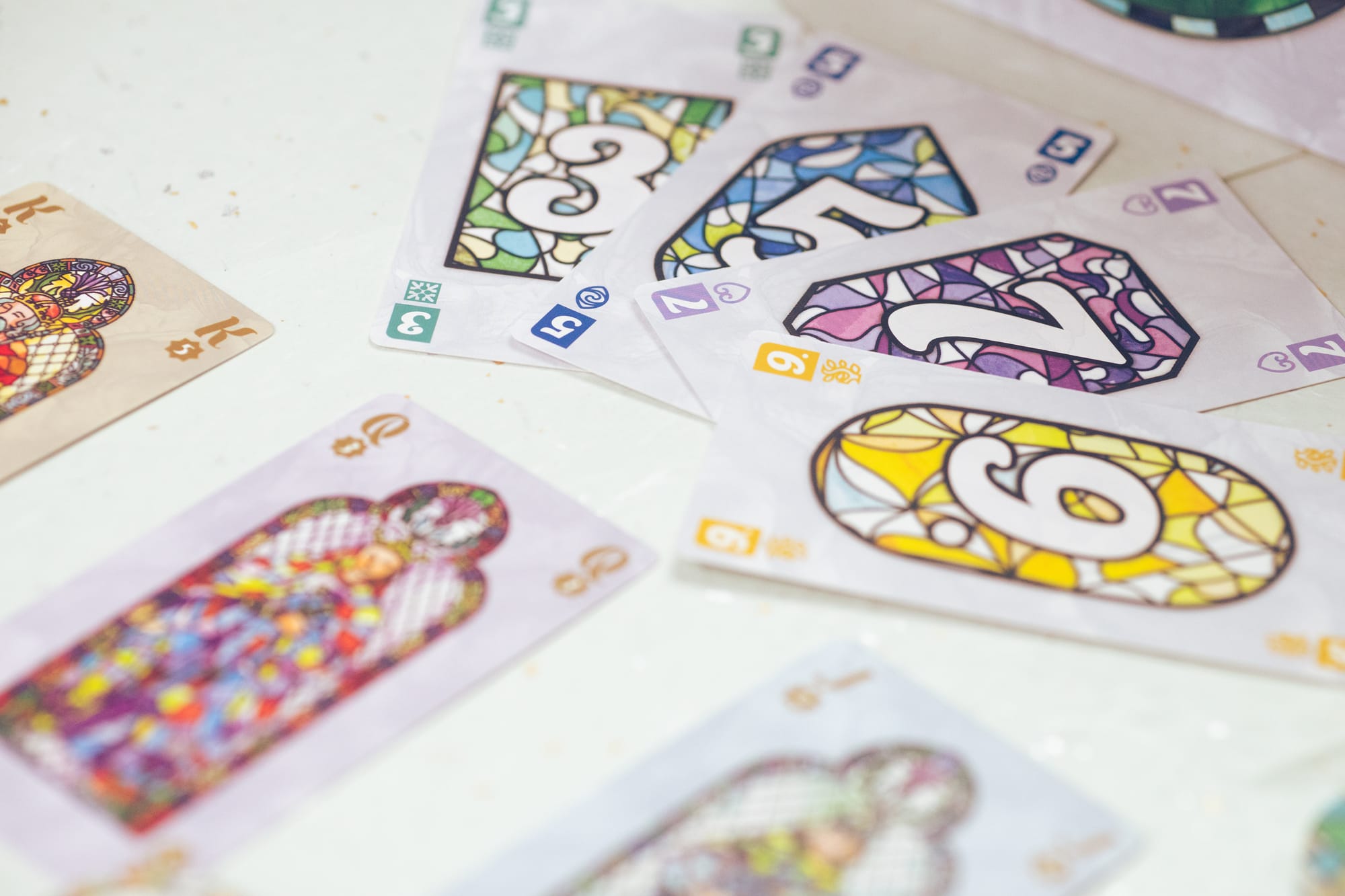
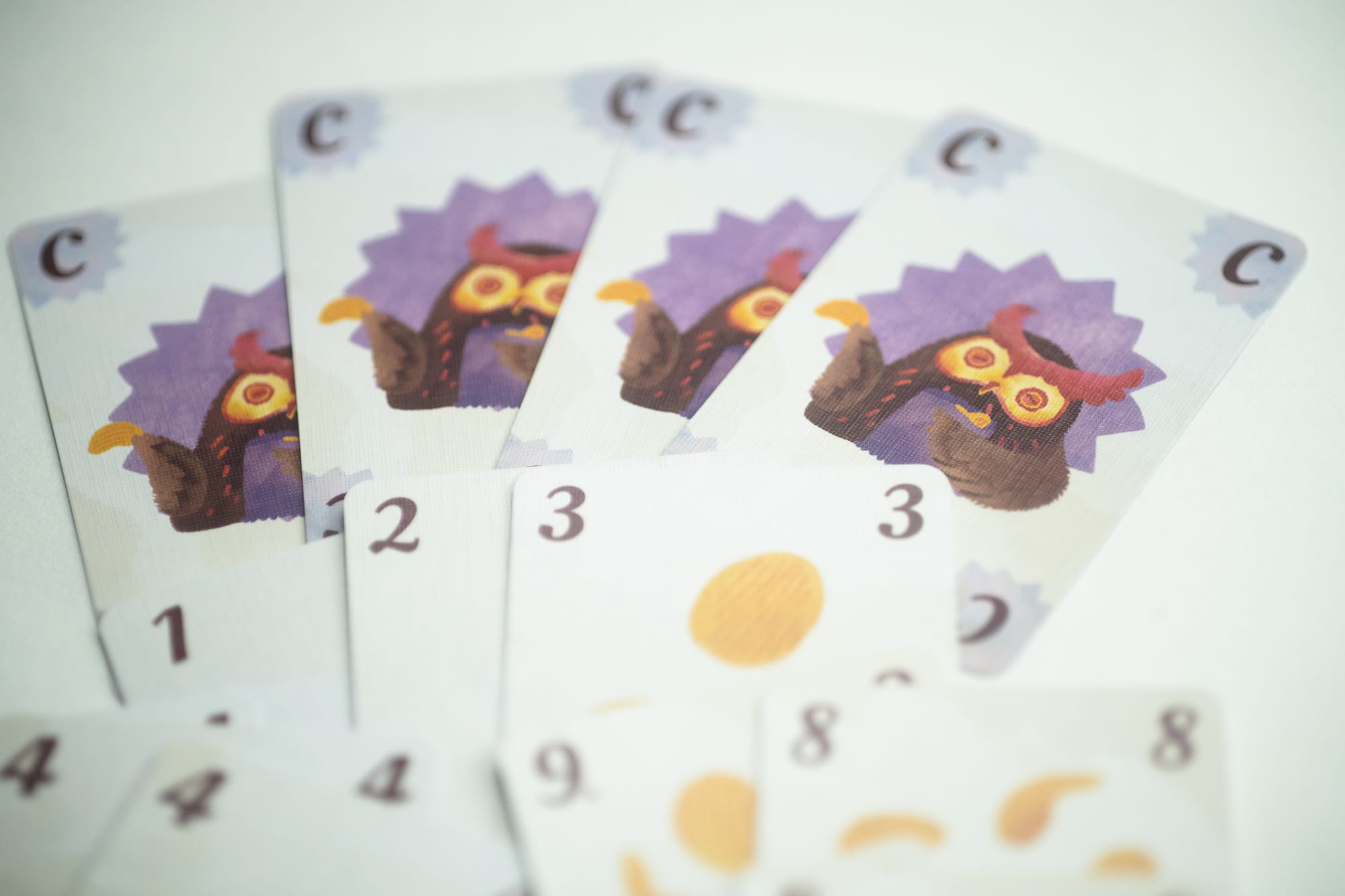
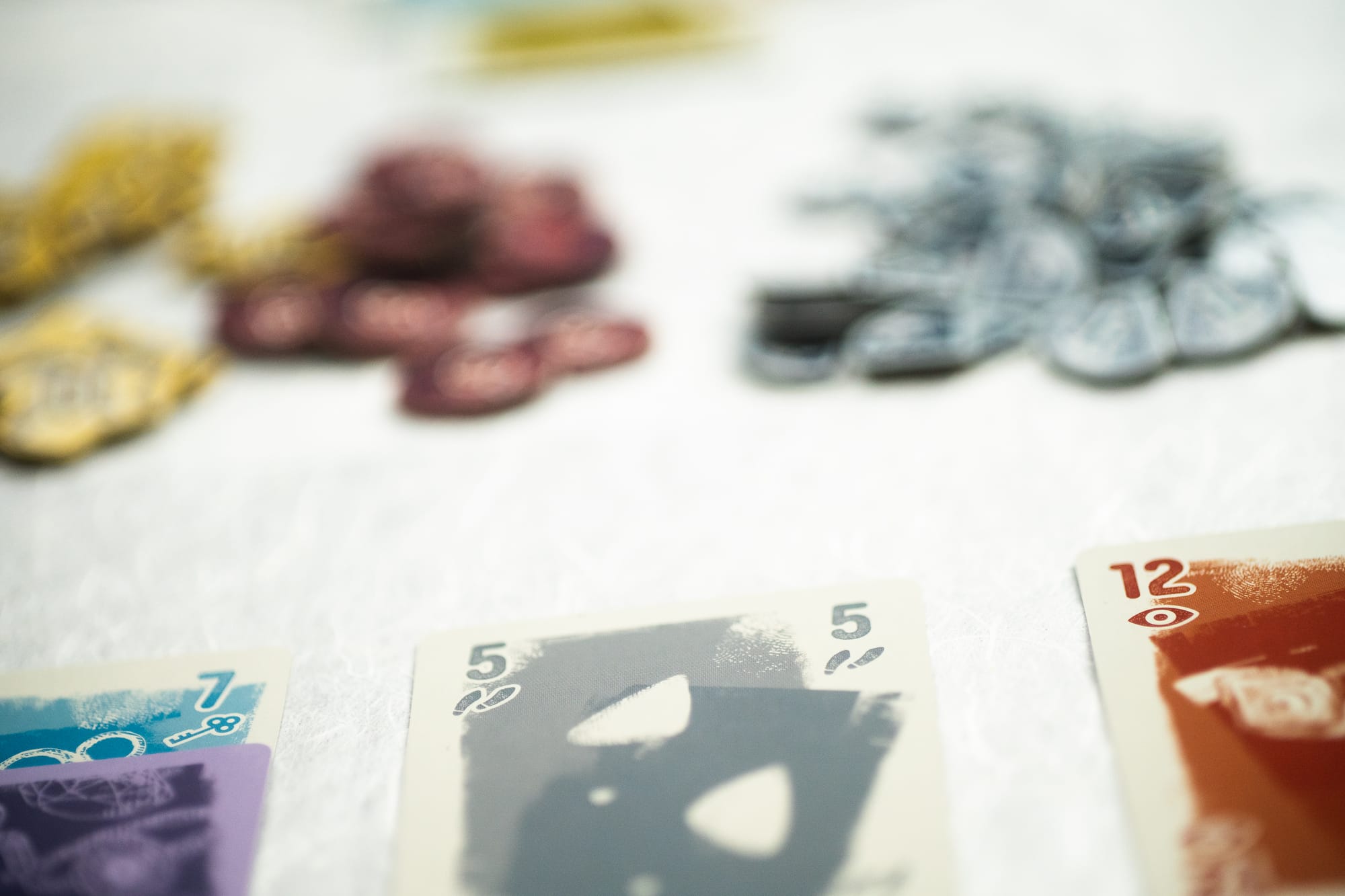
Haggis, Crisps and No Loose Ends | Photos by Matt Montgomery
Five trick-taking (and climbing!) games
These five games — four of which have only been generally available in the U.S. as of this year — are great examples of the breadth of the trick-taking genre.
Several trick-taking and climbing games appeared earlier on the list, including The Lord of the Rings: The Fellowship of the Ring — Trick-Taking Game, Fives and I’m Out. A few more appear later, including Enemy Anemone and Numberwang.
- Haggis (Ross, 2010) is a fantastic climbing-shedding game that really thrives at two players. Purchase from Portland Game Collective.
- VIVO (LEO, 2024) switches trick-taking rules each round between must-follow, may-follow and must-not-follow, and it’s also themed around dogs, which is a nice bonus. Purchase from Allplay.
- Ruins (Clair, 2025) takes that card-crafting idea that started with Mystic Vale (Clair, 2015), iterates on John D. Clair’s previous Custom Heroes (2017). It’s basically a suitless climbing-shedding game where you can improve the cards in your hand, and it gets kind of wild when somebody slaps down seven 9s when there were only four in the deck to begin with. Purchase from Allplay.
- No Loose Ends (Shinzawa, 2025) This is a fascinating little trick-taking game from one of the great innovators of the genre. His games don’t always make their way stateside, so this is a perfect opportunity to see what all the fuss is about. Purchase from GameHead.
- Crisps! (Bhat, 2025) is one of my favorite two-player games, and it’s a fantastic, quick climbing game. After each trick, you’ll be adding a new card to your hand (at least until the stack runs out) — and that means you’re always having to adjust your thinking as you progress. Purchase from New Mill Industries.
Five small-box games
Some other great small-box games appeared on this list earlier, including VIVO, Crisps!, and Beat the Heat.
- Forest Shuffle: Dartmoor (Kosch, 2025) is a sequel to the 2023 hit Forest Shuffle, and while it’s not the smallest box, strictly speaking, I think it counts here, as it’s roughly the size of a stack of A5 paper. You’ll place animals, insects, and plants on trees and moors, and I honestly think it’s just a bit better than its predecessor.
- High Tide (Leiman, 2025) is a delightful little two-player strategy game, in which each player has seven hexagonal tiles that’ll be placed in a grid. Each turn, you’ll move one of your tiles up, and if you can’t, your opponent wins. It comes in a small box from a real up-and-coming designer. Purchase from Under Dog Games.
- Numberwang (Cardner and Babakitis, 2025) is a trick-taking game in which you’re bidding for how many tricks you think each player will take. You’ll also know exactly which cards each player has in their hands, because you get to see each player’s hand before making your bid — but it’s done by passing your hand around the table, and you can never revise a bid based on what you discover other players have. Purchase from Odd Candy.
- Soda Jerk (Yi, 2025) is a quick-playing card game that BoardGameGeek describes as a “commodity speculation” game, which I think is true — but it’s also a game about fixing the prices of soda at a soda shop. So, you know, it’s not exactly heavy. Purchase from Allplay.
- Wriggle Roulette (Faidutti and Sasaki, 2025) is a push-your-luck game in which each player in turn sticks their hand into a bag and pulls out a handful of snakes or eels — or, alternatively, passes their turn, banking points for the eels they have in front of them. If the number of snakes around the table ever exceeds a player-count-specific limit, everyone who hasn’t banked their points loses all of their points for the round. It’s a classic push-your-luck idea executed perfectly. Designed by Bruno Faidutti and Jun Sasaki, illustrated by Jun Sasaki, and published by Oink Games.
Five party games
A few good party games appeared earlier. I’d recommend Beat the Heat (2–10p) and No Thanks! (3-7p) as party games worth exploring, too.
- 3 Second Try (Chihara and Ikegami, 2021) is basically a game where you’re given three seconds to complete a task as many times as you can — wiggle your arm in a specific way, name characters from Star Trek, that sort of thing. You’ll be bidding to be the player to do the most of that action, with the most ambitious player getting a chance to try it first. This game is weird and makes me laugh every time I play. Purchase from Allplay.
- Anomia (Innes, 2010) is a game in which players will be placing a card with a symbol and a category face-up in front of them on their turn. Any time a match appears between two players, the first person to name something that matches their opponent’s category will take their opponent’s card. It’s fast-paced and smart, but it’s also extremely chaotic and has many times resulted in players just shouting the name of the category or shouting something that matches their own category and not their opponents’. It’s great.
- Ito (326, 2019) is a cooperative party game that’s a bit like The Mind (Warsch, 2018) and Wavelength (Hague, Vickers and Warsch, 2019) merged into one odd little game. Each round, a category with two poles (“hot” and “cold” are good examples) will be revealed by some mechanism (I tend to give players a chance to choose between two categories, so each player gets a chance to pick throughout the game), and each player will be given a card with a number between 1 and 100. Players will then go around the table describing where there card sits in the category spectrum by giving a short clue. It really hits that party game feel without relying on tacked-on humor, and that’s so valuable.
- Hot Streak (Perry, 2025) is a game about a mascot race, and you’re betting on that race. Like a horse race. The mascots are the classic American extra-large-costume sorts, and the figures are perfection. (My two-year-old loves the mascots, too. It’s a little bit of a problem how much he does. The game now lives on a higher shelf.) Anyway, this games plays up to 8 players, and each player will be contributing a card to the mix. You can also play with more players, but I’ve never tried that. Maybe I should!
- Monikers (Hague and Vickers, 2015) is a party game based on the public domain game Celebrities, but it has some big advantages over its predecessor. First, it comes in a box, and it’s easy to give as a gift. Second, it helps target your creativity to gameplay and less to figuring out what cards to include. Anyway, it’s a classic sort of party game, and I think it would be a big hit. There’s even a new family edition out that ensures everything you’re doing fits well for that particular audience.
https://www.donteatthemeeples.com/two-great-games-to-play-this-summer/
Purchasing a game? Consider adding these to your order!
I don’t usually include links to purchase games here, but for two reasons, I’ve taken a different approach with this board game guide. First, I’m only linking to publishers I feel comfortable supporting. Their work and stance on AI-created works are important to me, and I feel well-aligned with these publishers. Second, most of these aren’t huge publishers. If I haven’t added a link to a publisher’s website, it’s generally because the game will be available from the usual online retailers.
Ordering from Allplay? (Soda Jerk, Alibis, 3 Second Try, VIVO, Ruins)
- In Front of the Elevators (Saashi, 2019)
- River Valley Glassworks (Hill, Pinchback and Riddle, 2024)
- Sail (Koryo and Yusei, 2023)
- Viking See-Saw (Knizia, 2021)
Ordering from Portland Game Collective? (Haggis)
- Bridge City Poker (Gianou, 2022)
- Five Three Five (Kabuki, 2020)
- Tip of the Diceberg (Barron, 2025)
- Tricky Time Crisis (Barron, 2023)
Ordering from CMYK?
- Daybreak (Leacock and Menapace, 2023)
- Quacks (Warsch, 2018)
- Spots (Hague, Perry and Vickers, 2022)
- That’s Pretty Clever (Warsch, 2018)
Ordering from New Mill?
- Reapers (Newman, 2021)
- Lepidoptery (Karesh and Vasudevan, 2025)
- Quattro Trick-Taking (Shinzawa, 2025)
- Seven Prophecies (Origuchi, 2017)
Thanks for joining me at Don't Eat the Meeples! I hope the season finds you and yours well. We're doing well over here, though our sleep has significantly reduced since introducing the new member of our family.
I'll be taking some time from here forward for a bit of a self-imposed parental leave, but I'll be back before you know it. I think I'll be writing about the best games I've played from 2025, maybe? I'll probably have to break it in parts. These 4,000 word posts don't seem sustainable — at least not on this level of sleep.
Alright! Cheers — I appreciate you all. See you soon.
 Matt Montgomery
 Matt Montgomery
 Matt Montgomery