The 33 trick-taking games I played last weekend
I spent four days in Austin at T3C playing trick-takers.


Over the weekend (including Friday and Monday — a long weekend at its very best), I attended T3C, or the Texas Trick Taking Con. Having the opportunity to focus closely on trick-taking and climbing games with an audience that was well-attuned to learning and teaching new games is an unforgettable experience. It’s an experience I’ve already had twice at the fantastic TTUTCON — the Trick-Takers of Utah Convention — and T3C didn’t disappoint.
While sleep was a little hard to come by, games were plentiful. I played 32 unique trick-taking and climbing days over the course of the four or so days, including plenty in the hotel lobby and even a couple outside a coffee shop at Austin–Bergstrom International Airport.
Trick-Taking
6 Forces (Shinzawa, 2024) is a classic Taiki Shinzawa game in that it’s fairly experimental, but it also trades well in classic trick-taking ideas. In each round of 6 Forces, each player will select one of six potential trump suits or conditions (four suits, plus a highest card and lowest card). They can’t be reused over the course of the game by a single player, and each round will feature at least three unique conditions. But those conditions only apply when the player with that card is leading, and thus you’re always finding yourself slightly regretting what you chose as trump when you lead. At least, that’s what happened with me. A funny thing about this game: I played a three-player game of it one night with Chris Wray, and he remarked on ‘score clumping.’ (I believe this is a Chris Wray original — it’s an intuitive term, though.) It was an astute observation, because the next day I played a four-player game, and we ended in a four-way tie. Anyway, this game also integrates Luz-style bidding, and I thought that was a nice addition.
12 Chip Trick (root, 2022) is only four years old (seriously?) but it feels like a well-established classic among modern trick-takers now. I think there are two things going on there: First, there’s probably a personal bias there, as four years ago was a very different time in my life, pre-kids and all that. There’s a clear dividing line there. The second is that it’s so quick and straightforward, even though you’re playing with clay chips, not cards. I think it works tremendously well, but my brain was a little wiped while I played, so I played quite poorly. Still a great game. It’s better in its physical editions than the digital implementations, because those chips are just so fun to hold.
Catte (LEO, 2025) is another title from the prolific trick-taking designer LEO, who’s likely best known for the Allplay release Vivo (2024). It’s a fascinating little design, as it’s a three-suit trick-taker themed around a cafe. There’s a milk suit, a coffee suit, and a caffe latte suit, and you can follow the caffe latte suit by playing a coffee and milk card together. That little twist is great, but it’s when it combines with the final piece that really makes this game: Every time you win a trick, you’ll be taking a point card. That point card is determined by the lead player for the trick, and taking too many points results in getting zero points for the round.
Coiffeur-Jass is a traditional compendium trick-taking game in the Jass family, and I believe it’s generally played as a partnership game. (I have so much to learn about traditional card games.) That’s how we played it, too, and it was quite an experience. Each team completes one of eight (or sometimes ten) contracts when they win a bid, and those bids each represent a different trump condition for the round. We played 24 hands, and after hearing Ryan of the Trick Talkers podcast talk about compendiums several times, it was a treat to have him teach my first one.
DATTO! (2020) is about rabbits preparing for a race against a tortoise (I mean, it’s about racing rabbits, and it’s also about the tortoise and the hare, so I guess I put two and two together on that one.) There are a plethora of suits (eight!), each of which has ranks 1, 3, 5, 7 and 9. The winner of the trick moves spaces equal to the lowest rank on-suit. There’s some more nuance, but the track loops around, which really adds to the wackiness of this one.
Differenzler Jass is another traditional game in the Jass family, and this one’s much simpler than Coiffeur-Jass. You’re going to be bidding on the number of tricks you think you’ll take, but you score for the difference between your bid and your final trick count. Oh, and points? They’re bad. This was my introduction to Jass games at the con, and it helped to get accustomed to the 36-card deck.
Fearless (Friese, 2025) is one of the recent Friedemann Friese trick-takers. The deck construction is four suits with ranks ranging from -6 to +6, and the winner of each trick will score points for the sum of the ranks in the trick, regardless of whether they’re played on or off suit. You’ll score the absolute value of your distance from the center, with the best score possible being 0. This was intentionally very swingy, and I’m not sure it quite worked for me.
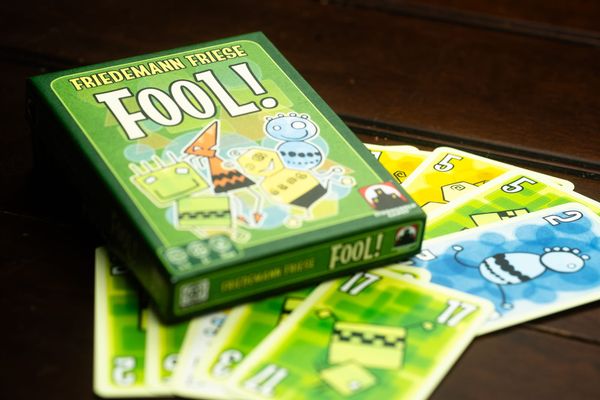
Fool! (Friese, 2018) is another Friese trick-taker, and it’s kind of a mean game in the best of ways. In this one, the player with the worst card in the trick — prioritized as lowest-value off-suit, then lowest-value on-suit — actually sits out a trick. Once a player runs out of cards (which, of course, we’re used to happening all at once), players score negative points for the sums of cards remaining in their hands. Fool! lacks the inherent friendliness of most modern trick-takers (a relative term, to be sure, as trick-taking is not often a friendly mechanic), and for that, it gets full points. Me, on the other hand? I get a bunch of negative points.
Final Binary (Matsumoto, 2025) is the latest trick-taker from the designer of the extremely well-regarded Nokosu Dice (2016). In this one, you’ll have a hand made up of two types of cards. The first is suited and ranked as usual, but the second is just suited. You’ll also have a little three-bit binary number in front of you that becomes your bid as well as a set of binary cards in front of you, and when you play a suited card, you’ll flip the bits on your binary number according to the binary card you’ve selected. (Really, you don’t even need to know binary to play this one.) It’s wonky! I don’t know how to explain it. But honestly, it played pretty smoothly, and it really made a nice difference to play the game while learning it. It probably helps that I’ve loved binary since I was a kid. Anyway! Great game.
Identity (Kasagi, 2025) is a trick-taker with positive and negative ranks, and you’ll use two of the cards in your hand to make your bid at the start of the round — it can even be a negative-value bid. When you take a trick, that’s a positive trick, and when you play a card off-suit, you’ll take it as a negative trick. It’s a cool twist, and it provided some interesting incentives for off-suiting, but it really makes that initial bid incredibly important.
Karaoke Trick (argent, 2025) was one of my highlights of the con, and I know plenty of other folks who have described it similarly. This game has one of the more interesting leading mechanics I’ve seen, which is that you’ll be assigning cards as your lead — they’re your reserved song picks, thematically. When following, you can either play a card to the trick, or you can reserve a card. If you can’t lead because you’re out of reserved songs, lead rotates to the next player, and if nobody has a reserved pick, the round just … ends. That creates such an interesting tension, because you might find yourself reserving a song so that the round doesn’t end prematurely. Scoring points in this game heightens that tension, because the player who wins the most tricks gets a point per trick, but everyone else gets a point per card they win. The ruleset’s pretty simple, but the tension it creates definitely isn’t.
Le Plateau (Gallardo, 2021) remains my favorite trick-taker to play at a convention. We played a really compelling six-player game — my first at that particular player count. It’s an area control trick-taker, sort of, where players will bid for the right to try to connect some number of ends of a hexagonal board, with the points you earn escalating for the number of ends you’ll aim to connect, and for whether you’re attempting it with a partner or not. The board is comprised of tiles for various conditions, like winning specific face cards in each suit, winning specific tricks in the round, and winning with specific trump cards. Every trick is tense until either the bidding party has achieved their goal, or the bidding party can no longer do so. What a game.
The Magic Shop (Kim and Reader on Jupiter, 2025) is another incredible game from the Korean oddball publisher Jupiters Club, and from the very first time you see the game, you’ll understand it intuitively. Like many of their other games, the game comes packaged in a DVD case, and it includes a compact disc with a soundtrack. It’s got some good things going for it, like a fantastic use of public domain art by Karl Friederich Schinkel and a plethora of references to H.G. Wells’ works. When you win a trick, you’ll perform an effect based on the rotation of the CD in the box (it’s functional! But I suppose this also means you can’t really listen to the soundtrack while you play. It’s a good thing there’s a QR code so you can listen to the soundtrack online. Unfortunately, the soundtrack is kind of wacky, and it’s not really something I’d keep on while gaming. It’s got a real ‘90s MIDI feel.) Anyway, this game has a lot going for it, and it’s just the right kind of experiment for me. Will I play it again? Maybe! But probably not for a while.
Ouroboros Trick (Shinohara, 2025) is another highlight of the con for many, and I had a really lovely time playing this unusual single-loser trick-taker. (I love single-loser games. I don’t know why, exactly. I should inspect that feeling. I don’t even mind being the single loser.) Every time you win a trick, you’ll discard cards from your hand equal to the lowest card, and when you run out of cards in your hand, you’re going to take your discard pile and make it your hand. If you ever run out of cards in your hand and in your discard, you’re the game’s loser. That recycling-cards concept just sings.
Potato Man (Burkhardt and Lehmann, 2013) is an old standby in the modern trick-taker scene, and for a long time, it was the must-not-follow game around. While I think I’d probably argue that it’s been supplanted by some other games more recently — I particularly like Enemy Anemone (Newman, 2023) and Aurum (Bhat, 2023) for their respective implementations of the idea — there’s still something nice about Potato Man. Throughout, my friend Dave and I called it “Human Potato” (no ‘the’ — I think it’s funnier without it), largely because we played a Portuguese copy, which calls it Homem Potato. Anyway, it’s a classic, but maybe I’m OK leaving it behind.
Seas of Strife (Major, 2015) is a veritable classic in trick-taking, and I think we can say that because it’s officially over a decade old. Of course, Seas of Strife isn’t actually over a decade old itself, having just been released in 2023, but Texas Showdown was released in 2018, and the earliest of predecessors, Strife came in 2015. Anyway, this is one of the old standbys, with a very cool following mechanic where cards played off-suit become eligible to follow, and the suit with the most cards played becomes the winning suit. But if somebody plays the top-ranked card of the suit, it cancels it out from being considered a potential winner — unless each suit has the top-ranked card played, in which case, it goes back to the plurality rule. As a major added bonus, this one thrives with more players, and where so many trick-takers cap out at 4, this becomes a really valuable game to have in your back pocket. (Depending on the size of your back pocket, I guess. The box isn’t huge, but pockets are highly variable. Anyway…)
Stick 'Em (Palesch, 1993) is a mean game. It’s a may-follow game, which is exceedingly rare among trick-takers and has long been debated: Can you have a ‘may-follow’ trick-taker at all? I tend to think so, and this game really showed me why. It’s essentially that off-suiting requirements are lifted here. OK, the basics of the game are this: Each round, you’ll declare a ‘pain suit’ for which you’ll score negative points. When following, you can choose to play a card off-suit instead of on-suit, and should you do so, any card off-suit is essentially a trump card, and the highest off-suit card played to a trick wins. This can lead to you playing cards in somebody’s pain suit, hoping that they’ll have to take it. Someone might swoop in and take the trick, but equally, the pained player might just have to off-suit because they don’t have any cards to follow with. Points are where this game gets mean: You get a positive point per card you take in everything but your pain suit, and you’ll get negative points equal to cards’ face values in your pain suit. What a game. I want to play it right now.
Take Over That Job / Kaware Sono Job (Mashikamaru, 2025) is a cooperative trick-taking game where you’re trying to coordinate how many tricks each player takes in a round. Every player has 2, 3, 4 and 5-bid cards in front of them, and at the end of the round, any player that hits one of those bid cards will remove that card. That’s simple enough to grasp when playing, but coordinating how many tricks each player wins to remove a card in the first round will prove exceedingly difficult, and the game doesn’t give you a ton of mechanisms to make it easier. (There are plenty of great cooperative games that do that — this is one that doesn’t. Both ideas are great!) And all of that becomes much more complicated when you take the hand and your bid cards and pass them around the table each round. After the first round, you’ll also have an opportunity to name a trump suit, a weak suit or pass a single card, and those mechanisms serve to make the game at least a little more possible. You score points based on your performance. This has been honestly a fairly long and insufficient explanation, but it’s a tricky cooperative game that really pushes groups. I love it.
Torchlit (Spalinski, 2024), which just received a wide release from Allplay, has players placing a bid from their hand, and then it sends them through a dungeon to determine how many points that bid will be worth. After each trick, any player who played the winning number, whether on-suit or off, will move their pawn forward along the dungeon track. The player who played the lowest-ranked card will then place card from each played suit to the dungeon track. If you hit your bid, which means your character is on the same dungeon track space as the card you selected, then you’ll earn points for the monster cards there. It’s a really cool premise, and I’m glad it’ll be more widely available.
Touchdown Heroes (Kuro, 2021) is a trick-taking game in which you’re playing a game of football. (Not football football, mind you. This is the one commonly played in the United States.) There are first, second and third downs (I suppose four downs broke the game?), ability to execute passing and running plays, and attempts to intercept and block. I had a fun time playing this, but it was sure a little weird, and in a strange way, it shows its age, which is weird to say — it’s only five years old. But the genre has been zooming along, and some of these more unusual games have become more streamlined as of late. A good example follows this game.
The Tricktaker's Guide to the Galaxy (mor!, 2025) is, um, basically No Thanks! (Gimmler, 2004) and trick-taking with contracts. Together. Let me explain: To start, you’re literally going to play the classic game No Thanks!, but instead of taking number cards, you’re going to be taking contracts to complete through trick-taking. They’ll set out conditions you’ll need to follow, lest you incur a pretty significant penalty. Those contracts come in some number of categories, and if you take more than one of a category, you could lose a ton of points and gain few, too. This game really wants to you to be good at No Thanks!. This is a truly bizarre combination of ideas, but it works so well that you can’t help but admire it. I’d love to play this game more.
Trick-Taking in Black and White: Serif & Sans-Serif (Dejima, 2025) is basically the earlier game Trick-Taking in Black and White (2021) by the same designer, but it’s got a bidding system. And a really wacky suit system, where the suit you play on a card (each of which has a black rank and a white rank), is the combination of the color and rank. So when you play, for example, a white four with a black three on the side closer to you, other players must follow with another card with a black three closest to them. I dunno, I thought this game was cool, but I’m not sure the complexities it adds made it a better game than its original. Having to really scan my hand every time I played to a trick just got a bit exhausting. Maybe I need more experience with these dominoes-like games?
Tricky Landing (Petchey, 2025) is a trick-taker where you get to throw a card on to the table during each trick. It’s a must-follow game, but you have to physically toss the card on to the table at a target, and if you’re following and you miss, then you won’t win the trick — instead, if you’re the only one to miss, you’ll set the trump suit for the following round. If more than one player misses, all players who miss lose a point. You can also try to hit the target without your card landing on any other cards, in which case you’ll actually create a bit of a sub-trick situation, where each separate set of cards connected to the target is evaluated separately. I’ll honest, I had no idea this would work, but I had a blast. Yeah, it’s more dexterity with trick-taking as the accompaniment, but there’s also a surprising amount of real-life trick-taking happening, too. What a weird game. I was given a review copy by the publisher, Huff No More.
Tricky Time Crisis: the Spawn of Time (Barron, 2025) is a sequel to the excellent Tricky Time Crisis (2023), which was a novel take on the must-not-follow trick-taking idea we discussed during the section on Human Potato Man. In each trick, you’ll be playing a little many-versus-one game, with one player leading a villain card and the others playing a hero card. The original just demanded that the sum of the hero cards exceeded that of the villain card, but in The Spawn of Time, you’re trying to meet a mathematical condition about the sum — the sum must be even, or it must be odd, or it must be a prime number, for example. I was lucky enough to be taught the game by the designer, Jon Barron (of Baron Jon games), which was a nice treat.
Verhext / Pups (Bink, 2016) is a trick-taker with a bid system that gets a bit wild. The higher you bid, the more points you could make, but you could also lose a slew of points, too. Those bids come as cards with 0, 1, 2 or 3 tricks won, and let me tell you, taking the 3-bid is sure tempting every time. There’s a bit of a twist in that there are also cards that you can use to increase the ranks of the cards you play, but those cards can also be played on their own as a suit, and I think they can also be the trump suit. None of the individual qualities of the game are brilliant alone, but together they make a nicely compelling game. I had a fantastic time playing this at the airport before heading home, and it was certainly more enjoyable than watching people stand in line unnecessarily.
Hack the Stack (Jones) was an unpublished prototype partnership game, and given it’s unpublished, I’m not going to talk much about it — but I had a nice time playing with the designer, and I hope he finds success getting it published. This one’s on BGG already if you’re looking to learn more.
Climbing and Shedding
Frank's Zoo (Matthäus and Nestel, 1999) is a climbing game that features cards with no ranks or suits, just an animal, as well as the animals by which it can be scared away. The first round fairly mundane, if a bit weird because of the animal cards — it’s once the second round starts that things get interesting. Partnerships are formed according to player order, and the junior partner (or, as I liked calling myself, the ‘lesser partner’) gets to request help from their partner. This game honestly feels pretty dated, but I’m glad I played it.
Ghost Lift (Onegear, 2025) was one of the more controversial games of the convention. It’s a climbing game in which the order of the cards you can play changes from ascending to descending throughout the trick, and if you pass, you can claim one of three stack of cards to add to your hand. You’re only playing sets in this one, so you’ll sometimes want to add cards so you can beat other players’ melds. I do think this plays significantly better when you’re playing with players who are taking lots of cards, because otherwise, it can be a bit too easy to get locked up. I had a great time, as we all took a ton of cards.
Match Fixer’s High (Kim and Reader on Jupiter, 2025) is a game I can’t want to get to the table again. Recently republished by Korean publisher Playte as Too Sloth to Win!, Match Fixer’s High is a climbing game in which you’re racing to be the second sloth to reach the finish line of a race, but only if you’ve used a ‘suspicious’ drink card, which is a wild that can be used to replace a card in your melds. It’s another oddball game, but those conditions work so well that the game’s oddities aren’t really hindering anything — they’re largely just artifacts of the unusual theme and the fact that the game is packaged in a small, clear soda can-shaped thing. I love it for that, but I also love that the game has been given more prominent availability and a normal box, because it’s much easier to explain why a game comes in a box than it is to explain why a game comes in a soda can.
Mirianth Pets (Shinzawa, 2025) is a slight reimplementation of Taiki Shinzawa’s earlier Ambiente Abissal / Planet etuC (2020) — it’s just as wonky, and really, there wasn’t much different about the whole thing. I think. Anyway, it’s a climbing game where you’re playing pairs of ranks or suits, and you often won’t really know which you’re playing at first. I can’t explain this game in short order, so, uh, you might be best served just playing it. Or watching a video about it, I suppose.
Piplus (Kuji, 2025) is another game that rapidly made its way on to people’s best-of-con lists, and with good reason. It’s a climbing game where you’re playing singles and sets, but you can augment those singles and sets with the three dice you start the game with. You can add a die to a card to increase its rank — taking a 6 to a 9, for example, in order to play, say, four 9s when you only have three of them naturally — or you can play dice on their own, or alongside cards. But after you play a meld, your dice are removed, and suddenly that 9/9/9/9 becomes a 6/9/9/9, and the next player only has to beat the equivalent of a 6/6/6/6. It’s weird, it’s wonky, and honestly, it works so incredibly well.
Sumida River (Mashikamaru, 2023) has a cult reputation — and I think I finally understand why. It’s a climbing game that will frustrate and delight in equal measure, and that’s really all we can ask for from a game, isn’t it? You’re basically playing a must-not-follow climbing game, where each meld played must be both higher and of a different type than the melds played previously in the trick. You can also trade your hand at the beginning of each round, earning a high-value wild card for your trouble. I’m still reeling from playing it several days later.
Tip of the Diceberg (Barron, 2025) is another climbing game where you’re playing a bit of must-not-follow, but it also has a bunch of dice you’ll be using, and the makeup of the deck is that of a six-die polyhedral dice set, but in card form. You can combine those dice and your hand when making melds. It’s a bit breezier, and the melds you’ll be making are randomized each time you play, so it just feels a bit lighter-weight and more casual. I really enjoyed playing this one.